Keras
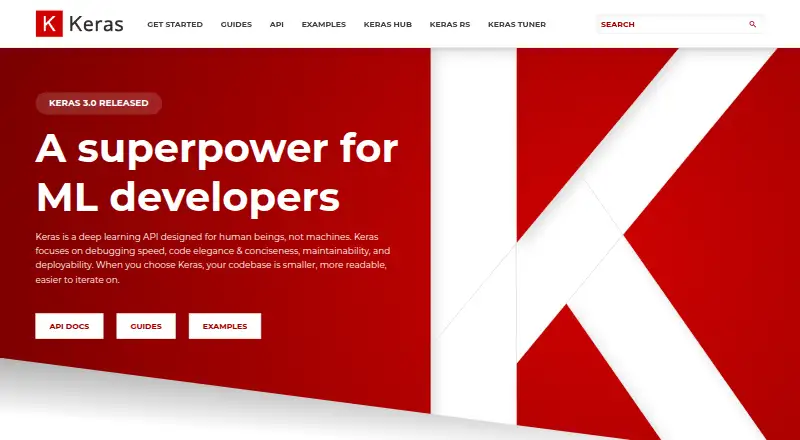
Keras is a free Python deep learning API for developing models with concise, readable code.
What Keras is
Keras is a free Python deep learning API for developing models with concise, readable code. Keras 3 runs on JAX, TensorFlow, or PyTorch; OpenVINO is available for inference only. Building blocks include layers, metrics, loss functions, optimizers, callbacks, training and evaluation workflows, and tools to save and serialize models. The built-in fit, evaluate, and predict routines work with inputs such as NumPy arrays, Pandas dataframes, TensorFlow datasets, and PyTorch DataLoaders. Models can be used as PyTorch modules, exported as TensorFlow SavedModels, or instantiated as stateless JAX functions. Keras also includes a distribution API for data and model parallelism, currently implemented for JAX. KerasHub offers architecture implementations and pretrained checkpoints, while KerasTuner includes Bayesian Optimization, Hyperband, and Random Search. The getting-started materials include more than 150 example notebooks across computer vision, natural language processing, and generative AI. Installation is through PyPI, and Keras 3 requires a separately installed, configured backend.
Good
- Runs on JAX, TensorFlow, or PyTorch.
- Built-in training, evaluation, and prediction workflows.
- Accepts several common data formats.
- More than 150 example notebooks.
- Free plan; supports Linux, macOS, and Windows.
Watch out
- Keras 3 requires a separately installed backend.
- Backend must be configured before importing Keras.
- Distribution API is currently implemented for JAX.
Who it suits
Keras suits machine learning engineers building and iterating on models in Python. Its guides and examples cover common machine learning use cases.
Verdict
Keras brings model-building components, training workflows, and multiple backend choices into one Python API. Account for the separate backend requirement and JAX-only distribution implementation when planning a setup.
The facts
Each one read from Keras's own pages, with the date it was checked.
What it does
- Backends
- Keras 3 runs on JAX, TensorFlow, and PyTorch, and offers an OpenVINO backend for inference.checked 30 Sep 2026
- Community support
- Keras provides a Google Group, community meetings, Discord, and a Google AI Forum for discussion and updates.checked 30 Sep 2026
- Compatibility limit
- The Keras distribution API supports model parallelism through JAX; TensorFlow and PyTorch support is described as coming soon on the Keras 3 launch page.checked 30 Sep 2026
- Contributions
- The Keras site invites code, ideas, and feedback and links to its roadmap, contribution guide, and GitHub repository.checked 30 Sep 2026
- Data inputs
- Keras 3 training, evaluation, and prediction routines support tf.data.Dataset, PyTorch DataLoader, NumPy arrays, and Pandas dataframes.checked 30 Sep 2026
- Data integrations
- Keras models can use NumPy arrays, Pandas dataframes, TensorFlow tf.data datasets, PyTorch DataLoaders, and Keras PyDataset objects.checked 30 Sep 2026
- Distribution
- The distribution API supports data and model parallelism and is currently implemented for the JAX backend.checked 30 Sep 2026
- Examples
- The getting-started page offers over 150 example notebooks covering computer vision, natural language processing, and generative AI.checked 30 Sep 2026
- Frameworks
- Keras 3 runs on JAX, TensorFlow, or PyTorch, and supports OpenVINO for inference only.checked 30 Sep 2026
- Hyperparameter tuning
- KerasTuner includes Bayesian Optimization, Hyperband, and Random Search algorithms and can be extended with new search algorithms.checked 30 Sep 2026
- Installation
- Keras installs from PyPI with pip install --upgrade keras; using Keras 3 also requires installing a backend framework.checked 30 Sep 2026
- Intended users
- Keras describes its audience as machine learning engineers and presents guides and examples for model development across common ML use cases.checked 30 Sep 2026
- Model building
- Developers can build models with the Sequential API, the Functional API, or model subclassing.checked 30 Sep 2026
- Model interoperability
- Keras 3 models can be used as PyTorch modules, exported as TensorFlow SavedModels, or instantiated as stateless JAX functions.checked 30 Sep 2026
- Model portability
- Keras 3 models can be used as PyTorch modules, exported as TensorFlow SavedModels, or instantiated as stateless JAX functions.checked 30 Sep 2026
- Pretrained models
- KerasHub provides Keras 3 implementations of popular architectures and pretrained checkpoints on Kaggle Models for training and inference.checked 30 Sep 2026
- Product
- Keras is a Python deep learning API focused on readable, maintainable code and fast model iteration.checked 30 Sep 2026
- Purpose
- Keras is a Python deep learning API designed to make model development concise, readable, and easier to debug.checked 30 Sep 2026
- Requirement
- Keras 3 requires a separately installed backend framework, and the backend must be configured before importing Keras.checked 30 Sep 2026
- Security and compliance
- The Keras pages reviewed do not state security certifications or compliance claims.checked 30 Sep 2026
- Support
- The Keras site directs users to its Google Group for questions and development discussion, and GitHub issues for bug reports and feature requests.checked 30 Sep 2026
- Training
- Keras provides built-in fit, evaluate, and predict workflows for training, evaluation, and inference.checked 30 Sep 2026
The company
- Founded
- 2015checked 28 Sep 2026
Alternatives to Keras
- 1
Paperspace Gradient
Free planOpen sourceWebAPIExtensionLinux8.3From $8 a month - 2
Apache TVM
Free planOpen sourceAndroidiOSWebAPI7.8Free plan - 3
Lightning AI Studios
Free planWebAPILinuxmacOS7.8From $20 a month - 4
ONNX Runtime
Free planAndroidiOSWebLinux7.2Free plan - 5
Ludwig
Free planAPILinuxmacOSSelf-hosted6.7Free plan - 6
MegEngine
Free planAndroidiOSLinuxmacOS6.7Free plan