
Keel
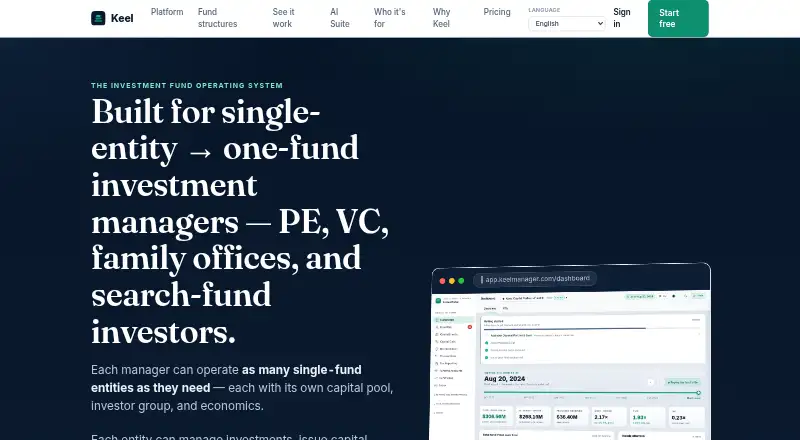
Keel is fund administration software for private equity, venture capital, family offices, search funds, and independent sponsors.
What Keel is
Keel is fund administration software for private equity, venture capital, family offices, search funds, and independent sponsors. It supports investor onboarding, commitments, capital calls, bank reconciliation, distributions, performance reporting, and tax workflows. Fund economics include European and American distribution waterfalls, GP catch-up, carried interest, preferred returns, hurdles, and recallable capital. Investors can access a branded portal with capital-call notices, real-time capital-account balances, statements, tax documents, and fund analytics. The AI Suite processes emailed capital-call notices, deal materials, and portfolio updates for review, but a manager must confirm before it creates or issues actions. Keel supports USD, EUR, GBP, and JPY fund currencies and describes support for K-1 and foreign-investor tax forms including W-8, 1042-S, and K-3. The Free tier is free for one entity and up to 10 active investors. Single-entity funds are administered today; multi-entity structures, including master-feeder funds, are described as coming soon. Keel says it is not yet SOC 2 or ISO 27001 certified.
Good
- Covers onboarding, capital calls, distributions, and reporting
- Supports European and American distribution waterfalls
- Investor portal includes balances, statements, and tax documents
- AI Suite requires manager confirmation before issuing actions
- Free tier includes one entity and up to 10 active investors
Watch out
- Multi-entity structures are coming soon
- Free tier is limited to one entity and 10 active investors
- Keel is not yet SOC 2 or ISO 27001 certified
- Plaid live bank sync is unavailable in some countries
Who it suits
Keel is intended for private equity, venture capital, family office, search fund, and independent sponsor operations. Its investor portal and fund workflows may suit managers administering single-entity funds today.
Verdict
Keel brings fund administration workflows and investor access together, with its AI Suite requiring manager confirmation before actions. Note the current single-entity scope, free-tier limits, and stated certification status when assessing fit.
Plans and prices
From Keel's own pricing page, checked 14 Oct 2026.
| Plan | Price | What it gives you |
|---|---|---|
| Free | Free | 1 entity · 10 active investors · no Plaid live bank sync · no fundraising portal · $0/mo; free forever |
| Starter | £350 a month | 1 entity · unlimited active investors · Plaid bank sync · no fundraising portal · $350/fund/mo Early Adopter; standard $500/fund/mo |
| Single Fund | £799 a month | 1 entity · unlimited active investors · 30-day trial · fundraising portal included · subscription documents add-on · $799/fund/mo Early Adopter; standard $1,250/fund/mo |
| Multi-Fund | £1,999 a month | 3 entities included · +$500/entity after · 30-day trial · multiple funds · AI Suite and accounting integration · $1,999/mo Early Adopter; standard $3,500/mo |
| Enterprise | $6,000 a month | Unlimited entities · dedicated database/data residency · SAML/enterprise SSO · API and webhooks · white-label · CPA and legal portals · from $6,000/mo + per fund |
The facts
Each one read from Keel's own pages, with the date it was checked.
What it does
- AI automation
- AI reads emailed capital-call notices, deal materials and portfolio updates, drafts actions and summaries, and requires manager confirmation before execution.checked 14 Oct 2026
- AI features
- The AI Suite processes emailed capital-call notices, deal materials, and portfolio updates for review, while requiring manager confirmation before creating or issuing actions.checked 29 Sep 2026
- API and extensibility
- API, webhooks and white-label capabilities are listed only for Enterprise.checked 14 Oct 2026
- Audit and compliance
- Keel says it keeps a seven-year audit trail and is not yet SOC 2 or ISO 27001 certified.checked 29 Sep 2026
- Audit retention
- Administrator and operator actions are retained in a seven-year audit trail, and financial records are not hard-deleted.checked 14 Oct 2026
- Bank reconciliation
- Keel supports CSV ledger uploads and Plaid-connected bank feeds to match wires and reconcile capital-call and month-end activity.checked 14 Oct 2026
- Capital calls
- Managers can allocate calls per investor or household and send branded notices with delivery tracking.checked 14 Oct 2026
- Commitments
- The system tracks called, uncalled and paid-in-capital commitments, including upsizes, amendments and transfers.checked 14 Oct 2026
- Compliance status
- Keel explicitly says it is not yet SOC 2 or ISO 27001 certified.checked 14 Oct 2026
- Currencies and tax
- Keel supports USD, EUR, GBP, and JPY fund currencies and describes K-1 and foreign-investor tax form support including W-8, 1042-S, and K-3.checked 29 Sep 2026
- Data residency
- A dedicated database and data-residency option is listed for Multi-Fund and Enterprise plans.checked 29 Sep 2026
- Distributions
- Realizations support distributed, retained or reinvested proceeds and carried-interest calculations.checked 14 Oct 2026
- Documentation
- The public site exposes product, pricing, security, privacy, terms, Plaid disclosure and policy pages but no public API reference or SDK documentation.checked 14 Oct 2026
- Fund economics
- It supports European and American distribution waterfalls, GP catch-up, carried interest, preferred returns, hurdles, and recallable capital.checked 29 Sep 2026
- Fund scope
- The site says single-entity funds are administered today and multi-entity structures, including master-feeder structures, are coming soon.checked 29 Sep 2026
- Fund workflows
- The platform supports investor onboarding, commitments, capital calls, bank reconciliation, distributions, performance reporting, and tax workflows.checked 29 Sep 2026
- Independent announcement
- A LinkedIn post dated two months before the crawl said Keel's beta would open soon for private-equity, venture-capital and family-office managers.checked 14 Oct 2026
- Independent-directory identity issue
- The available G2, Capterra, GetApp and Software Advice pages use the name Keel for products unrelated to the keelmanager.com fund platform, so they provide no validated user sentiment for KeelManager.checked 14 Oct 2026
- Integrations
- Plaid is used as the optional bank-data aggregation provider for connected-account reconciliation.checked 14 Oct 2026
- Investor access
- Investors have a branded portal with capital-call notices, real-time capital-account balances, statements, tax documents, and fund analytics.checked 29 Sep 2026
- Investor onboarding
- Prospects can use branded data rooms, accreditation workflows and web subscription documents with electronic signatures.checked 14 Oct 2026
- Investor portal
- Investors receive branded access to capital calls, balances, statements, tax documents and TVPI, DPI, MOIC and IRR analytics.checked 14 Oct 2026
- Limit: enterprise gating
- Dedicated data residency, SAML, API/webhooks, white-labeling and external accountant or legal portals require Enterprise.checked 14 Oct 2026
- Limit: roadmap features
- GP clawback and equalization-interest calculations are marked “Soon” across all plans.checked 14 Oct 2026
The full review of Keel
Overview
Keel is fund administration software for private equity, venture capital, family offices, search funds, and independent sponsors. It suits managers who want investor operations and fund administration in one system, but its current single-entity scope rules out firms that need multi-entity structures today.
Its breadth is a draw for single-entity funds: workflows run from onboarding and capital calls through reporting and tax documents, with a branded investor portal alongside manager tools. The free tier is useful for a small fund’s first steps; larger or more demanding operations will need paid plans and, for some features, add-ons.
For more options, see our Fund Administration Software list.
Key features
Administration and fund economics
Keel covers onboarding, commitments, capital calls, bank reconciliation, distributions, performance reporting, and tax workflows. It also supports NAV workflows, capital-account tracking, and both European and American distribution waterfalls, including GP catch-up, carried interest, preferred returns, hurdles, and recallable capital. That range makes it relevant to managers handling fund economics as well as routine investor administration, rather than only contact and deal tracking.
Investor access and AI Suite
The branded investor portal gives investors capital-call notices, real-time capital-account balances, statements, tax documents, and fund analytics. The AI Suite processes emailed capital-call notices, deal materials, and portfolio updates for review, but a manager must confirm before it creates or issues actions. That confirmation requirement keeps the manager in control; it is not an autonomous execution system.
Currencies, tax, and integrations
Keel supports USD, EUR, GBP, and JPY fund currencies, plus K-1 and foreign-investor tax forms including W-8, 1042-S, and K-3. Plaid live bank sync is available on paid tiers, though it is unavailable in some countries. Accounting integration is listed with the AI Suite on Multi-Fund and Enterprise, so firms needing that connection should budget for one of those tiers.
Security and compliance
Keel states that it uses TLS/HTTPS in transit, AES-256-GCM application-layer encryption for sensitive data at rest, mandatory administrator MFA, role-based access, tenant isolation, and a seven-year audit trail. It is not yet SOC 2 or ISO 27001 certified, which may be a deciding limitation for organizations with certification requirements. Multi-Fund and Enterprise include a dedicated database and data-residency option. Security diligence questions can be sent to [email protected].
Pricing
Keel has a free tier, paid tiers, and a 30-day trial on Single Fund and Multi-Fund. The displayed early-adopter prices are in GBP; Starter and Single Fund show earlier prices as well. Choose by entity count and required capabilities, not just headline cost.
| Plan | Price and terms | What it fits |
|---|---|---|
| Free | free; no credit card or time limit. One entity and up to 10 active investors. | A small fund evaluating basic administration. The investor cap makes it a poor fit once the fund grows beyond ten active investors. |
| Starter | £265 a month; billed £265/fund / mo (Early Adopter; £380/fund / mo shown as prior price). One entity, unlimited active investors, monthly billing from signup. | A single-entity fund that has outgrown Free. It removes the active-investor cap, but does not include the stated 30-day trial or web subscription documents add-on. |
| Single Fund | £605 a month; billed £605/fund / mo (Early Adopter; £945/fund / mo shown as prior price). One entity, unlimited active investors, 30-day free trial; web subscription documents add-on. | A single fund that wants a trial and can use the subscription-documents add-on. It still does not expand beyond one entity. |
| Multi-Fund | £1,515 a month; billed £1,515/mo (Early Adopter; £2,650/mo shown as prior price). Three entities included, then + £380 / entity after; unlimited active investors; 30-day free trial. | Managers running multiple entities who need room to grow. Additional entities add a stated monthly cost, and multi-entity structures are not yet administered today. |
| Enterprise | from £4,540 (priced on request); billed from £4,540 / mo + per fund. Unlimited entities, dedicated DB / data residency, SAML / enterprise SSO, API + webhooks, and white-label. | Organizations needing enterprise access controls, integrations, or dedicated infrastructure. The per-fund charge is additional to the starting monthly price. |
Web subscription documents and investor tax reporting are paid add-ons on eligible tiers, so those costs should be included when budgeting for a document-heavy operation. The free plan's one-entity and ten-investor caps are meaningful constraints; paid plans remove the investor cap, while entity capacity rises by tier. Enterprise is custom pricing despite its stated starting point and per-fund charge.
Platforms
Keel is available on web and through an API. That combination supports browser-based fund work and programmatic access, while the Enterprise plan specifically includes API and webhooks.
Who it's for
Keel is best suited to private-market managers administering single-entity funds who want investor access, capital activity, fund economics, and reporting together. Free can suit a fund with up to ten active investors; Starter is the direct step up for unlimited investors in one entity. Single Fund and Multi-Fund add a 30-day trial, while Multi-Fund and Enterprise target broader entity and infrastructure needs.
It is not the right choice today for a firm that must administer master-feeder or other multi-entity structures, because those structures are described as coming soon. Organizations whose procurement depends on SOC 2 or ISO 27001 certification should also look elsewhere or resolve that requirement before committing.
Pros and cons
Pros
- Broad fund workflows: onboarding, capital calls, distributions, reporting, tax, and fund economics sit within one administration product.
- Useful investor portal: investors can reach statements, tax documents, balances, notices, and analytics without relying solely on manager communications.
- Manager confirmation for AI actions: the AI Suite reviews incoming materials but requires confirmation before creating or issuing actions.
- Clear entry point: Free has no time limit or credit-card requirement, and paid tiers offer a path to unlimited active investors.
Cons
- Single-entity scope today: multi-entity structures are not yet supported, limiting suitability for more complex fund setups.
- Certification gap: Keel is not yet SOC 2 or ISO 27001 certified, a potential blocker for regulated or policy-bound buyers.
- Feature costs can climb: subscription documents and investor tax reporting are paid add-ons, and Multi-Fund charges £380 / entity after its three included entities.
- Integration caveats: Plaid sync is unavailable in some countries, and accounting integration is tied to Multi-Fund and Enterprise.
Alternatives
Choose Hemrock if self-hosting and avoiding per-seat fees matter more than Keel's hosted setup: its free plan runs on your infrastructure for all funds, SPVs, and team, with estimated running costs roughly $0 to $75 a month.
Choose Dynamo CRM & Deal Management if you want a paid product spanning Android, iOS, web, and API; pricing is obtained through a demo request.
Choose Fundwave if you need a paid, multi-platform fund-admin option and its Fund Admin Seed plan's $800/mo. price and fund/AUM scope suit your operation.
aama.io is another paid, multi-platform option, with per-deal syndicate SPV and monthly fund-administrator plans.
Juniper Square is a paid, multi-platform alternative.
Infra One is a web-based alternative with paid Essentials and Professional plans.
Allvue Investment Management is a web-based option with custom pricing available by demo request.
ModelTree is a paid web and Windows alternative with a free trial.
Verdict
Keel is a strong fit for single-entity private-market managers who want administration workflows and investor access in one product, with manager sign-off retained over AI-driven actions. Its broad operational coverage is the main reason to choose it; its current single-entity scope and lack of SOC 2 or ISO 27001 certification are the clearest reasons to look elsewhere.
Getting started
- Visit the Keel website.
- Start with the Free plan, which requires no credit card and has no time limit, or select a paid plan.
- Create a single-entity fund; multi-entity structures are described as coming soon.
- Set up investor onboarding, commitments, capital calls, or other supported fund workflows.
- Invite investors to use the branded portal for notices, balances, statements, tax documents, and analytics.
- Book a demo by emailing [email protected].
Limits worth knowing
The Free plan allows one entity and up to 10 active investors. Web subscription documents and investor tax reporting are paid add-ons on eligible tiers.
Questions
Is there a free plan?
Yes. The Free plan is free and includes one entity and up to 10 active investors. It has no time limit and does not require a credit card.
What do the listed paid plans cost?
Starter is £265 a month, Single Fund is £605 a month, and Multi-Fund is £1,515 a month.
Which fund structures does Keel support?
Keel administers single-entity funds today. Multi-entity structures, including master-feeder structures, are described as coming soon.
Which currencies and tax forms are supported?
Keel supports USD, EUR, GBP, and JPY fund currencies. Its described tax-form support includes K-1, W-8, 1042-S, and K-3.
Does Keel integrate with banks and accounting tools?
Plaid live bank sync is available on paid tiers and is unavailable in some countries. Accounting integration is listed with the AI Suite on Multi-Fund and Enterprise.
Is Keel SOC 2 or ISO 27001 certified?
Keel says it is not yet SOC 2 or ISO 27001 certified. It describes using TLS/HTTPS in transit, AES-256-GCM encryption for sensitive data at rest, administrator MFA, role-based access, and tenant isolation.
Alternatives to Keel
- 1
Hemrock
Free planOpen sourceWebAPISelf-hosted7.8From $20 a year - 2
Dynamo CRM & Deal Management
AndroidiOSWebAPI7.3From $1 a year - 3
aama.io
AndroidiOSWebAPI6.8From $1,500 a month - 4

Fundwave
AndroidiOSWebAPI6.7 - 5

Juniper Square
AndroidiOSWebAPI6.6 - 6

Archstone
Web6.3From $297 a month