KAVACH
KAVACH is an automotive cybersecurity engineering workspace that connects vehicle architecture to cybersecurity evidence across ISO/SAE 21434 lifecycle workf…
What KAVACH is
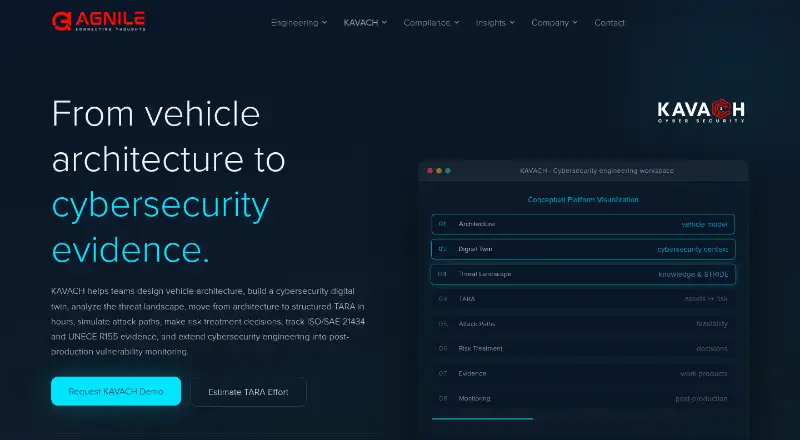
KAVACH is an automotive cybersecurity engineering workspace that connects vehicle architecture to cybersecurity evidence across ISO/SAE 21434 lifecycle workflows. Its TARA workflow links assets, damage and threat scenarios, attack paths, risk assessment and treatment, security goals, controls, and evidence. The workspace also includes architecture context, attack-tree editing, a traceability hub, vulnerability monitoring, a cybersecurity case, an R155 compliance matrix, and report generation. The current release focuses on Clauses 5–15, UNECE R155/R156 evidence, AIS 189/AIS 190 readiness, and post-production vulnerability monitoring. Deployment options include a customer-controlled desktop workspace, on-premise installation, and a customer-dedicated EU cloud VPC. KAVACH offers manual engineering, deterministic automation, and optional private AI configurable by programme. The maker says work products are structured drafts requiring engineering review and customer approval. Architecture inputs and cybersecurity records are designed to remain within the customer-defined boundary unless exported or shared. Pricing is scoped per programme, with no public rate card.
Good
- Connects TARA elements to evidence
- Includes vulnerability monitoring and a cybersecurity case
- Offers desktop, on-premise, and dedicated EU VPC deployment
- Supports manual, automated, and optional private AI modes
Watch out
- Pricing is scoped per programme
- Work products require engineering review and customer approval
- Streaming and private AI configurations may depend on programme setup
Who it suits
KAVACH is intended for OEMs and Tier-1 suppliers, including automotive cybersecurity teams and programme engineers. Its deployment options are also described for individual engineers, small programmes, and early evaluation.
Verdict
KAVACH brings automotive cybersecurity workflow elements and evidence into one workspace, with deployment choices for different customer boundaries. Teams should plan for programme-scoped pricing and review of generated work products.
Plans and prices
From KAVACH's own pricing page, checked 8 Oct 2026.
| Plan | Price | What it gives you |
|---|---|---|
| Engineering Services Accelerator | Priced on request | Scoped per programme · Embedded senior engineers for a defined workstream · KAVACH optional |
| Evaluation | Priced on request | Scoped per programme · Guided walkthrough on a representative ECU or system architecture · No deployment required |
| Program Deployment | Priced on request | Scoped per programme · Full programme rollout · On-premise or customer-dedicated EU VPC deployment |
| Scoped Pilot | Priced on request | Scoped per programme · Time-boxed pilot on one feature, ECU family, or vehicle subsystem · Customer-controlled desktop, on-premise, or customer-dedicated EU VPC |
The facts
Each one read from KAVACH's own pages, with the date it was checked.
What it does
- AI and customer data
- The Trust Center says KAVACH is not designed to train models on customer data unless explicitly agreed in writing.checked 8 Oct 2026
- AI modes
- KAVACH supports manual engineering, deterministic automation, and optional private AI, with AI configurable by programme.checked 7 Oct 2026
- Audience
- KAVACH is built for OEMs and Tier-1 suppliers, including automotive cybersecurity teams and programme engineers.checked 7 Oct 2026
- Controls
- Published security controls include customer identity-provider integration for on-premise and VPC deployments, TLS in transit, storage-layer encryption at rest, and auditable engineer-review actions.checked 7 Oct 2026
- Data boundary
- Architecture inputs, TARA records, attack paths, controls, cybersecurity case artefacts, and operational metadata are designed to remain inside the customer-defined boundary unless exported or shared.checked 7 Oct 2026
- Data handling
- The maker says architecture inputs, TARA records, cybersecurity work products, and operational metadata are designed to stay within the customer-defined boundary.checked 8 Oct 2026
- Deployment
- Deployment options include a customer-controlled desktop workspace, on-premise deployment, and a customer-dedicated EU cloud VPC.checked 7 Oct 2026
- Deployment options
- Deployment options are a customer-controlled desktop workspace, on-premise deployment, and a customer-dedicated EU cloud VPC.checked 8 Oct 2026
- Features
- The workspace includes architecture context, attack-tree editing, a traceability hub, vulnerability monitoring, a cybersecurity case, an R155 compliance matrix, and report generation.checked 7 Oct 2026
- Integrations
- The maker names DOORS, Polarion, Jira, and AUTOSAR ARXML as toolchain context or integration targets, where applicable.checked 8 Oct 2026
- Intended customers
- KAVACH is described as built for OEMs and Tier-1 suppliers, with deployment options also described for individual engineers, small programmes, and early evaluation.checked 8 Oct 2026
- Lifecycle coverage
- The current release focuses on ISO/SAE 21434 lifecycle workflows across Clauses 5–15, including the Cybersecurity Case and post-production vulnerability monitoring.checked 8 Oct 2026
- Limitations
- The maker publishes no public rate card and says engagement pricing is scoped per programme.checked 8 Oct 2026
- Limits
- The maker says generated work products are structured drafts for engineering review and customer approval.checked 7 Oct 2026
- Operating modes
- It offers manual engineering, deterministic automation, and optional private AI, with engineers responsible for review, correction, approval, and final evidence.checked 8 Oct 2026
- Product
- KAVACH is an automotive cybersecurity engineering workspace for connecting vehicle architecture to cybersecurity evidence.checked 8 Oct 2026
- Purpose
- KAVACH is an automotive cybersecurity engineering workspace supporting ISO/SAE 21434 lifecycle workflows from vehicle architecture to traceable evidence.checked 7 Oct 2026
- Security
- Agnile states it is certified to ISO 9001:2015 and ISO/IEC 27001:2022.checked 7 Oct 2026
- Security certifications
- Agnile states that it is certified to ISO 9001:2015 and ISO/IEC 27001:2022.checked 8 Oct 2026
- Security controls
- The security page describes configurable customer identity providers for on-premise and VPC deployments, TLS in transit, storage-layer encryption at rest, and auditable engineer-review actions.checked 8 Oct 2026
- Standards
- The current release focuses on ISO/SAE 21434 Clauses 5–15, UNECE R155/R156 evidence, AIS 189/AIS 190 readiness, and post-production vulnerability monitoring.checked 7 Oct 2026
- Support
- Program Deployment includes onboarding, training, governance setup, and Agnile engineering support across the programme.checked 8 Oct 2026
The company
- Founded
- 2023checked 28 Sep 2026
- Headquarters
- Bengaluru, Indiachecked 28 Sep 2026
Alternatives to KAVACH
- 1

Dethernety
Free planOpen sourceWebAPISelf-hosted7.2Free plan - 2

ThreatModeler Nexus
Free planWebAPISelf-hosted6.7From $4,000 a year - 3

ThreatOpus
Free planWebAPI6.7From £129.99 a month - 4
ThreatTree
Free planWebAPI6.6From $29 a month - 5
OWASP Threat Dragon
Free planWebLinuxmacOSSelf-hosted6.4Free plan - 6
CAIRIS
Free planWebAPILinuxmacOS6.3Free plan