KakaoCloud Container Registry
KakaoCloud Container Registry is a managed cloud repository for storing and managing private Docker container images.
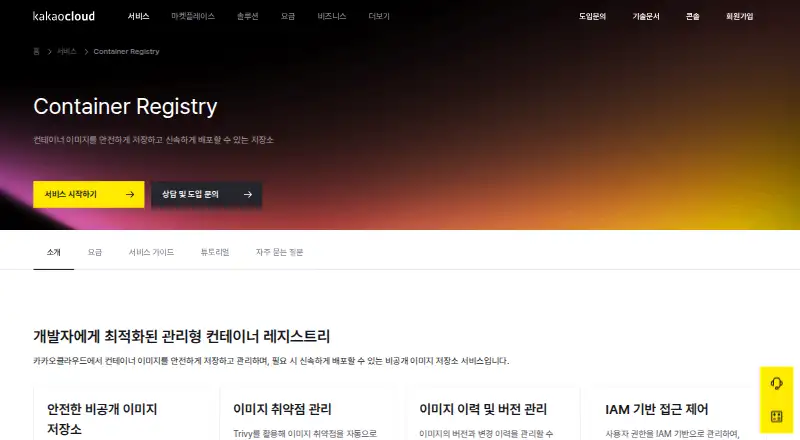
What KakaoCloud Container Registry is
KakaoCloud Container Registry is a managed cloud repository for storing and managing private Docker container images. It works with standard Docker images and Docker CLI authentication, push, and pull workflows, and integrates with KakaoCloud Kubernetes Engine for managing and deploying images. Access is controlled through IAM roles: repository members can push and pull, while viewers can pull only. Trivy scanning checks for CVE-based vulnerabilities, either daily or automatically after an image is pushed. Users can review image and tag history and restore earlier image versions or deleted tags. Repositories can also be public, so KakaoCloud-authenticated users who know the URI can pull without separate repository authentication. The service supports OCI artifacts, immutable tags, retention policies, lifecycle rules, and S3 compatibility. It includes 1 GB of storage, with a maximum object size of 50 GB. The free allowance is 1 GiB of storage and 30 GiB of outbound traffic; usage above those allowances is billed, with VAT excluded. KakaoCloud is headquartered in Seongnam-si, South Korea.
Good
- Integrates with KakaoCloud Kubernetes Engine
- Trivy scans can run daily or after pushes
- Image and tag history supports recovery
- Supports OCI artifacts and immutable tags
- Includes 1 GB of storage
Watch out
- Paid usage applies above free storage and traffic allowances
- Public pulls require KakaoCloud authentication and the repository URI
Who it suits
It suits teams storing Docker images in the cloud, especially those deploying through KakaoCloud Kubernetes Engine. The role controls, vulnerability scans, and image history support teams managing access and image changes.
Verdict
KakaoCloud Container Registry combines Docker image storage with access controls, vulnerability scanning, and recovery features. Its listed free allowances are limited, with additional storage and outbound traffic billed by usage.
Plans and prices
From KakaoCloud Container Registry's own pricing page, checked 4 Oct 2026.
| Plan | Price | What it gives you |
|---|---|---|
| Container Registry — outbound traffic | Free | 30 GiB free · 90 won/GiB through 10 TiB · 80 won/GiB from 10–20 TiB · 70 won/GiB above 20 TiB · Per GiB for usage over 30 GiB, up to 10 TiB; VAT excluded |
| Container Registry — registry storage | Free | 1 GiB free storage · 0.14 won per GiB/hour above 1 GiB · GiB/hour for usage over 1 GiB; 1 GiB or less is free; VAT excluded |
The facts
Each one read from KakaoCloud Container Registry's own pages, with the date it was checked.
What it does
- Access control
- IAM roles control repository access, with repository member permission to push and pull and viewer permission to pull only.checked 4 Oct 2026
- Docker compatibility
- The service supports standard Docker images and Docker CLI authentication, push, and pull workflows.checked 4 Oct 2026
- Garbage collection
- Garbage collection removes layer data for manifests that are not referenced by any image.checked 4 Oct 2026
- Image history
- Users can track image and tag history and recover previous image versions or deleted tags.checked 4 Oct 2026
- Kubernetes integration
- The registry integrates with KakaoCloud Kubernetes Engine for managing and deploying container images.checked 4 Oct 2026
- Purpose
- Container Registry is a managed private repository for securely storing and managing Docker container images in the cloud.checked 4 Oct 2026
- Quotas
- Default quotas are 1,000 repositories per project, 10,000 images per repository, and 1,000 tags per image; quota increases can be requested.checked 4 Oct 2026
- Security certifications
- KakaoCloud lists ISMS-P, CSAP, ISO/IEC 27001, 27017, 27018, 27701 and 27799, and CSA STAR Gold certifications.checked 4 Oct 2026
- Support
- The service guide directs users to the KakaoCloud Help Desk for service questions.checked 4 Oct 2026
- Visibility
- Repositories can be made public so KakaoCloud authenticated users who know the URI can pull images without separate repository authentication.checked 4 Oct 2026
- Vulnerability scanning
- Trivy scans images for CVE-based vulnerabilities, and scans can run daily or automatically when images are pushed.checked 4 Oct 2026
- Workflow tutorials
- KakaoCloud provides tutorials for storing and using images, managing Helm charts, and building GitOps on its Kubernetes environment.checked 4 Oct 2026
The company
- Headquarters
- Seongnam-si, Gyeonggi-do, South Koreachecked 28 Sep 2026
The full review of KakaoCloud Container Registry
Overview
KakaoCloud Container Registry is a managed service for storing and managing Docker images in private cloud repositories. It is strongest for teams building or deploying on KakaoCloud Kubernetes Engine who want registry security and recovery features without operating registry infrastructure. The main trade-off is a small free storage and outbound allowance, with usage charges beyond both.
Key features
Standard Docker images and Docker CLI authentication, push, and pull workflows keep the registry compatible with familiar container practices. Integration with KakaoCloud Kubernetes Engine makes it a natural fit for deployments in that environment; teams using other infrastructure have less reason to choose it. KakaoCloud’s tutorials cover image workflows, Helm charts, and GitOps on its Kubernetes environment.
Trivy scans images for CVE-based vulnerabilities, either daily or automatically on image pushes. IAM roles give repository members permission to push and pull, while viewers can only pull. Image and tag history supports restoring earlier image versions or deleted tags, useful safeguards against mistakes during routine releases.
Repositories can be made public, but access is limited to KakaoCloud-authenticated users who know the repository URI; this is not anonymous public distribution. Immutable tags, retention policies, and lifecycle rules add controls for managing image versions and cleanup. Garbage collection removes layer data for manifests no longer referenced by an image.
Default quotas allow 1,000 repositories per project, 10,000 images per repository, and 1,000 tags per image, with quota increases available by request. These are ample ceilings for many teams, but they do not change the separate storage and traffic charges. The service supports OCI artifacts and S3 compatibility, with a 50 GB maximum object size. KakaoCloud lists ISMS-P, CSAP, ISO/IEC 27001, 27017, 27018, 27701 and 27799, and CSA STAR Gold certifications; service questions go through its Help Desk.
Pricing
The service is paid, with free allowances rather than a broad free tier. Registry storage costs nothing for 1 GiB or less, then 0.14 won per GiB/hour above 1 GiB; VAT is excluded. That cap is modest for teams retaining multiple large images, so storage costs can rise as repositories accumulate.
Outbound traffic costs nothing for the first 30 GiB, then 90 won/GiB through 10 TiB, 80 won/GiB from 10–20 TiB, and 70 won/GiB above 20 TiB. The declining rates at higher volumes do not remove the need to account for image pulls, especially for teams with frequent deployments or many consumers. Both allowances suit small workloads better than large-scale distribution.
Platforms
The listed platforms are API, Linux, macOS, and web. Docker CLI workflows provide the practical route for image operations, while the web platform supports access to the managed service.
Who it's for
This is a sensible choice for teams already using KakaoCloud Kubernetes Engine that want CVE scanning, role-based repository permissions, and recovery options in a managed registry. It is less compelling for teams needing substantial included storage or outbound traffic, or those whose container workflow is centered on another cloud or self-managed infrastructure.
Pros and cons
- Pro: Kubernetes Engine integration and Docker CLI compatibility connect familiar image workflows to KakaoCloud deployments.
- Pro: Trivy scanning, differentiated push/pull roles, and image-history recovery address security and operational mistakes.
- Pro: High default repository, image, and tag quotas leave room to grow, with increases requestable.
- Con: Only 1 GiB of storage and 30 GiB of outbound traffic are free, so larger repositories or distribution can incur usage charges quickly.
- Con: Public repositories still require KakaoCloud authentication and knowledge of the URI, limiting their use for anonymous distribution.
Alternatives
Compare container registries if you want to assess more services category by category.
- Docker Desktop suits readers who want Docker Engine and Kubernetes alongside Docker Hub and Docker Scout, with a free Personal plan and a Pro plan at $9 a month.
- Inedo ProGet is worth considering for private-package feeds as well as Docker; its free edition offers unlimited feeds but limits security and compliance features.
- JFrog Container Registry is an option for a free, self-managed registry supporting Docker, OCI, Helm, Helm OCI, and Generic artifacts, though its free edition has no Xray.
- 8gears Container Registry offers individuals 1 GB of storage and unlimited private repositories for free forever, a fit for users prioritizing repository count over the KakaoCloud Kubernetes integration.
- Chainguard Registry offers a free image plan capped at five images per organization.
- Quay is a free Apache 2-licensed open-source community distribution, but requires a database and reliable image storage.
- Satama Container Registry provides free-of-charge use only for cases that meet CSC’s policy; other users should contact CSC Service Desk.
- STACKIT Compute Engine is a paid compute service rather than a direct registry alternative, with an hourly Tiny Server-t1.1-EU01 entry at no cost.
Verdict
Choose KakaoCloud Container Registry if your team deploys through KakaoCloud Kubernetes Engine and values built-in scanning, scoped repository permissions, and image recovery. Its clearest reason to look elsewhere is cost exposure beyond the small free storage and traffic allowances; teams with larger image footprints should compare plans before committing.
Alternatives to KakaoCloud Container Registry
- 1

JFrog Container Registry
Free planWebAPILinuxSelf-hosted7.6Free plan - 2

Inedo ProGet
Free planWebAPILinuxSelf-hosted7.4From $2,395 a year - 3
Alibaba Cloud Container Registry
Free planWebAPILinuxWindows7.1Free plan - 4

Oracle Cloud Infrastructure Container Registry
Free planWebAPILinux7.0Free plan - 5
Samsung Cloud Platform Container Registry
AndroidiOSWebAPI7.0 - 6

Chainguard Registry
Free planWebLinuxSelf-hosted6.8Free plan