
Juspay Hyperswitch
Juspay Hyperswitch is an open-source, modular platform for coordinating payments across processors.
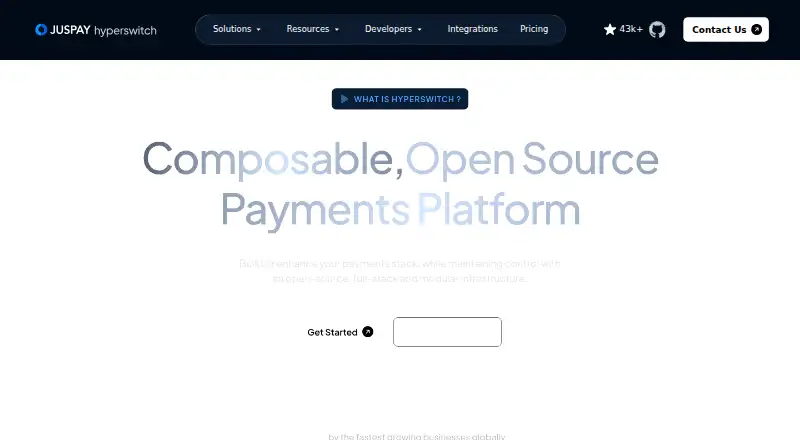
What Juspay Hyperswitch is
Juspay Hyperswitch is an open-source, modular platform for coordinating payments across processors. Its routing module applies rules and machine-learning decision engines to transactions, while its vault stores payment credentials and supports network tokenization and portability between processors. Hyperswitch lists more than 150 payment methods, including cards, wallets, BNPL, bank transfers, open banking, and crypto; its integrations directory describes connections to over 300 payment providers and methods. Revenue recovery uses configurable retry strategies based on factors such as card BIN, region, payment method, and penalty budgets. Unified Checkout supports web, Android, and iOS, with customizable styling and global payment methods. Merchants can run the platform on their own infrastructure or use managed cloud hosting. The free Self-Host Community Edition includes 90+ payment integrations and support through public Slack and GitHub discussions. Enterprise and Cloud offerings list SLA-driven support or managed compliance and support, but no prices are provided. Revenue Recovery, Cost Observability, and Reconciliation are paid add-ons for both self-hosted editions.
Good
- Rule-based and machine-learning transaction routing
- Vault supports network tokenization and portability
- More than 150 listed payment methods
- Can be self-hosted or used as managed cloud
- Checkout supports web, Android, and iOS
Watch out
- Enterprise and Cloud prices are not listed
- Community support is through public Slack and GitHub
- Three named modules are paid add-ons for self-hosted editions
Who it suits
Hyperswitch suits merchants that need to route transactions across processors and coordinate varied payment methods. The self-hosted option may fit teams managing their own infrastructure, while a managed cloud service is also available.
Verdict
Hyperswitch combines payment routing, credential vaulting, retry strategies, and checkout in a modular platform. Its free community edition is self-managed; listed Enterprise and Cloud prices are unavailable.
Plans and prices
From Juspay Hyperswitch's own pricing page, checked 15 Oct 2026.
| Plan | Price | What it gives you |
|---|---|---|
| Self-Host Community Edition | Free | 90+ payment integrations · unified checkout SDK · public Slack/GitHub support · self-managed uptime/compliance |
| Integrate Hyperswitch Cloud | Priced on request | 210+ payment integrations · managed hosting · unified checkout SDK · SLA support · 99.999% uptime guarantee |
| Self-Host Enterprise Edition | Priced on request | 90+ payment integrations · unified checkout SDK · SLA technical support · dedicated key account manager · supported uptime/compliance |
The facts
Each one read from Juspay Hyperswitch's own pages, with the date it was checked.
What it does
- 3DS
- A 3DS Decision Manager applies authentication selectively to balance fraud control and checkout friction.checked 15 Oct 2026
- Alternative payment methods
- Documentation lists support for UPI, wallets and other local payment methods.checked 15 Oct 2026
- API
- Hyperswitch exposes JSON-over-HTTP APIs with standard HTTP status codes for payment processing and management.checked 15 Oct 2026
- API authentication
- It uses secret API keys for merchant servers and publishable keys for client-side applications.checked 15 Oct 2026
- API environments
- The API reference documents sandbox and production base URLs for testing and live traffic.checked 15 Oct 2026
- Checkout
- Unified Checkout supports web, Android, and iOS, with customizable styling and global payment methods.checked 29 Sep 2026
- Checkout SDK
- A web Checkout SDK provides an embeddable responsive checkout with styling and flow controls.checked 15 Oct 2026
- Compliance
- The pricing page lists PCI-SSS certification, PCI DSS 4.0, and ISO 27001:2022 for its compliance and security stack.checked 29 Sep 2026
- Deployment
- Hyperswitch can be deployed on a merchant's own infrastructure or used as a managed cloud service.checked 29 Sep 2026
- Google Play listing
- The Hyperswitch Android demo-store app shows 100+ downloads and describes a native Android SDK checkout demonstration.checked 15 Oct 2026
- Hosted sandbox
- A hosted sandbox and preconfigured playground are available without local installation.checked 15 Oct 2026
- Independent limitation: compliance responsibility
- Open-source.store states that self-hosting the vault can place the operator in full PCI DSS SAQ D scope unless client-side tokenization or an external vault is used.checked 15 Oct 2026
- Independent limitation: operations burden
- Open-source.store warns that self-hosting requires substantial DevOps work across Rust services, PostgreSQL, Redis and encryption-key infrastructure.checked 15 Oct 2026
- Integrations
- The integrations directory describes connections to 300+ payment providers and methods.checked 29 Sep 2026
- License
- The public Hyperswitch repository is released under the Apache-2.0 license.checked 15 Oct 2026
- Limit: administration and sandbox
- A G2 reviewer described the admin portal as somewhat clunky and reported occasional sandbox maintenance outages.checked 15 Oct 2026
- Limit: connector rollout
- A G2 reviewer said that standing up some new third-party integrations took time.checked 15 Oct 2026
- Limit: performance
- A G2 reviewer reported that the system sometimes slowed and needed efficiency improvements.checked 15 Oct 2026
- Modular architecture
- The platform lets teams deploy selected payment modules instead of adopting the entire stack.checked 15 Oct 2026
The company
- Company
- Juspay says it was founded in 2012 and is headquartered in Bangalore, India.checked 29 Sep 2026
- Company facts
- LinkedIn lists Juspay Hyperswitch as privately held, founded in 2012, headquartered in San Mateo, California, with 1,001–5,000 employees.checked 15 Oct 2026
- Company legal name
- The Google Play listing identifies the developer as JUSPAY TECHNOLOGIES PRIVATE LIMITED.checked 15 Oct 2026
- Company operations
- LinkedIn says Juspay operates offices in San Mateo, Dublin, Singapore, Dubai, São Paulo and Bangalore and serves more than 500 enterprises and brands.checked 15 Oct 2026
Money
- Cost observability
- Cost-observability tools provide visibility into processor fees and payment costs.checked 15 Oct 2026
The full review of Juspay Hyperswitch
Overview
Juspay Hyperswitch is an open-source payment orchestration platform for merchants that need to coordinate multiple processors and payment methods. It suits teams able to manage payment infrastructure themselves, as well as businesses that prefer a hosted service. Its broad routing and recovery toolkit is compelling, but the self-managed free edition comes with operational responsibility and paid add-ons.
Hyperswitch brings processor routing, credential vaulting, checkout, and revenue recovery into one modular platform. Its integrations directory describes connections to more than 300 providers and methods, while the platform lists over 150 payment methods spanning cards, wallets, BNPL, bank transfers, open banking, and crypto. Those counts describe different parts of its ecosystem: integrations are not the same as payment methods.
Key features
Routing and recovery
Rule-based and machine-learning decision engines route transactions across processors, and routing rules are supported. That combination gives merchants options to shape transaction handling, though the value depends on having multiple processors and the expertise to configure a routing strategy. Automatic retries target failed payments using factors such as card BIN, region, payment method, and penalty budgets. This is useful for businesses seeking to recover revenue through tailored retry policies rather than a single generic retry pattern.
Vault and checkout
The vault stores payment credentials and supports network tokenization and portability across processors. Hyperswitch's security guide describes SSL/TLS encryption for card data in transit and layered encryption for vaulted data. Unified Checkout supports web, Android, and iOS, with customizable styling and global payment methods. Together, these capabilities can reduce the need to assemble separate credential-storage and checkout components, but they still require decisions about deployment and payment operations.
Methods, integrations, and compliance
The platform lists recurring payments and marketplace payouts alongside its payment capabilities. Its compliance and security stack lists PCI-SSS certification, PCI DSS 4.0, and ISO 27001:2022. These are relevant credentials for payment operations, but merchants still need to assess their own compliance responsibilities and deployment requirements.
Pricing
Hyperswitch uses a freemium model. Self-Host Community Edition costs nothing and includes 90+ payment integrations, self-managed hosting, and free support through public Slack and GitHub discussions. It is the clearest fit for teams that can operate their own deployment and are comfortable relying on community channels; hosting and operational work remain with the merchant.
Self-Host Enterprise Edition has custom pricing and includes 90+ integrations, SLA-driven technical support, and a dedicated key account manager. It is aimed at organizations that want self-hosting with a more accountable support relationship. Revenue Recovery, Cost Observability, and Reconciliation are paid add-ons for both self-hosted editions, so the free edition does not include those capabilities at no charge.
Integrate Hyperswitch Cloud has custom pricing, with 210+ integrations, hosting included, and managed compliance and support. It better suits businesses that want to avoid running the platform themselves. Compared with self-hosting, it includes hosting and a broader integration set, but the price is not a published fixed amount. No trial length, seat allowance, or usage quota is given for these offerings.
Platforms
Hyperswitch supports Android, iOS, web, API, and self-hosted deployment. Checkout spans web and mobile, while the API and self-hosted options suit teams integrating orchestration into their own payment stack. Merchants can choose their own infrastructure or managed cloud hosting.
Who it's for
Hyperswitch is strongest for merchants with multiple processors, meaningful payment-method breadth, and engineering capacity to configure or operate an orchestration layer. Its community edition offers a no-cost entry point for self-managing teams, while Cloud is a better fit for those who want included hosting. It is less suitable for a business seeking a simple, fully priced subscription with predictable published limits or one that does not need multi-processor orchestration.
Pros and cons
- Pro: Rule-based and machine-learning routing plus configurable retries support more nuanced transaction handling across processors.
- Pro: The vault combines credential storage with network tokenization and portability across processors.
- Pro: A free self-hosted edition provides 90+ integrations, and Cloud includes hosting with 210+ integrations.
- Con: The community edition is self-managed and supported through public Slack and GitHub discussions, which may not suit teams needing direct, SLA-backed help.
- Con: Revenue Recovery, Cost Observability, and Reconciliation are paid add-ons for both self-hosted editions, limiting what the free deployment includes.
- Con: Enterprise and Cloud use custom pricing, so buyers cannot compare their fixed costs from a published rate.
Alternatives
For a broader comparison, see Payment Orchestration Platforms. Choose PayOrc if a freemium option with a defined 0.00 USD free tier capped at USD 5k monthly TPV and one PSP, or a $25 a month Growth plan for up to USD 100k monthly TPV and five PSPs, better matches your scale. Choose Orchestra if you need a free testing-only sandbox with unlimited transactions, 130+ provider sandboxes, and no live payments. Consider DeloPay if you prefer a paid service with a free trial and transaction-volume pricing. PayServ Multi-PSP Platform offers a free sandbox connection with 500 test transactions per month, making it relevant when testing rather than live orchestration is the immediate need. OpenSwitch is another freemium option for API and self-hosted deployments. MoneyHash is a paid alternative. P26P is a paid API and web option with a pay-as-you-go plan. ACI Automated Dispute Manager is a paid, web-based alternative.
Verdict
Choose Hyperswitch if your business needs flexible multi-processor routing, credential portability, and configurable recovery, and you can manage the operational demands or pay for hosted service. Its central advantage is combining those payment controls with broad method and provider coverage; its main drawback is that self-hosting shifts responsibility to your team while key paid editions and add-ons lack fixed published pricing. If you need predictable costs, minimal payment infrastructure work, or a narrower payment tool, look elsewhere.
Getting started
- Visit https://hyperswitch.io/.
- Choose the self-hosted community edition or a listed Enterprise or Cloud offering.
- For the community edition, prepare to manage hosting on your own infrastructure.
- Use public Slack and GitHub discussions for community support.
Limits worth knowing
The Self-Host Community Edition is free and includes 90+ payment integrations, but Revenue Recovery, Cost Observability and Reconciliation are paid add-ons for both self-hosted editions. Its support is through public Slack and GitHub discussions.
Questions
Is Hyperswitch free?
Yes. The Self-Host Community Edition costs nothing.
What does the free edition include?
It includes 90+ payment integrations, self-managed hosting and free support through public Slack and GitHub discussions.
What platforms does Hyperswitch support?
Its listed platforms are Android, API, iOS, self-hosted and web. Unified Checkout supports web, Android and iOS.
Can Hyperswitch be self-hosted?
Yes. It can run on a merchant's own infrastructure, or be used as a managed cloud service.
What integrations and payment methods are listed?
The integrations directory describes connections to 300+ payment providers and methods. Hyperswitch lists 150+ payment methods, including cards, wallets, BNPL, bank transfers, open banking and crypto.
Who makes Hyperswitch?
It is from Juspay, which says it was founded in 2012 and is headquartered in Bangalore, India.
Alternatives to Juspay Hyperswitch
- 1

PayServ Multi-PSP Platform
Free planAndroidiOSWebAPI7.9From $99 a month - 2

PayOrc
Free planAndroidiOSWebAPI7.8From $25 a month - 3

DeloPay
AndroidiOSWebAPI7.7From $2.25 a month - 4

IXOPAY
AndroidiOSWebAPI7.6From $1,000 a month - 5
BridgerPay
Free planWebAPI7.3From $199 a month - 6
Orchestra
Free planWebAPI7.3$350 usage-based