Jsmon Dark Web Monitoring
Jsmon Dark Web Monitoring is a web-based paid service for monitoring business-related information across dark web and breach sources.
What Jsmon Dark Web Monitoring is
Jsmon Dark Web Monitoring is a web-based paid service for monitoring business-related information across dark web and breach sources. Its monitored data types include credentials, email/password pairs, session cookies, browser-saved credentials, source code, internal documentation, configuration files, database dumps, network access, domains, brands, executives, IP ranges, and code signatures. The service includes remediation support. There is no free plan, and the listed price starts at $15/mo (annual). This broad set of monitored data categories can help businesses assess whether the types of information they want watched are covered. Jsmon is focused on monitoring and remediation rather than a general-purpose software tool.
Good
- Monitors dark web and breach sources.
- Includes business monitoring.
- Covers credentials, cookies, source code, and more.
- Remediation support is included.
Watch out
- No free plan.
- Starts at $15/mo (annual).
- Web platform only.
Who it suits
Jsmon may suit businesses looking to monitor exposed credentials, technical materials, or organization-related identifiers. It is relevant to teams that want remediation support alongside monitoring.
Verdict
Jsmon covers a wide range of business data types and includes remediation support. Consider the annual starting price and confirm that its listed monitoring categories match your needs.
Plans and prices
From Jsmon Dark Web Monitoring's own pricing page, checked 8 Oct 2026.
| Plan | Price | What it gives you |
|---|---|---|
| Starter | Free | 1,500 credits lifetime · Findings and leaked secrets · Email alerts only · No WAF bypass, authenticated scans, custom modules, or workspace sharing · One-time trial; no card needed |
The facts
Each one read from Jsmon Dark Web Monitoring's own pages, with the date it was checked.
What it does
- Alert timing
- The page claims a median time from posting to alert of under four hours.checked 8 Oct 2026
- API and webhooks
- The comparison section describes Jsmon's SIEM/SOAR integration as a native API with webhooks.checked 8 Oct 2026
- Compliance references
- The product page says it supports NIST CSF Identify and Detect, SOC 2 CC7.2, ISO 27001 A.12.4, and GDPR breach-awareness obligations.checked 8 Oct 2026
- Credential handling
- Jsmon says exposed credentials are hashed and matched against the watchlist, and raw passwords are never stored or displayed in full.checked 8 Oct 2026
- Integrations
- The page lists Slack, Teams, Jira, PagerDuty, and XSOAR, and says workflows can be automated through an API and SOAR playbooks.checked 8 Oct 2026
- Intended users
- The page describes use by threat intelligence teams, incident response teams, and executives or boards, including exposure reporting for compliance and insurance reviews.checked 8 Oct 2026
- Matching and context
- Jsmon says AI models match mentions, deduplicate results, attribute actors, filter false matches, and add severity, source reputation, and blast-radius context.checked 8 Oct 2026
- Monitoring coverage
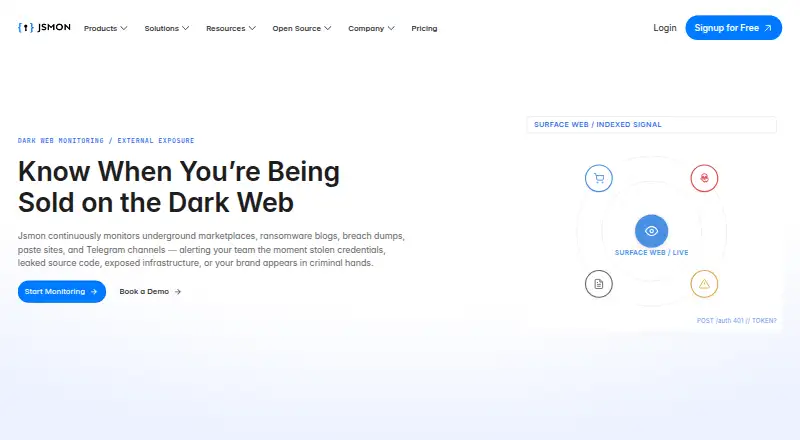
- Jsmon says it continuously monitors underground marketplaces, ransomware blogs, breach dumps, paste sites, and Telegram channels for exposed credentials, source code, infrastructure, and brand mentions.checked 8 Oct 2026
- Source coverage
- The page says its crawlers, Telegram bots, and scrapers continuously ingest more than 100 sources, including forums, stealer log marketplaces, and code repository leaks.checked 8 Oct 2026
- Watchlists
- Users can define domains, brands, executives, IP ranges, products, and code signatures to monitor.checked 8 Oct 2026
Where it runs
- Collection approach
- Jsmon describes its collection as passive: it observes and indexes and says it does not purchase data or interact with threat actors.checked 8 Oct 2026
The company
- Company founders
- Jsmon says it was founded by security researchers Inderjeet and Gaurav Bisht.checked 8 Oct 2026
- Company founding date and headquarters
- The opened company page names the founders but does not state a founding year or headquarters location.checked 8 Oct 2026
The full review of Jsmon Dark Web Monitoring
Jsmon Dark Web Monitoring tracks exposed business data across underground sources, with watchlists and response workflows aimed at security teams. It suits organizations that need to monitor more than employee credentials, including infrastructure, source code, and brand exposure. Its breadth and remediation support stand out, though the free allowance is limited and paid access starts at $15/mo (annual).
Overview
Jsmon says it continuously ingests more than 100 sources, including forums, stealer log marketplaces, code repository leaks, ransomware blogs, breach dumps, paste sites, and Telegram channels. That scope can help teams watch for exposure across credentials, internal material, infrastructure, and brand mentions rather than focusing on a single kind of leak.
Collection is passive: Jsmon observes and indexes material without purchasing data or engaging threat actors. It says exposed credentials are hashed for matching against watchlists, with raw passwords neither stored nor displayed in full. For organizations handling sensitive findings, that is a meaningful safeguard in the monitoring workflow.
Key features
Broad watchlists and contextual findings
Watchlists can cover domains, brands, executives, IP ranges, products, and code signatures. Monitored data types include email and password pairs, session cookies, browser-saved credentials, source code, internal documentation, configuration files, database dumps, and network access. This range is useful for security teams responsible for both account exposure and broader corporate assets.
Jsmon says its AI models match mentions, remove duplicates, attribute actors, filter false matches, and add severity, source reputation, and blast-radius context. That context can help analysts prioritize investigation, although it does not replace their judgment about how to respond. The service claims a median posting-to-alert time of under four hours, a useful target for time-sensitive response rather than a guarantee for every finding.
Response workflows
Slack, Teams, Jira, PagerDuty, and XSOAR are listed integrations, and the API, webhooks, and SOAR playbooks support automated workflows. Remediation support is included, making Jsmon a stronger fit for teams that want findings connected to response processes than for users seeking a simple breach lookup.
The product references NIST CSF Identify and Detect, SOC 2 CC7.2, ISO 27001 A.12.4, and GDPR breach-awareness obligations. It is described for threat intelligence and incident response teams, as well as executives and boards reviewing exposure for compliance or insurance purposes.
Pricing
The Starter plan is free as a one-time trial, requires no card, and provides 1,500 credits for the lifetime of the plan. It includes findings and leaked secrets, but alerts are email-only. It excludes WAF bypass, authenticated scans, custom modules, and workspace sharing. That is enough to assess basic findings, but the lifetime credit cap and missing team features make it a narrow evaluation option rather than a durable team plan.
Paid access starts at $15/mo (annual). That starting price is relevant for buyers considering ongoing monitoring, but the available plan detail does not establish its included quotas or seats. Teams should weigh the annual term and confirm that the paid tier covers their required monitoring categories and workflow needs.
Platforms
Jsmon is available through web and API access. The API and webhooks are particularly relevant for teams connecting alerts to existing SIEM, SOAR, or ticketing workflows.
Who it's for
Jsmon is best suited to organizations with a security or incident response function that can act on contextualized exposure alerts. Its broad watchlists also make it relevant when executives need exposure reporting for compliance or insurance reviews. A user who only wants an occasional personal credential check is unlikely to need its business monitoring scope and response integrations.
Pros and cons
- Broad monitoring coverage: More than 100 sources and watchlists spanning credentials, code, infrastructure, and brands support wider exposure tracking.
- Useful alert context: Actor attribution, severity, source reputation, and blast-radius context can help teams triage findings.
- Response options: Listed integrations, API access, webhooks, and remediation support connect monitoring with follow-up work.
- Limited free evaluation: The one-time 1,500-credit allowance and email-only alerts restrict ongoing use and team evaluation.
- Annual starting price: The $15/mo entry point is tied to an annual term, which may not suit buyers who need a short commitment.
Alternatives
Dark Web Monitoring Services is the category directory for comparing services. Consider CyberGuard360 Deep Diver if a free-forever option with five dark web prospect scans a month, training, and marketing templates better matches the task; its stated features differ from Jsmon's business exposure monitoring. DARKX offers a free plan with 15 monthly credits and one domain, IP, or phone, plus a $21.00 per month Pro plan; it may suit buyers who want a defined monthly credit allowance.
PhishEye may fit buyers focused on brand monitoring and typosquat scans, with a free plan covering one brand and a single scan. Dark Web ID is another paid option for readers comparing dark web monitoring services. eMonitor has a $3.90 per month Starter plan billed annually, supports up to 25 users and two teams, and may suit buyers prioritizing those stated team limits and cross-platform availability.
RiskProfiler KnyX is another paid API and web option. Symbol Cyber Threat Surveillance offers daily searches of internet sources on a subscription-dependent basis, with pricing available by demo or quote. Allure Security Dark Web Monitoring is also a paid API and web option.
Verdict
Choose Jsmon if your organization needs broad business exposure monitoring, contextualized alerts, and support connecting findings to remediation. Its strongest case is the range of monitored data and response routes; look elsewhere if you need an ongoing free tier, a short commitment, or clearer seat and quota terms before choosing a paid plan.
Getting started
- Open the Jsmon Dark Web Monitoring website
- Choose the free Starter option or a paid plan from $15/mo (annual)
- Create watchlists for domains, brands, executives, IP ranges, products, or code signatures
- Use the web platform or API
- Connect Slack, Teams, Jira, PagerDuty, or XSOAR integrations
- Automate workflows through API webhooks or SOAR playbooks
Limits worth knowing
Starter includes 1,500 credits for its lifetime and email alerts only. It excludes WAF bypass, authenticated scans, custom modules, and workspace sharing.
Questions
Is there a free option?
Yes. The Starter plan is listed as free, billed as a one-time trial with no card needed.
What does Starter include?
Starter includes 1,500 lifetime credits, findings and leaked secrets, and email alerts.
How much do paid plans cost?
Paid pricing starts at $15/mo (annual).
Which platforms are supported?
Jsmon is available through web and API.
Which integrations are available?
The listed integrations are Slack, Teams, Jira, PagerDuty, and XSOAR, with API and webhook support.
Who founded Jsmon?
Jsmon says it was founded by security researchers Inderjeet and Gaurav Bisht.
Alternatives to Jsmon Dark Web Monitoring
- 1

CyberGuard360 Deep Diver
Free planWeb7.2From $79 a month - 2
eMonitor
WebAPILinuxmacOS6.7From $3.90 a month - 3

DARKX
Free planWebAPI6.6From $21 a month - 4
Passguard
WebAPI6.3From €250 a month - 5
PhishEye
Free planWebAPI6.3Free plan - 6

DarkThreat
WebAPI6.2From $2,000 a year