JAX
JAX is a free Python library for accelerator-oriented array computation and program transformation, designed for numerical computing and large-scale machine …
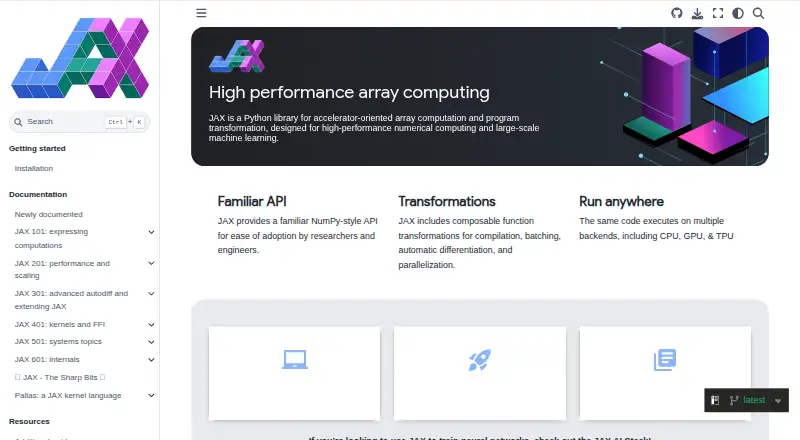
What JAX is
JAX is a free Python library for accelerator-oriented array computation and program transformation, designed for numerical computing and large-scale machine learning. Its NumPy-style API is intended to feel familiar to researchers and engineers. JAX provides composable transformations for compilation, batching, automatic differentiation, and parallelization, with code that can run on CPU, GPU, or TPU backends. The project focuses on efficient array operations and transformations, alongside an evolving ecosystem that includes Flax, Keras, Optax, TensorFlow Datasets, Hugging Face Datasets, NumPyro, and PyMC. Installation uses the `jax` package and `jaxlib`, whose compiled binaries vary by operating system and accelerator. JAX is available for Linux, macOS, Windows, and self-hosted environments, and supports local training, GPU acceleration, and distributed training. Some platform support is experimental. Distributed coordination connections are not encrypted or authenticated by default, and XLA optimizations can make JIT-compiled results numerically different from eager computations.
Good
- Free, open-source Python library
- Code can target CPU, GPU, and TPU
- Includes automatic differentiation and parallelization
- Supports local and distributed training
Watch out
- Windows x86_64 CPU support is experimental
- Apple GPU support on Apple ARM is experimental
- Distributed coordination is plaintext by default
- JIT results can differ numerically from eager results
Who it suits
JAX is suited to Python researchers and engineers working on numerical computing or machine learning at scale, especially those targeting multiple accelerator backends. Users who need distributed coordination should account for the documented security defaults.
Verdict
JAX offers array computation and transformation tools across several hardware backends, with a broad ecosystem around its focused core. Review platform status and distributed-connection security requirements before adopting it.
Plans and prices
From JAX's own pricing page, checked 11 Oct 2026.
| Plan | Price | What it gives you |
|---|---|---|
| JAX | Free | Open-source Python library; installation requires the `jax` package and platform-specific `jaxlib` binaries |
The facts
Each one read from JAX's own pages, with the date it was checked.
What it does
- Accelerator support
- The project describes its core library as focused on machine learning and numerical computing, with a modular backend stack for targeting different accelerators.checked 11 Oct 2026
- Contributors
- The project says it welcomes open-source contributions and frequently receives contributions from Google DeepMind, Alphabet, NVIDIA and others.checked 11 Oct 2026
- Development
- JAX development takes place in the open on GitHub through pull requests, the issue tracker, discussions and JAX Enhancement Proposals.checked 11 Oct 2026
- Ecosystem
- The documentation lists ecosystem tools including Flax, Keras, Optax, TensorFlow Datasets, Hugging Face Datasets and NumPyro.checked 11 Oct 2026
- Hardware
- The same code can execute on multiple backends, including CPU, GPU, and TPU.checked 11 Oct 2026
- Installation
- JAX uses the `jax` Python package and `jaxlib`, which contains compiled binaries with different builds for operating systems and accelerators.checked 11 Oct 2026
- Integrations
- The documentation lists ecosystem libraries including Flax, Keras, Optax, TensorFlow Datasets, Hugging Face Datasets, NumPyro, and PyMC.checked 11 Oct 2026
- Numerical behavior
- The FAQ explains that XLA optimizations can cause JIT-compiled computations to produce numerically different results from eager computations.checked 11 Oct 2026
- NumPy-style API
- JAX provides a familiar NumPy-style API for researchers and engineers.checked 11 Oct 2026
- Open development
- JAX development takes place in the open on GitHub, where the project uses pull requests, an issue tracker, discussions, and JAX Enhancement Proposals.checked 11 Oct 2026
- Scope
- The JAX project says the core library is narrowly scoped around efficient array operations and program transformations, with an evolving surrounding ecosystem.checked 11 Oct 2026
- Security
- Distributed coordination connections are neither encrypted nor authenticated by default; the documentation describes optional mutual TLS for securing them.checked 11 Oct 2026
- Security limits
- The documentation says CPU and non-NVLink GPU collectives, and the JAX profiler server connection, are plaintext and unauthenticated.checked 11 Oct 2026
- Support
- The installation guide directs users with problems using prebuilt wheels to the JAX GitHub issue tracker.checked 11 Oct 2026
- Transformations
- JAX includes composable transformations for compilation, batching, automatic differentiation, and parallelization.checked 11 Oct 2026
- What it does
- JAX is a Python library for accelerator-oriented array computation and program transformation, designed for high-performance numerical computing and large-scale machine learning.checked 11 Oct 2026
- Who it is for
- The project describes its core library as focused on the fundamentals of machine learning and numerical computing at scale.checked 11 Oct 2026
Where it runs
- Platform limits
- The installation guide labels Windows x86_64 CPU support experimental and Apple GPU support on Apple ARM experimental.checked 11 Oct 2026
- Platforms
- The installation guide lists CPU support for Linux, macOS and Windows, with accelerator support varying by operating system and hardware.checked 11 Oct 2026
Alternatives to JAX
- 1
Paperspace Gradient
Free planOpen sourceWebAPIExtensionLinux8.3From $8 a month - 2
Apache TVM
Free planOpen sourceAndroidiOSWebAPI7.8Free plan - 3
Lightning AI Studios
Free planWebAPILinuxmacOS7.8From $20 a month - 4
ONNX Runtime
Free planAndroidiOSWebLinux7.2Free plan - 5
Ludwig
Free planAPILinuxmacOSSelf-hosted6.7Free plan - 6
MegEngine
Free planAndroidiOSLinuxmacOS6.7Free plan