
IPComms SIP Trunking
IPComms SIP Trunking connects a business PBX or session border controller to the public telephone network over the internet.
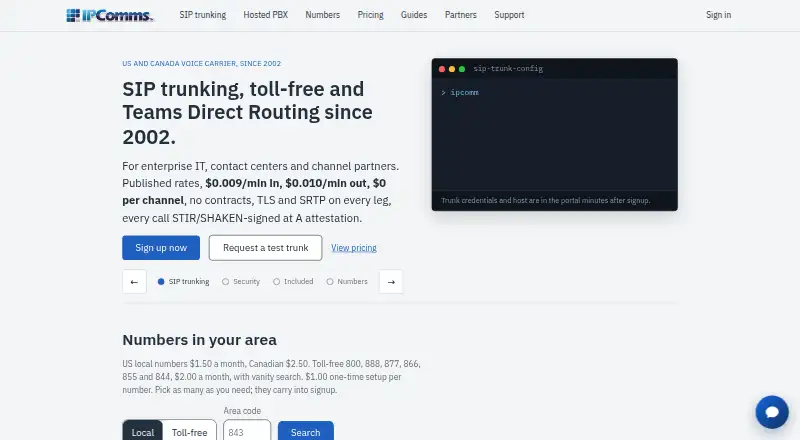
What IPComms SIP Trunking is
IPComms SIP Trunking connects a business PBX or session border controller to the public telephone network over the internet. Its standard trunk has no per-channel fee or fixed channel count; concurrent calls depend on bandwidth and a fraud-protection limit that support can raise on request. It supports SIP over UDP or TCP on port 5060 and TLS on port 5061, with G.711 μ-law, G.711 A-law and G.729 codecs. IPComms lists two geographically separate US points of presence, inbound delivery to both and automatic failover for outbound calls. Trunks can use TLS signaling and SRTP media, and calls are signed with STIR/SHAKEN A attestation. The company lists compatibility with PBX systems including Asterisk, FreePBX, 3CX and Cisco CUBE, plus Microsoft Teams Direct Routing and contact-center connections. Its REST API supports number provisioning, trunk management, sub-account creation and call-detail retrieval. Usage is billed from prepaid balance; a free plan is listed and paid service starts at $1.50/mo. E911 is available for $2.50 per number per month.
Good
- No per-channel fee or fixed channel count.
- Lists two geographically separate US points of presence.
- Supports TLS signaling and SRTP media.
- REST API supports trunk and number management.
- 24/7 coverage for critical issues.
Watch out
- Concurrent calls depend on bandwidth and a fraud limit.
- E911 costs $2.50 per number per month.
- Test trunk is limited to one concurrent call.
- Auto-dialers, robocalling and campaign traffic are prohibited.
Who it suits
IPComms positions its SIP trunking for enterprise IT, contact centers and channel partners connecting telephony systems to the public network.
Verdict
IPComms provides internet-based SIP connectivity with API controls, listed PBX compatibility and failover features. Call capacity remains subject to bandwidth and the fraud-protection limit, and E911 is an extra charge.
Plans and prices
From IPComms SIP Trunking's own pricing page, checked 30 Sep 2026.
| Plan | Price | What it gives you |
|---|---|---|
| Usage-billed SIP Trunking | — | $0 trunk and channel fees · no contract or monthly minimum · two trunks included · call concurrency subject to bandwidth and fraud-protection limit · Usage from prepaid balance; numbers and other monthly items invoiced monthly |
The facts
Each one read from IPComms SIP Trunking's own pages, with the date it was checked.
What it does
- API
- IPComms describes a REST API for automation and custom applications, with number provisioning, trunk management, sub-account creation, and call-detail retrieval.checked 30 Sep 2026
- Call capacity
- The standard trunk has no per-channel fee or set channel count; concurrent calls are subject to bandwidth and a fraud-protection limit that support can raise on request.checked 30 Sep 2026
- Emergency calling
- E911 with a dispatchable location is available for $2.50 per number per month; the company associates it with Kari’s Law and the RAY BAUM’S Act.checked 30 Sep 2026
- Integrations
- The company lists Microsoft Teams Direct Routing and contact-center BYOC connections for Genesys Cloud CX, Five9, Talkdesk, Webex Contact Center, and Zoom.checked 30 Sep 2026
- PBX compatibility
- IPComms lists compatibility with Asterisk, FreePBX, 3CX, FreeSWITCH, FusionPBX, Cisco CUBE, Avaya, Yeastar, Issabel, and Kamailio.checked 30 Sep 2026
- Redundancy
- IPComms lists two geographically separate US points of presence, with inbound calls delivered to both and automatic failover on the outbound path.checked 30 Sep 2026
- Security
- The company says trunks can use TLS signaling and SRTP media, and that every call is signed at STIR/SHAKEN A attestation.checked 30 Sep 2026
- Signaling and codecs
- The service supports SIP over UDP or TCP on port 5060 and TLS on port 5061, with G.711 μ-law, G.711 A-law, and G.729 codecs.checked 30 Sep 2026
- Support
- The SLA lists 24/7 coverage for critical issues and response targets of 15 minutes for critical outages, one hour for high severity, four hours for medium, and 24 hours for low severity.checked 30 Sep 2026
- Test offer
- A 30-day test trunk is available on request with one local number and $1.00 calling credit, and is limited to one concurrent call and US and Canada destinations.checked 30 Sep 2026
- Traffic restriction
- The company permits human-initiated conversational traffic and prohibits auto-dialers, robocalling, and campaign traffic.checked 30 Sep 2026
- What it does
- IPComms SIP trunking connects a business PBX or SBC to the public telephone network over the internet.checked 30 Sep 2026
- Who it is for
- IPComms positions the service for enterprise IT, contact centers, and channel partners.checked 30 Sep 2026
The company
- Founded
- 2002checked 23 Sep 2026
- Headquarters
- Acworth, Georgia, USAchecked 23 Sep 2026
The full review of IPComms SIP Trunking
IPComms SIP Trunking connects a business PBX or SBC to the public telephone network over the internet. It is best suited to enterprise IT teams, contact centers and channel partners that need PBX flexibility and API-driven control. Its $0 trunk and channel fees and failover features are attractive, but usage, number charges and E911 add costs, while call capacity is bounded by bandwidth and fraud controls.
Overview
IPComms has operated since 2002 and is based in Acworth, Georgia. Its standard trunk has no per-channel fee or fixed channel count, so capacity can follow available bandwidth rather than a preset seat allowance. That flexibility is tempered by a fraud-protection limit: support can raise it on request, but it remains a factor for businesses with sharp or unpredictable call-volume peaks.
The service is restricted to human-initiated conversational traffic. Auto-dialing, robocalling and campaign traffic are prohibited, ruling it out for outbound campaign operations. Number porting and toll-free numbers are supported.
Key features
- PBX and signaling support: Compatibility spans Asterisk, FreePBX, 3CX, FreeSWITCH, FusionPBX, Cisco CUBE, Avaya, Yeastar, Issabel and Kamailio. SIP works over UDP or TCP on port 5060 and TLS on 5061; supported codecs are G.711 μ-law, G.711 A-law and G.729. This breadth suits varied existing voice deployments, though it does not remove the need to configure and operate a PBX or SBC.
- Resilience: Two geographically separate US points of presence receive inbound calls, and outbound calls have automatic failover. That is a useful safeguard against a single-site disruption, particularly for organizations that depend on voice continuity.
- Security and caller identity: Trunks can use TLS signaling and SRTP media, and calls receive STIR/SHAKEN A attestation. These controls support encrypted signaling and signed caller identity.
- Integrations and API: Microsoft Teams Direct Routing and BYOC connections for Genesys Cloud CX, Five9, Talkdesk, Webex Contact Center and Zoom are supported. A REST API covers number provisioning, trunk management, sub-account creation and call-detail retrieval, giving IT and channel teams options for automation.
- Emergency calling: E911 with a dispatchable location costs $2.50 per number per month. Organizations that need emergency calling should include this recurring per-number charge in their budget.
- Support: Critical issues have 24/7 coverage, with response targets of 15 minutes for critical outages, one hour for high severity, four hours for medium and 24 hours for low severity.
Pricing
Usage-billed SIP Trunking
The plan uses a prepaid balance for calling; numbers and other monthly items are invoiced monthly. Trunks and channels have $0 fees, with no contract or monthly minimum, and two trunks are included. Calling is billed by usage, while concurrent calls remain subject to bandwidth and the fraud-protection limit. This structure suits businesses that want to avoid fixed trunk charges, but total spend depends on calling and number usage.
Pricing is freemium, with paid service from $1.50/mo. A 30-day test trunk is available on request with one local number and $1.00 calling credit. It allows one concurrent call and calls to US and Canada destinations, so it can help check a basic setup but is not a meaningful test of higher-volume or international service. E911 is an additional $2.50 per number per month.
Platforms
IPComms lists API and web platforms. Its PBX compatibility and integrations connect it to a broad set of voice systems, but those integrations do not make the trunk a general-purpose consumer calling app.
Who it's for
Choose IPComms if you manage business telephony through a compatible PBX or SBC, need API automation, or connect a contact center or Teams deployment. The lack of trunk and channel fees is particularly relevant when you want usage-based service without a contract or monthly minimum. Look elsewhere if you need auto-dialing or campaign traffic, or if a one-call test limit is too restrictive for evaluating your expected capacity.
Pros and cons
- Pros: $0 trunk and channel fees, no contract or monthly minimum, and two trunks included; useful for avoiding fixed trunk costs.
- Pros: Two US points of presence with inbound delivery to both and outbound failover; adds resilience for business voice traffic.
- Pros: Broad PBX compatibility, contact-center connections and a REST API; supports varied existing systems and automation needs.
- Cons: Concurrent calls are subject to bandwidth and a fraud-protection limit; capacity is not unlimited simply because there is no channel count.
- Cons: E911 costs $2.50 per number per month; emergency calling increases recurring costs.
- Cons: Auto-dialers, robocalling and campaign traffic are prohibited; outbound campaign teams need another provider.
- Cons: The test trunk is limited to one concurrent call and US and Canada destinations; it cannot establish how the service will handle larger or broader traffic patterns.
Alternatives
Browse SIP Trunking Providers to compare more services. Consider Callcentric SIP Trunking if you want a free plan with broad desktop, mobile and self-hosted platform support and a $0.00 monthly Pay Per Call plan billed at variable per-minute rates; it has no free trial. Choose Anveo Direct if you are considering a paid provider instead.
DIDWW Two-way SIP Trunking may suit buyers seeking per-minute international outbound termination without a monthly minimum; its destination-specific rates vary. BulkVS SIP Trunking is another paid option. AVOXI Global SIP Trunking is a paid web-based alternative.
Pick Twilio Elastic SIP Trunking if per-minute termination and origination pricing and published US number prices are a better fit: local numbers are $1.1500 per month and toll-free numbers $2.1500 per month. Flowroute is worth considering for metered usage, with domestic inbound from $0.005/minute and US lower 48 and Canada outbound from $0.00833/minute. SIP.US Cloud SIP Trunking offers a free trial and a US48 Local DID plan at $1 a month per number, plus a one-time $1.00 setup fee with CNAM included; its Nomadic e911 Enhanced DID is $2.50 a month.
Verdict
IPComms is a strong fit for enterprise IT, contact centers and channel partners that want a usage-billed trunk with API controls, broad PBX compatibility and geographic failover without fixed trunk or channel fees. Its main appeal is flexibility around existing business voice systems; its limits are capacity controls, usage-dependent costs, extra E911 charges and a strict ban on campaign traffic. Choose it for conversational business calling and integrations, not for outbound campaigns or guaranteed capacity independent of bandwidth and fraud controls.
Alternatives to IPComms SIP Trunking
- 1

Callcentric SIP Trunking
Free planAndroidiOSWebExtension8.0From $1.95 a month - 2

Telnyx SIP Trunking
Free planAndroidiOSWebAPI8.0Free plan - 3
Flowroute
Free planAndroidiOSWebAPI7.9From $1 a month - 4

Anveo Direct
Free planWebAPI7.3From $0.15 a month - 5
SIP.US Cloud SIP Trunking
AndroidiOSWebAPI7.1 - 6
BulkVS SIP Trunking
Free planWebAPI7.0From $0.01 a month