Infrared
Infrared is free, open-source Minecraft reverse-proxy software written in Go, designed for self-hosted deployment with Layer 7 protection.
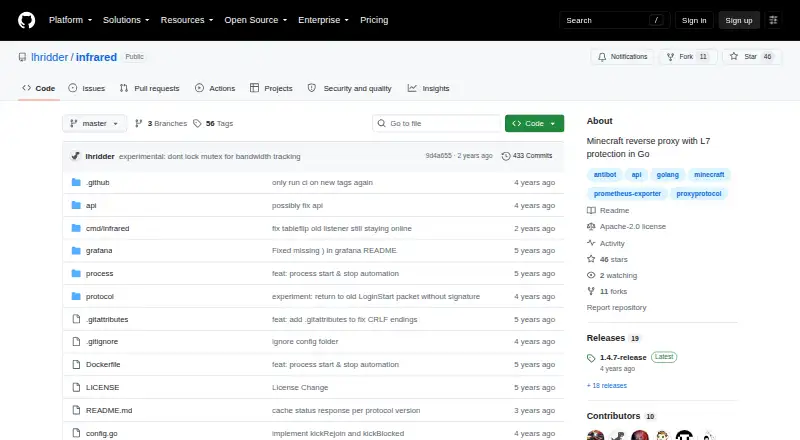
What Infrared is
Infrared is free, open-source Minecraft reverse-proxy software written in Go, designed for self-hosted deployment with Layer 7 protection. Its antibot checks can use IP lookups, encryption, authentication, protocol, and username checks. One configuration file can define multiple domains and route them to destination servers. Redis can cache lookups or provide configurations across instances, but enabling Redis-based configuration disables the built-in API. When enabled, the optional JSON HTTP API can list, retrieve, add, and delete proxy configurations. A Prometheus exporter reports metrics such as connected players and handshake counts. Named components include MaxMind MMDB GeoIP databases, the Mojang API, HAProxy Proxy Protocol, and TCPShield/RealIP Protocol. Infrared supports IPv4 and IPv6, documents server version 1.18 with protocol 757, and includes optional tableflip live upgrades that preserve existing connections during process replacement. The repository uses Apache License 2.0 terms.
Good
- Layer 7 antibot checks
- Routes multiple domains to destinations
- Prometheus metrics exporter included
- Optional API manages proxy configurations
- Supports IPv4 and IPv6
Watch out
- Redis configuration disables the built-in API
- Mitigation setup recommends Linux kernel 5.8+
- Tableflip upgrades require systemd
- Self-hosted deployment requires administration
Who it suits
It suits Minecraft server administrators comfortable with Linux, self-hosting, and proxy configuration. It is relevant when bot mitigation, routing, monitoring, and IPv4/IPv6 support are needed.
Verdict
Infrared provides a configurable Minecraft proxy with antibot checks, monitoring, Redis support, and live-upgrade options. Its self-hosted model and configuration trade-offs suit administrators who can manage the required infrastructure.
The facts
Each one read from Infrared's own pages, with the date it was checked.
What it does
- Antibot
- Its antibot checks can use IP lookups, encryption, authentication, protocol, and username checks.checked 8 Oct 2026
- API
- An optional JSON HTTP API provides routes to list, retrieve, add, and delete proxy configurations.checked 8 Oct 2026
- Availability
- The project documents live upgrades using tableflip that can preserve existing connections during the process swap.checked 8 Oct 2026
- Bot mitigation
- Its antibot checks use IP lookups, encryption checks, authentication checks, protocol checks, and username lookups.checked 7 Oct 2026
- Configuration
- One configuration file can define multiple domains, and proxy configurations can optionally be fetched from Redis.checked 7 Oct 2026
- Deployment
- The README documents Linux kernel 5.8 or later for its recommended mitigation setup and shows running Infrared as a systemd service.checked 7 Oct 2026
- GeoIP
- GeoIP lookup uses MaxMind MMDB files, and the README says the required GeoLite2 databases can be downloaded for free by creating an account.checked 8 Oct 2026
- Integrations
- The README names Redis, Prometheus, MaxMind MMDB GeoIP databases, the Mojang API, and HAProxy Proxy Protocol among supported integrations or components.checked 7 Oct 2026
- IP forwarding
- Proxy configurations support HAProxy Proxy Protocol and TCPShield/RealIP Protocol when the destination server is compatible.checked 8 Oct 2026
- License
- The repository lists the Apache License 2.0, whose terms grant no-charge copyright and patent licenses subject to its conditions.checked 8 Oct 2026
- License and warranty
- The repository includes an Apache License 2.0, which grants no-charge use rights and provides the work as-is without warranties.checked 7 Oct 2026
- Live upgrades
- The optional tableflip feature allows upgrading the Go application without closing existing connections and requires systemd, according to the README.checked 7 Oct 2026
- Metrics
- A built-in Prometheus exporter reports proxy metrics, including connected players and handshake counts.checked 7 Oct 2026
- Monitoring
- The built-in Prometheus exporter exposes operational metrics, including connected players and handshake counts.checked 8 Oct 2026
- Network support
- The project says it supports both IPv4 and IPv6.checked 8 Oct 2026
- Operational limit
- The README says enabling Redis based proxy configuration disables the built-in API.checked 7 Oct 2026
- Purpose
- Infrared describes itself as a Minecraft reverse proxy with Layer 7 protection, written in Go.checked 8 Oct 2026
- Redis
- Redis can be used to cache lookups and to retrieve proxy configurations, including across multiple instances.checked 8 Oct 2026
- Routing
- A proxy configuration can map multiple domain names to a destination server.checked 8 Oct 2026
- System requirement
- The README recommends Linux kernel 5.8 or newer for mitigation setup.checked 8 Oct 2026
Alternatives to Infrared
- 1
Geyser
Free planAndroidiOSAPILinux6.7Free plan - 2
Minekube Connect
Free planWebAPILinuxSelf-hosted6.6From $10 a month - 3
MineShield
Free planWebAPI6.6From $9.99 a month - 4
Gate
Free planWebAPILinuxmacOS6.4Free plan - 5
Void
AndroidAPILinuxmacOS6.3 - 6
mc-router
Free planAPILinuxmacOSSelf-hosted6.2Free plan