HRClaw
HRClaw is a local-first recruiting tool for turning job descriptions and candidate information into structured hiring evaluations.
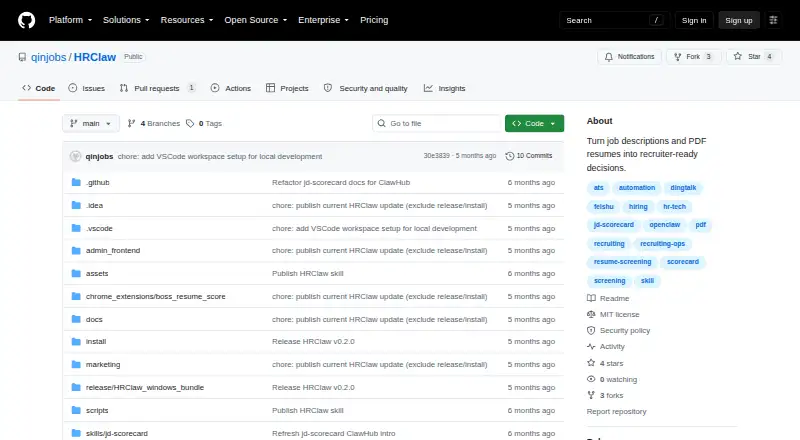
What HRClaw is
HRClaw is a local-first recruiting tool for turning job descriptions and candidate information into structured hiring evaluations. It creates reusable scorecards with hard filters, required and preferred signals, interview questions, and red flags. Recruiters can import PDF, DOC, and DOCX resumes in batches; the tool extracts candidate profiles and supports evidence-based recommendations, reviews, or rejections. Its batch workflow includes OCR for scanned PDFs. A Chrome MV3 side panel captures candidate detail pages and sends them to the same scoring backend used for resume imports. The browser plugin also records candidate status, notes, communication results, and follow-up timing. Results can be shared in JSON or Markdown, or in recruiter-friendly text for Feishu, DingTalk, Slack, and Teams. HRClaw is free and open source under the MIT license, with extension, macOS, self-hosted, web, and Windows options. Its README describes a local app at http://127.0.0.1:8080/login. The security policy cautions against committing API keys, session data, candidate data, internal exports, or client-specific scoring rules.
Good
- Builds reusable scorecards from job descriptions
- Batch imports PDF, DOC, and DOCX resumes
- OCR fallback supports scanned PDFs
- Tracks candidate status, notes, and follow-up time
- Free and MIT-licensed
Watch out
- Requires care with sensitive candidate and session data
- Local workflow is described at a specific login address
Who it suits
HR teams with recurring hiring in role families may find its shared scorecards and batch screening useful. It also suits pilots that favor local deployment over a full ATS rollout.
Verdict
HRClaw brings scorecards, batch resume review, browser capture, and candidate tracking into a local-first recruiting workflow. Its stated focus is repeated hiring and consistent screening rather than a full ATS rollout.
The facts
Each one read from HRClaw's own pages, with the date it was checked.
Where it runs
- Browser capture
- A Chrome MV3 side panel captures candidate detail pages and sends them to the same scoring backend used for resume imports.checked 8 Oct 2026
- Platforms
- The repository lists Windows and macOS bundles, local frontend packages, and a Chrome extension package.checked 8 Oct 2026
What it does
- Candidate tracking
- The browser plugin lets HR save candidate tracking status, notes, communication results, and next follow-up time.checked 8 Oct 2026
- Deployment services
- The README lists workflow customization, team calibration and rollout support, internal deployment assistance, and enterprise process adaptation under private deployment or service.checked 8 Oct 2026
- Integrations
- The README names Feishu, DingTalk, Slack, and Teams as destinations for recruiter-friendly results.checked 8 Oct 2026
- Integrations and output
- Results can be shared as JSON, Markdown, or Feishu- and DingTalk-friendly chat text, and the README also names Slack and Teams as recruiter-ready output destinations.checked 8 Oct 2026
- Intended users
- It is intended for recruiting teams with repeated hiring in role families, HR teams seeking a shared screening standard, Feishu or DingTalk teams, and pilots that value speed and local deployment over a full ATS rollout.checked 8 Oct 2026
- JD scorecards
- It turns job descriptions into reusable scorecards with hard filters, must-have and nice-to-have signals, interview questions, and red flags.checked 8 Oct 2026
- License
- The repository identifies its license as MIT.checked 8 Oct 2026
- License and support
- The repository is MIT-licensed and lists [email protected] and GitHub Issues demo requests as contact routes.checked 8 Oct 2026
- Local deployment
- The README describes a local app opened at http://127.0.0.1:8080/login and calls the workflow local-first.checked 8 Oct 2026
- Outputs
- Results can be shared as JSON, Markdown, or Feishu- and DingTalk-friendly chat text.checked 8 Oct 2026
- Purpose
- HRClaw is a local-first recruiting copilot for JD scorecards, batch resume scoring, browser capture, and recruiter-ready output.checked 8 Oct 2026
- Resume screening
- It imports PDF, DOC, and DOCX resumes in batches, extracts candidate profiles, and recommends, reviews, or rejects candidates with evidence.checked 8 Oct 2026
- Scanned PDFs
- The batch import workflow includes an OCR fallback for scanned PDFs.checked 8 Oct 2026
- Scorecards
- It turns job descriptions into reusable scorecards with hard filters, must-have and nice-to-have signals, interview questions, and red flags.checked 8 Oct 2026
- Security guidance
- The security policy says not to commit API keys, browser session data, login cookies, private candidate data, internal ATS or CRM exports, or client-specific scoring rules.checked 8 Oct 2026
- Security policy
- The security policy says not to commit API keys, browser session data, login cookies, private candidate data, internal ATS or CRM exports, or client-specific scoring rules.checked 8 Oct 2026
- Security reporting
- The policy asks users to report vulnerabilities privately through GitHub Security Advisories or direct maintainer contact.checked 8 Oct 2026
- Support
- The README provides [email protected] and GitHub Issues options labeled Demo request and 中文 demo 预约 for contact.checked 8 Oct 2026
- Target users
- It is aimed at recruiting teams with repeated hiring needs, HR teams seeking a consistent screening standard, and pilot projects that value local deployment over a full ATS rollout.checked 8 Oct 2026
Alternatives to HRClaw
- 1

CVViZ Job Distribution
AndroidiOSWebAPI7.7From $625 a year - 2

Talsense
Free planWebAPI7.5$199 usage-based - 3
Rezmatch.ai
Free planWebAPI7.4From $19.99 a month - 4
Hirvana
Free planWeb7.2$100 usage-based - 5
Truffle
AndroidiOSWeb7.1 - 6

VeraHire
Free planWeb6.7From $49 a month