
Hoppscotch
Hoppscotch is a collaborative, open-source platform for creating, testing, documenting and sharing APIs.
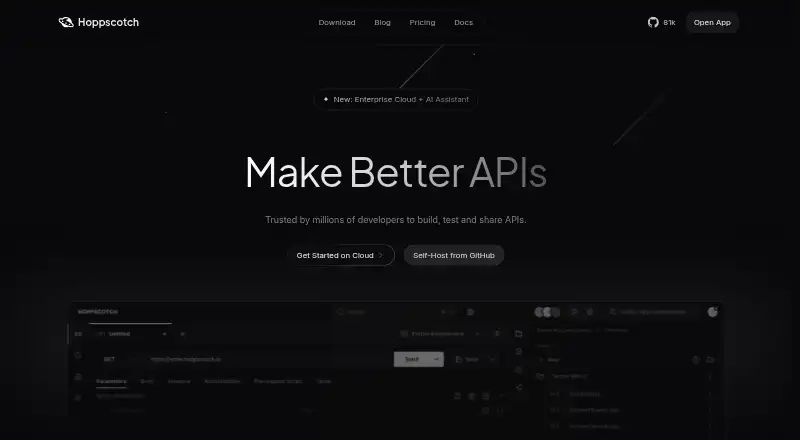
What Hoppscotch is
Hoppscotch is a collaborative, open-source platform for creating, testing, documenting and sharing APIs. Its client supports HTTP, GraphQL, WebSocket, Socket.IO, MQTT and Server-Sent Events. Testing tools include pre-request scripts, post-request tests, environment variables, request history and collection runners. Teams can use shared workspaces, access-level roles and real-time collaboration, and the platform can be deployed on their own servers. Users can migrate from Postman, Insomnia and cURL, and generate code snippets for various languages and frameworks. Hoppscotch describes its storage as local-first and says it has no tracking, analytics or ads. The Free plan includes REST, GraphQL and realtime API testing, a personal workspace, collections and environments, scripts and tests, a collection runner and community support. Business is listed at $6 per user/month billed annually; Enterprise is $11 per user/month billed annually and includes identity and access management, audit logs and priority Slack Connect support. The platform supports more than 30 languages and is listed for API, Linux, macOS, self-hosted, web and Windows.
Good
- Supports HTTP, GraphQL and four other protocols.
- Includes scripts, tests and collection runners.
- Supports team workspaces and real-time collaboration.
- Describes storage as local-first, without tracking, analytics or ads.
Watch out
- Business costs $6 per user/month, billed annually.
- Enterprise costs $11 per user/month, billed annually.
- Free plan provides a personal workspace.
Who it suits
Hoppscotch suits individuals and teams building or testing APIs across its supported protocols. Teams needing shared workspaces, collaboration or self-hosting may find those options relevant.
Verdict
Hoppscotch brings API testing, documentation and collaboration into one platform, with self-hosting also available. Review the Free plan’s personal-workspace scope and the annual per-user prices for team and enterprise plans.
Plans and prices
From Hoppscotch's own pricing page, checked 1 Oct 2026.
| Plan | Price | What it gives you |
|---|---|---|
| Free | Free | REST, GraphQL and realtime API testing · personal workspace · collections and environments · pre-request scripts and tests · collection runner · community support · forever |
| Organization | $6 a month | Everything in free plan · Admin dashboard · Dedicated support · Custom payment options · billed annually |
| Business | $6 a month | team workspaces · real-time collaboration · shared collections and environments · API documentation publishing · API mocking · code snippets · MCP server support · admin dashboard · email support · per user/month, billed annually |
| Enterprise | $11 a month | identity and access management · role-based access controls · SAML SSO and OpenID Connect · SCIM provisioning · AI Agent features · audit logs · domain whitelisting · advanced admin controls · Slack Connect priority support · per user/month, billed annually |
The facts
Each one read from Hoppscotch's own pages, with the date it was checked.
What it does
- API development
- Hoppscotch helps users create and test APIs, document them and share them.checked 1 Oct 2026
- Collaboration
- The platform provides team workspaces, access-level roles and real-time collaboration.checked 1 Oct 2026
- Deployment
- Hoppscotch can be deployed on the user's own servers through on-prem deployment.checked 1 Oct 2026
- Enterprise security
- The Enterprise plan includes identity and access management, role-based access controls, SAML-based SSO, OpenID Connect, SCIM provisioning, audit logs and domain whitelisting.checked 1 Oct 2026
- GraphQL support
- Yeschecked 23 Sep 2026
- Integrations
- Users can migrate from Postman, Insomnia and cURL with one click and generate code snippets in various languages and frameworks.checked 1 Oct 2026
- Languages
- Hoppscotch supports more than 30 languages.checked 1 Oct 2026
- Paid from
- 6checked 23 Sep 2026
- Privacy
- The product describes its data storage as local-first and says it has no tracking, analytics or ads.checked 1 Oct 2026
- Product purpose
- Hoppscotch is a collaborative open source API development platform for building high-quality APIs.checked 1 Oct 2026
- Protocols
- The client supports HTTP, GraphQL, WebSocket, Socket.IO, MQTT and Server-Sent Events.checked 1 Oct 2026
- Scale
- The homepage states that Hoppscotch processes more than 5 million requests every month.checked 1 Oct 2026
- Support
- Free includes community support, Business includes email support and Enterprise includes priority support via Slack Connect.checked 1 Oct 2026
- Testing tools
- Hoppscotch includes pre-request scripts, post-request tests, environment variables, request history and collection runners.checked 1 Oct 2026
Money
- Free plan
- Yeschecked 23 Sep 2026
The full review of Hoppscotch
Hoppscotch is an open-source API development platform for creating, testing, documenting and sharing APIs. It best suits developers who want broad protocol support and collaborative workspaces in one tool. Its free personal workspace is a useful starting point, but teams should weigh the low annual per-user price against the sharper security controls reserved for Enterprise.
Overview
Hoppscotch brings API requests, testing and documentation together, with support for HTTP, GraphQL, WebSocket, Socket.IO, MQTT and Server-Sent Events. That breadth makes it relevant beyond teams working only with REST APIs. Collections, environments, scripts and runners cover repeatable workflows, while CI/CD integration can connect API work to delivery pipelines.
The platform is described as local-first, with no tracking, analytics or ads. Teams can also deploy it on their own servers. Those options may appeal to organizations with specific privacy or hosting needs, though the Enterprise plan is where the listed identity, access and audit controls appear.
Key features
- API testing and automation: Pre-request scripts, post-request tests, environment variables, request history and collection runners support both exploratory requests and repeatable checks. CI/CD integration extends that work into automated delivery workflows.
- Team collaboration: Team workspaces, access-level roles and real-time collaboration let colleagues share API work rather than keep it confined to individual collections. Business adds shared collections and environments, documentation publishing and API mocking.
- Migration and code generation: One-click migration from Postman, Insomnia and cURL lowers the friction of switching. Code snippets for various languages and frameworks help carry requests into application code.
- Self-hosting and privacy: On-prem deployment gives organizations the option to run Hoppscotch on their own servers. Local-first storage and the stated absence of tracking, analytics and ads are additional reasons privacy-conscious users may consider it.
- Enterprise controls: Enterprise adds SAML SSO, OpenID Connect, SCIM provisioning, audit logs, domain whitelisting and advanced admin controls. These controls make the top tier more appropriate for organizations with formal identity and governance requirements.
Pricing
Hoppscotch has a free plan and paid plans billed annually. The paid entry point is $6/user/mo (annual), but that rate does not apply to every plan in the same way.
- Free — free, billed forever: REST, GraphQL and realtime API testing, a personal workspace, collections and environments, scripts, tests, a collection runner and community support. It is a capable individual starting point, but the personal-workspace scope means it is not the plan for shared team work.
- Organization — $6 a month, billed annually: Includes the Free plan, an admin dashboard, dedicated support and custom payment options.
- Business — $6 per user/month, billed annually: Adds team workspaces, real-time collaboration, shared collections and environments, documentation publishing, API mocking, code snippets, MCP server support, an admin dashboard and email support. This is the practical upgrade for teams that need to work together and publish API documentation.
- Enterprise — $11 per user/month, billed annually: Adds identity and access management, role-based access controls, SAML SSO, OpenID Connect, SCIM, AI Agent features, audit logs, domain whitelisting, advanced admin controls and priority support via Slack Connect. It is the tier for organizations that need those access and oversight capabilities, at a higher per-user cost.
Business and Enterprise are priced per user per month with annual billing; the free plan is billed forever. No seat quota or trial term is stated for Hoppscotch, so buyers should compare the annual per-user commitment with their expected team size.
Platforms
Hoppscotch is available on the web and for Linux, macOS and Windows, and can be deployed as self-hosted software. Its API focus is central to the product rather than a platform limitation.
Who it's for
Hoppscotch is a strong fit for individual developers who want a free client for multiple API protocols, and for teams ready to pay for shared workspaces, real-time collaboration and published documentation. Organizations that want self-hosting or stronger identity and audit controls have a path to those capabilities, though the latter requires Enterprise. It is less suitable for teams that need shared collaboration while staying on a personal-workspace plan.
Pros and cons
- Pro: Broad protocol support covers HTTP, GraphQL and several realtime protocols in one API client.
- Pro: The forever-free plan includes scripts, tests and a collection runner, not just basic request sending.
- Pro: Business combines team collaboration, documentation publishing and mocking at $6 per user/month, billed annually.
- Pro: Self-hosting and stated local-first, no-tracking operation give privacy-conscious users deployment choices.
- Con: Free is limited to a personal workspace, making it a poor fit for teams that need shared collections without paying.
- Con: SSO, provisioning, audit logs and domain whitelisting require the $11 per user/month Enterprise tier.
- Con: Paid per-user plans are billed annually, which means the listed monthly rate comes with an annual billing commitment.
Alternatives
Apidog is worth considering for teams seeking a free plan that supports four users, or a tool available as a browser extension as well as on desktop, web and self-hosted platforms.
Pact is the alternative to consider when open-source API tooling is the priority; its official site presents open-source tooling and links to GitHub.
Postman is another freemium API client, with a free plan that includes an API client, core tools, specs and mock servers.
Bruno may suit individuals who prefer a desktop-focused client and a free plan with two workspaces and five OpenAPI syncs per month.
Insomnia is an option for small teams that can work within its free Essentials allowance of three users for Git Sync projects and 1,000 mock-server requests per month.
Karate is better suited to readers looking for a free, MIT-licensed framework that spans API testing and browser or desktop UI automation.
Kreya is an alternative for individuals who want a free client for Linux, macOS or Windows and can accept request history limited to the latest request.
SoapUI is a free alternative to consider for REST, SOAP and GraphQL testing, functional and regression testing, mocking and command-line automation.
For more options, browse API Testing Tools and API clients.
Verdict
Choose Hoppscotch if you want a broad-protocol API client that can grow from free individual testing into paid team collaboration, documentation and self-hosting. Its main strength is the combination of testing tools and team workflows; its main constraint is that shared work and enterprise-grade access controls sit behind paid tiers, with Enterprise required for SSO, provisioning and audit features.
Getting started
- Visit https://hoppscotch.com/.
- Choose the Free plan for a personal workspace, or select a paid plan for its listed features.
- Use the web app or choose a listed Linux, macOS, or Windows platform.
- For self-hosting, deploy Hoppscotch on your own servers.
- Create and test API requests, then organize them in collections and environments.
Limits worth knowing
The Free plan includes a personal workspace and community support. Organization costs $6 per month billed annually; Business is $6 per user/month billed annually, and Enterprise is $11 per user/month billed annually.
Questions
Is Hoppscotch free?
Yes. The Free plan is billed forever at $0.00 and includes REST, GraphQL, and realtime API testing, a personal workspace, collections and environments, scripts and tests, a collection runner, and community support.
What does Hoppscotch cost?
Organization is $6.00 per month billed annually. Business is $6.00 per user/month billed annually, and Enterprise is $11.00 per user/month billed annually.
Which platforms does Hoppscotch support?
Its listed platforms are API, Linux, macOS, self-hosted, web, and Windows.
Does Hoppscotch support GraphQL?
Yes. GraphQL support is listed, and the Free plan includes GraphQL testing.
Can Hoppscotch be self-hosted?
Yes. It can be deployed on the user's own servers through on-prem deployment.
What does Enterprise include?
Enterprise includes identity and access management, role-based access controls, SAML SSO, OpenID Connect, SCIM provisioning, audit logs, domain whitelisting, advanced admin controls, AI Agent features, and priority support via Slack Connect.
Alternatives to Hoppscotch
- 1

SoapUI
Free planOpen sourceAPILinuxmacOSSelf-hosted9.0From $1,069 a year - 2
HTTPie
Free planOpen sourceWebLinuxmacOSWindows9.0From $10 a month - 3

Apidog
Free planWebAPIExtensionLinux8.8From $9 a month - 4

Bruno
Free planOpen sourceAPIExtensionLinuxmacOS8.8From $6 a month - 5

Postman
Free planWebExtensionLinuxmacOS8.4From $9 a month - 6

ReadyAPI
WebAPILinuxmacOS8.3