High-Resolution Course Feedback
High-Resolution Course Feedback (HRCF) is a free web service that gives instructors weekly anonymous student feedback about class mood, helping them understa…
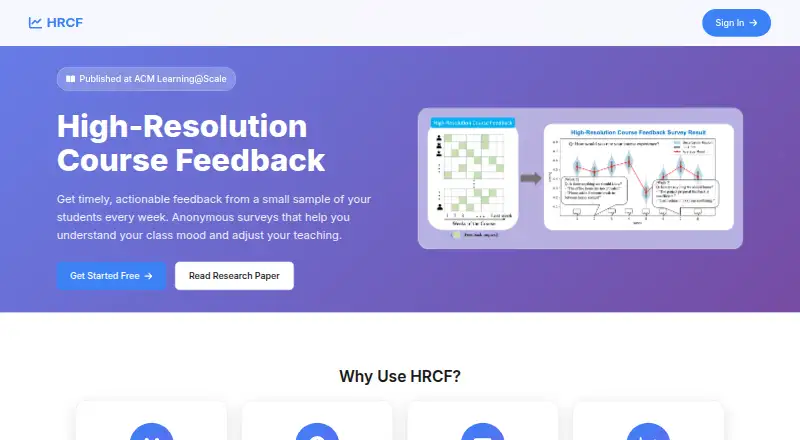
What High-Resolution Course Feedback is
High-Resolution Course Feedback (HRCF) is a free web service that gives instructors weekly anonymous student feedback about class mood, helping them understand where teaching may need adjustment. Each week, the service randomly selects students to participate, a method intended to provide representative feedback while limiting survey fatigue. Students receive unique survey links in their inboxes. The default survey asks what students liked, what remains confusing, what the teaching team should know, and for a course experience rating on a five-point scale. Instructors can add questions for particular topics each week. Surveys open Monday at noon PT, reminders are sent Thursday at noon PT, and an instructor digest arrives Sunday at 4pm PT. The digest includes participation rates, responses grouped by question with visualizations, and a graph of class mood over time. HRCF says it does not track which student submitted which feedback. To begin, a user creates an account using an institutional email, submits a course survey form, and sends a school profile page and generated course ID for review. Course roster, questions, and an admin list can be prepared while approval is pending.
Good
- Free course survey plan
- Weekly random sampling aims to reduce survey fatigue
- Instructors can add questions each week
- Digest includes participation rates and mood graph
- Unique links are not tracked to individual students
Watch out
- Course setup requires review and approval
- Survey schedule uses specified Pacific Time dispatches
Who it suits
It is intended for educators and instructors seeking regular anonymous feedback about a course. Its weekly cadence and customizable questions suit instructors who want input on specific topics as well as class mood.
Verdict
HRCF offers a defined weekly feedback cycle, with anonymous responses and a digest for instructors. Getting started includes an approval step, though course details can be prepared while review is pending.
Plans and prices
From High-Resolution Course Feedback's own pricing page, checked 15 Oct 2026.
| Plan | Price | What it gives you |
|---|---|---|
| Free course survey | Free | course survey · course roster · custom questions · admin list |
The facts
Each one read from High-Resolution Course Feedback's own pages, with the date it was checked.
What it does
- 2026 study sample
- A 2026 observational study examined 103 HRCF course offerings, 42 computer-science courses, and 24,216 enrollments across four years.checked 15 Oct 2026
- Account onboarding
- Getting started requires an account created with an institutional email address.checked 15 Oct 2026
- Anonymity
- The site says each student receives a unique, secure response link and that it does not track which student provided which feedback.checked 7 Oct 2026
- Anonymous access
- Students receive anonymous survey requests directly in their email inboxes.checked 15 Oct 2026
- Audience
- The site describes the service as built for educators and invites instructors to use it for course feedback.checked 7 Oct 2026
- Authentication
- The reference configuration supports Firebase email authentication and Google OAuth, with institution-specific OAuth settings recommended.checked 15 Oct 2026
- Class sentiment
- Weekly mood graphs show how reported class sentiment changes over time.checked 15 Oct 2026
- Course settings
- The course settings page manages weekly custom questions, student rosters, and course staff.checked 15 Oct 2026
- Custom questions
- Instructors can add topic-specific questions each week.checked 15 Oct 2026
- Default question 1
- The standard survey asks students what they have liked about the course so far.checked 15 Oct 2026
- Default question 2
- The standard survey asks whether anything from class remains confusing.checked 15 Oct 2026
- Default question 3
- The standard survey asks whether there is anything the teaching team should know.checked 15 Oct 2026
- Default question 4
- The standard survey asks students to rate their weekly course experience on a five-point scale.checked 15 Oct 2026
- Default questions
- Surveys include four default questions about what students liked, what remains confusing, what the teaching team should know, and a five-point course experience rating.checked 7 Oct 2026
- Digest participation metric
- The digest reports the number of students surveyed and the number of responses received.checked 15 Oct 2026
- Digest response collection
- Responses are grouped by question and accompanied by visualizations.checked 15 Oct 2026
- Digest timing
- Instructors receive the weekly feedback digest Sunday at 4 p.m. Pacific Time.checked 15 Oct 2026
- Getting started
- Users create an account with an institutional email, submit a course survey form, and send a school profile page and generated course ID for review and approval.checked 7 Oct 2026
- Instructor dashboard
- The repository describes an instructor dashboard for requesting surveys and managing approved surveys.checked 15 Oct 2026
- Instructor interviews
- The original study interviewed nine instructors about their experiences using HRCF.checked 15 Oct 2026
- Limit: first-use effects
- The 2026 study found no measurable change in average student ratings after first-time HRCF use.checked 15 Oct 2026
- Limit: large classes
- The 2026 study found no statistically significant association for courses enrolling 250 or more students.checked 15 Oct 2026
- Limit: scope of improvement
- Repeated use was associated with small learning-related rating gains in courses below 250 students, but not with instructional-quality or course-organization ratings.checked 15 Oct 2026
Where it runs
- Course approval
- Users submit a school profile page and generated course ID for review and approval of a course survey.checked 15 Oct 2026
The full review of High-Resolution Course Feedback
High-Resolution Course Feedback is a web service for instructors who need a recurring, anonymous read on how a class is progressing. It is best suited to educators willing to work within a weekly sampling cycle and institutional approval process. The free course survey offers a focused way to turn student sentiment into teaching adjustments without committing to a paid platform.
Overview
HRCF treats feedback as an ongoing course practice rather than a single evaluation at the end of term. A random group of students is selected each week, which is designed to produce a representative pulse while avoiding the fatigue of asking every student every time. That makes it a sensible choice for instructors who want to react while material is still being taught. It is a narrower fit for one-off surveys, institution-wide evaluation programs, or feedback work unrelated to a course.
Key features
Scheduled weekly cycle
Surveys open Monday at noon Pacific Time, reminders arrive Thursday at noon, and the instructor digest is delivered Sunday at 4pm. Students receive requests directly in their inboxes through unique survey links. The fixed timetable creates a dependable rhythm for reviewing sentiment, although instructors who need immediate or ad hoc responses will find the schedule less flexible.
Structured and custom questions
Every survey starts with four default prompts: what students liked, what remains confusing, what the teaching team should know, and a five-point course-experience rating. Instructors can add custom questions each week. The combination preserves a comparable baseline while allowing a teacher to investigate a new assignment, topic, or classroom issue.
Digest reporting and anonymity
The weekly digest combines participation rates, question-by-question responses with visualizations, and a class-mood graph showing sentiment over time. That gives instructors both a current snapshot and a way to notice movement across weeks. HRCF says each student gets a unique, secure response link and that it does not track which student submitted which feedback, a meaningful safeguard when candid comments matter. Anonymous feedback, instructor evaluations, benchmarking, and advanced reporting are part of the service's stated capabilities.
Approval and preparation
Getting started requires an account tied to an institutional email, a course survey form, and submission of a school profile page plus a generated course ID for review and approval. This gate may reassure institutions, but it adds lead time before a course can run. Users can still prepare the roster, custom questions, and admin list while approval is pending, reducing the amount of setup that has to wait.
Pricing
HRCF uses a free model. The Free course survey plan costs free and includes creating a course survey, setting up a course roster, adding custom questions, and configuring an admin list. For an individual instructor or a team wanting a no-cost weekly feedback workflow, that is the clearest reason to choose HRCF. The trade-off is not a paid tier with expanded capacity or service levels: the offering is centered on the free course-survey plan, so institutions seeking broader administrative packaging should compare dedicated evaluation platforms.
Platforms
HRCF runs on the web. Students and instructors therefore use browser-based access, with survey invitations delivered by email rather than requiring a native mobile app.
Who it's for
HRCF is aimed at educators and instructors who want weekly evidence about class mood, points of confusion, and teaching priorities. It fits courses where representative sampling and anonymous responses are more valuable than surveying every learner on every question. The service is less appropriate for organizations needing a broad multi-platform deployment, a one-time questionnaire, or a workflow that bypasses institutional approval.
Pros and cons
Pros
- Weekly sampling: Random selection reduces repeated demands on students while keeping feedback flowing during the course.
- Actionable cadence: Monday opening, Thursday reminders, and a Sunday digest give instructors a predictable review point.
- Useful context: Participation figures, visualized answers, and a mood-over-time graph make responses easier to interpret than a raw comment list.
- Flexible questioning: Custom weekly prompts let instructors follow up on specific teaching concerns without abandoning the default baseline.
- No license cost: The free plan covers the core survey, roster, question, and admin setup.
Cons
- Approval overhead: Institutional email, school information, a course ID, and review add steps before launch.
- Fixed timing: The weekly schedule is clear but not designed for urgent, same-day feedback.
- Course-focused scope: Its design does not address broader survey programs or non-course feedback needs.
Alternatives
Browse Course Evaluation Software for a wider category comparison. Choose FrontCore instead when you need Android, iOS, API, and web access, with a free tier for up to 30 participants and paid capacity up to 300. IASystem is a better fit for campus pilots and enrollment-based licensing, including a free one-term pilot. Pick Qualtrics for an individual free survey allowance of three active surveys and 500 total responses. SmartEvals offers a free Lite option for schools moving from paper evaluations. HelioCampus Course Evaluations & Surveys is an alternative for institutions wanting a paid course-evaluation product across mobile, API, and web platforms. Perspective AI Intelligent Intake is aimed at AI-powered conversations rather than a recurring course-feedback cycle. QuestionPro suits users who want a general survey tool, with a free Essentials plan capped at 200 responses per survey. Creatrix Campus Course Evaluation is a paid, institution-customized option.
Verdict
Choose HRCF if you are an instructor who wants a free, anonymous weekly pulse on a course and can accommodate institutional approval. Its main strength is the disciplined feedback-to-digest cycle, supported by representative sampling and trend reporting. Look elsewhere if you need instant surveys, broad institutional administration, or platforms and capacities beyond a web-based course workflow.
Alternatives to High-Resolution Course Feedback
- 1
FrontCore
Free planAndroidiOSWebAPI8.0From £42 a month - 2
Perspective AI Intelligent Intake
Free planiOSWebAPI7.7From $99 a month - 3
CourseEval HQ
AndroidiOSWeb7.5From $1,400 a year - 4
IASystem
Free planWebAPI7.3From $1.59 a year - 5

Qualtrics
Free planAPI7.3From $420 a month - 6
EduAdmin
AndroidiOSWebAPI7.0From $329 a month