
Heptora
Heptora combines deterministic robotic process automation, an AI assistant, and AI agents for business workflows.
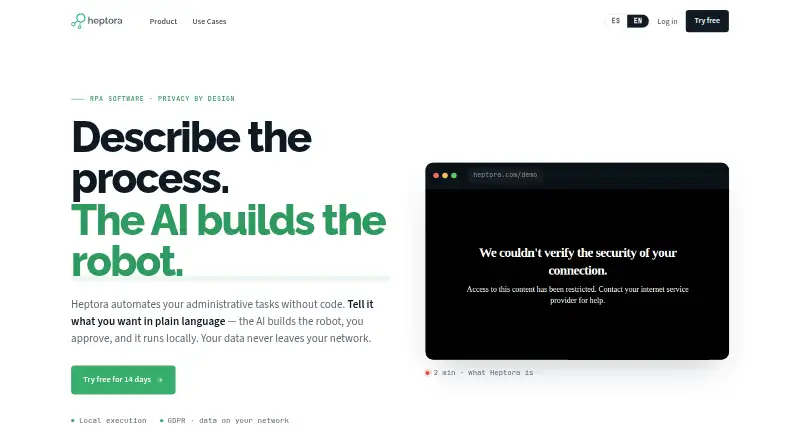
What Heptora is
Heptora combines deterministic robotic process automation, an AI assistant, and AI agents for business workflows. Users can describe a process in plain language, review the proposed plan, and approve the automation. Its visual Recorder captures clicks and fields as a person performs a task, without requiring code; the Robot runs on a user's machine or server and processes business data locally. The product is presented for data entry, document processing, report generation, reconciliation, portal extraction, and government submissions. The assistant can query connected systems and documents, then propose actions for approval. Agents can read and classify documents and handle exceptions within workflows that run as deterministic RPA after approval. Integrations described include ERPs, CRMs, spreadsheets, email, document folders, web portals, Excel, CSV, and REST API, without naming specific vendors. Heptora says production data remains on the user's infrastructure, while lightweight orchestration signals go to its cloud. It says cloud AI is used when building automations, but not during deployed execution.
Good
- Users can define workflows in plain language and approve plans.
- Visual Recorder captures tasks without requiring code.
- Robot processes business data on a user's machine or server.
- Supports document classification and exception handling.
- Lists integrations across business systems, files, and APIs.
Watch out
- A minimal outbound connection is required for orchestration and license validation.
- Cloud AI is used while building automations.
Who it suits
Heptora describes its RPA product for operations and finance teams, including teams of 20–200 people. It may suit teams seeking to automate document, browser, or data-entry workflows with local execution.
Verdict
Heptora pairs RPA with AI-assisted workflow creation and local execution of deployed automations. Teams should review its outbound-connection requirement and the distinction between cloud AI during building and local execution.
Plans and prices
From Heptora's own pricing page, checked 8 Oct 2026.
| Plan | Price | What it gives you |
|---|---|---|
| Co-creation program | — | Remote sessions · first 2–3 automations built with an expert · One-time; optional · 4 weeks |
| Heptora platform | Priced on request | Templates · documentation · email support · Monthly or annual subscription |
| Monthly support | — | SLA: 8 h for critical incidents · 24 h for functional questions · annual review and optimization · Monthly · optional |
The facts
Each one read from Heptora's own pages, with the date it was checked.
What it does
- AI agents
- AI agents read and classify documents and handle exceptions inside workflows that run as deterministic RPA after approval.checked 8 Oct 2026
- AI assistant
- The assistant can query connected systems and documents in plain language and propose actions for user approval.checked 8 Oct 2026
- AI privacy
- The security page says cloud AI is used while building automations, while deployed execution is local and production data does not touch an AI service.checked 8 Oct 2026
- Audience
- Heptora describes its RPA product as designed for operations and finance teams, including teams of 20–200 people.checked 8 Oct 2026
- Automation
- Users describe a process in plain language, review the AI's proposed plan, and approve the resulting automation.checked 8 Oct 2026
- Data flow
- The security page says production data stays on the user's infrastructure and only lightweight orchestration signals go to Heptora's cloud during execution.checked 8 Oct 2026
- Deployment limit
- Heptora says it needs a minimal outbound connection for orchestration signals and license validation; it offers on-premises deployment options for high-security environments.checked 8 Oct 2026
- Integrations
- The pages describe connecting ERPs, CRMs, spreadsheets, email, document folders, web portals, Excel, CSV, and REST API; they do not name specific vendors.checked 8 Oct 2026
- Local execution
- The Robot runs on a user's machine or server, processing business data locally.checked 8 Oct 2026
- Product
- Heptora combines deterministic RPA, an AI assistant, and AI agents in one platform.checked 8 Oct 2026
- Recorder
- The visual Recorder captures clicks and fields as a user performs a task, without requiring code.checked 8 Oct 2026
- Security
- Heptora says it is ISO 27001 certified and stores credentials in an encrypted local vault; its FAQ specifies AES-256 encryption at rest.checked 8 Oct 2026
- Support
- The site advertises support in English and Spanish; the platform subscription includes email support.checked 8 Oct 2026
- Use cases
- The product is presented for tasks such as data entry, document processing, report generation, reconciliation, portal extraction, and government submissions.checked 8 Oct 2026
The company
- Company history
- The About page says the company began as Harpia in 2020 and became Heptora in 2024; the site footer identifies Raindance, S.L.checked 8 Oct 2026
- Founded
- 2020checked 28 Sep 2026
Alternatives to Heptora
- 1
EdgeVerve AssistEdge
Free planWebAPILinuxSelf-hosted7.8Free plan - 2
Ui.Vision RPA
Free planWebAPIExtensionLinux7.3Free plan - 3

Hyland OnBase
AndroidiOSWebAPI7.0 - 4
Microsoft Power Automate
WebWindows6.9From $15 a month - 5

Brity RPA
AndroidWebAPILinux6.7 - 6
Tailent Automation Platform
Free planWebWindows6.7From €500 a month