
Hasura
Hasura GraphQL Engine creates a data API over connected databases, so developers can expose data without writing handlers, schemas, or resolvers.
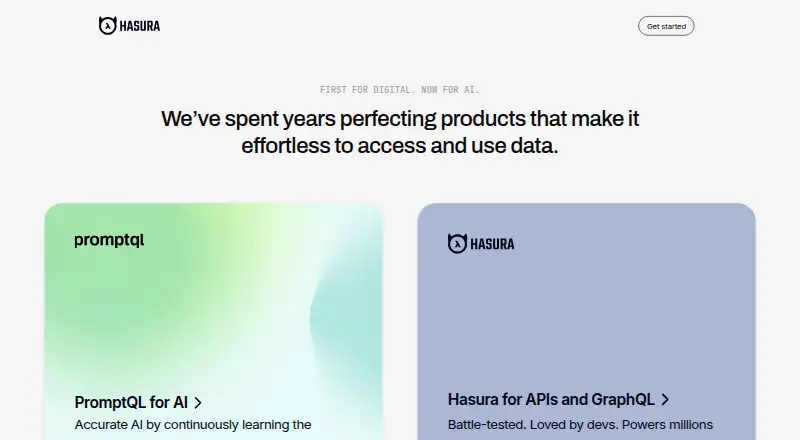
What Hasura is
Hasura GraphQL Engine creates a data API over connected databases, so developers can expose data without writing handlers, schemas, or resolvers. Hasura Cloud plans include GraphQL APIs, RESTified endpoints, and GraphQL subscriptions. Listed data sources range from Postgres-compatible databases and Microsoft SQL Server to BigQuery, Snowflake, MongoDB, and ClickHouse. Teams can extend APIs with remote schemas and joins, Actions, and event or scheduled triggers. Cloud authorization can integrate with an authentication provider of the customer's choice and supports JWT controls through headers, cookies, or webhooks. Hasura Cloud runs on AWS, Google Cloud Platform, and Microsoft Azure Cloud. The Community Edition can be deployed using a Docker image, and Enterprise Edition can run on-premises. Cloud security features include query allow lists, optional GraphQL introspection disabling, security event logging, access controls, and DDoS monitoring. The Free plan permits up to three projects, three million API requests per month, and 10 concurrent websocket connections.
Good
- Generates APIs without writing handlers, schemas, or resolvers.
- Supports multiple database types and API extensions.
- Cloud hosting is available on AWS, Google Cloud, and Azure.
- Community Edition can be deployed using Docker.
Watch out
- Free plan allows up to three projects.
- Free plan is limited to three million API requests monthly.
- Free plan allows 10 concurrent websocket connections.
Who it suits
It suits developers who want to expose connected database data through APIs, including teams considering cloud, self-hosted, or on-premises deployment. Hasura describes Professional for low-scale production APIs and Enterprise for high-scale, mission-critical production APIs with security and compliance needs.
Verdict
Hasura offers database API generation alongside cloud and self-hosted deployment options. Its free tier has explicit project, request, and connection limits; Professional is listed at $1.50 per active hour.
Plans and prices
From Hasura's own pricing page, checked 8 Oct 2026.
| Plan | Price | What it gives you |
|---|---|---|
| Free | Free | 2 databases per project · up to 100MB data passthrough/month · up to 3M API requests/month · Forever |
| Professional | Priced on request | Unlimited databases per project · unlimited data passthrough at $0.13/GB · up to 6M API requests/month · Starts at $1.50/active hour |
| Enterprise | Priced on request | Unlimited databases · unlimited data passthrough · unlimited API requests/month · Custom pricing |
The facts
Each one read from Hasura's own pages, with the date it was checked.
What it does
- API types
- Hasura Cloud plans include instant GraphQL APIs, RESTified endpoints, and GraphQL subscriptions.checked 8 Oct 2026
- Authorization
- Hasura Cloud authorization can integrate with an authentication provider of the customer's choice and supports JWT controls through headers, cookies, or webhooks.checked 8 Oct 2026
- Cloud hosting
- Hasura Cloud is available on AWS, Google Cloud Platform, and Microsoft Azure Cloud.checked 8 Oct 2026
- Compliance
- Hasura states that Hasura Cloud is SOC 2 Type II and HIPAA compliant and that its offerings are GDPR compliant; it also describes ISO/IEC 27001:2013 certification for its information security management system supporting Hasura GraphQL Engine.checked 8 Oct 2026
- Data sources
- The documentation lists Postgres-compatible databases, Microsoft SQL Server, BigQuery, Amazon Athena, Snowflake, MySQL, Oracle, MariaDB, MongoDB, and ClickHouse as supported databases.checked 8 Oct 2026
- Extending APIs
- Hasura supports remote schemas, remote joins, Actions, and event and scheduled triggers.checked 8 Oct 2026
- Integrations
- Hasura Cloud lists GitHub integration for CI/CD and observability integrations such as Datadog, New Relic, Azure Monitor, Prometheus, and OpenTelemetry.checked 8 Oct 2026
- Intended use
- Hasura describes Professional as intended for low-scale production APIs and Enterprise as intended for high-scale, mission-critical production APIs with security and compliance needs.checked 8 Oct 2026
- Product
- Hasura GraphQL Engine generates a data API over connected databases without requiring developers to write handlers, schemas, or resolvers.checked 8 Oct 2026
- Security
- Hasura Cloud lists query allow lists, optional GraphQL introspection disabling, security event logging, access controls, and DDoS monitoring among its security features.checked 8 Oct 2026
- Self-hosting
- The Hasura GraphQL Engine Community Edition can be deployed manually using its Docker image, and Hasura Enterprise Edition is deployable on-premises.checked 8 Oct 2026
- Support
- The Cloud Free plan includes community and email/ticketed support, Professional includes expert technical support, and Enterprise includes 24x7 expert technical support with customizable SLAs.checked 8 Oct 2026
The company
- Company history
- Hasura's company page says the team raised over $135 million and identifies it as the team behind Hasura GraphQL Engine and Hasura Data Delivery Network.checked 8 Oct 2026
Money
- Free plan limits
- The Free plan allows up to 3 projects per account, 3 million API requests per month, and 10 concurrent websocket connections.checked 8 Oct 2026
The full review of Hasura
Hasura turns connected databases into APIs, making it a strong fit for teams that want to expose data without building the API layer by hand. Its mix of cloud hosting, self-hosting, and extension points is useful across different deployment needs, but the Free plan’s quotas and Professional’s active-hour billing call for careful capacity planning.
Overview
Hasura GraphQL Engine generates a data API over connected databases without requiring developers to write handlers, schemas, or resolvers. Hasura Cloud adds instant GraphQL APIs, RESTified endpoints, and GraphQL subscriptions. That combination can reduce repetitive API work, while the range of supported databases gives teams latitude to expose data across a mixed stack.
Supported sources include Postgres-compatible databases, Microsoft SQL Server, BigQuery, Amazon Athena, Snowflake, MySQL, Oracle, MariaDB, MongoDB, and ClickHouse. Teams can extend APIs with remote schemas and joins, Actions, and event or scheduled triggers. Authorization can integrate with an authentication provider of the customer’s choice, with JWT controls through headers, cookies, or webhooks. These options suit APIs that need to connect existing services and identity systems; teams with simpler needs may not benefit from the added flexibility.
Key features
Cloud operations and security
Hasura Cloud runs on AWS, Google Cloud Platform, or Microsoft Azure Cloud. GitHub integration supports CI/CD, and observability integrations include Datadog, New Relic, Azure Monitor, Prometheus, and OpenTelemetry. Security features include query allow lists, optional GraphQL introspection disabling, security event logging, access controls, and DDoS monitoring. Hasura states that Cloud is SOC 2 Type II and HIPAA compliant, its offerings are GDPR compliant, and its information security management system supporting GraphQL Engine is ISO/IEC 27001:2013 certified. Those capabilities make Cloud a plausible choice for teams with operational and compliance requirements, though organizations should assess their own requirements before selecting a service.
Deployment and lifecycle
The GraphQL Engine Community Edition can be deployed manually using its Docker image, while Enterprise Edition can be deployed on-premises. This hybrid approach gives teams a choice between managed cloud operations and control over deployment. It is less compelling for teams looking only for a hosted GraphQL client or a small standalone API tool.
Pricing
The Free plan costs nothing, billed Forever. It allows two databases per project, up to 100MB of data passthrough per month, up to 3M API requests per month, three projects per account, and 10 concurrent websocket connections. Community and email/ticketed support are included. These caps make it practical for smaller projects and evaluation, but teams approaching the request, connection, or project ceiling will need to plan an upgrade.
Professional starts at $1.50/active hour and costs $1.50 per contact, with unlimited databases per project, unlimited data passthrough at $0.13/GB, up to 6M API requests per month, and expert technical support. It is intended for low-scale production APIs. Hour-based billing makes runtime an important budget factor, and the request cap means it is not an unlimited production tier.
Enterprise has custom pricing and includes unlimited databases, unlimited data passthrough, unlimited API requests per month, 24x7 expert technical support, and customizable SLAs. Hasura positions it for high-scale, mission-critical production APIs with security and compliance needs. Its custom pricing makes it less suited to buyers who need a predictable public rate before discussing requirements.
Platforms
Hasura supports API, Linux, self-hosted, and web environments. The Cloud and self-hosted options let teams choose where the engine runs rather than tying the product to a single deployment model.
Who it's for
Hasura is best for development teams building database-backed APIs that value fast API generation, multiple data sources, and the ability to extend APIs or choose between cloud and self-managed deployment. It is a weaker fit for projects that can stay within a simpler tool’s scope, or for teams that cannot accommodate the Free plan’s quotas or Professional’s hourly charges.
Pros and cons
- Pro: Broad database support, from Postgres-compatible systems to MongoDB and ClickHouse, can serve teams with varied data stores.
- Pro: Remote schemas, Actions, triggers, and configurable JWT authorization provide ways to connect APIs to existing services and identity systems.
- Pro: Cloud hosting across AWS, Google Cloud Platform, and Microsoft Azure Cloud sits alongside Docker-based Community Edition and on-premises Enterprise deployment.
- Con: Free is limited to three projects, 3M monthly API requests, and 10 concurrent websocket connections, which can constrain growing workloads.
- Con: Professional’s active-hour billing and $0.13/GB data passthrough charge make usage forecasting important even with unlimited passthrough volume.
- Con: Enterprise uses custom pricing, so teams must engage on requirements to establish the cost of its unlimited quotas and support terms.
Alternatives
Consider Altair GraphQL Client when you want a GraphQL client with team, query, collection, and history limits rather than a database API generation platform. Apollo Studio is another freemium option, with a Free plan capped at three developers, 60 router requests per minute, and one-day data retention. Choose Apollo Client when a free GraphQL client option with three developers, a 60-request-per-minute self-hosted router limit, one-day retention, and community support better matches your needs.
Hot Chocolate is a free, MIT-licensed option for commercial or private projects. Ariadne is a free alternative. GraphiQL is a free, MIT-licensed project distributed as a package for React applications. GraphQL Hive has a free Hobby plan with 1M monthly operations and seven-day usage data retention. Lighthouse is a free installable PHP package that requires a Laravel or Lumen project.
Browse GraphQL Tools or API Management Software for more options in those categories.
Verdict
Choose Hasura if your team wants to generate APIs across multiple database types and needs the option to extend them or control deployment. Its breadth is the main reason to pick it; the Free tier’s hard quotas and Professional’s hourly billing are the main reasons to look elsewhere or budget carefully.
Getting started
- Open https://hasura.io/
- Choose Hasura Cloud or a self-hosted deployment model
- Select the Free, Professional, or Enterprise plan
- For Community Edition self-hosting, deploy the Docker image
- Connect a supported database and configure the API
Limits worth knowing
The Free plan allows up to 3 projects per account, 3 million API requests per month, 10 concurrent websocket connections, 2 databases per project, and up to 100MB of data passthrough per month. Professional includes up to 6 million API requests per month, while Enterprise lists unlimited API requests.
Questions
Is Hasura free?
Yes. The Free plan costs nothing and is billed forever.
Which databases can Hasura connect to?
Listed sources include Postgres-compatible databases, Microsoft SQL Server, BigQuery, Amazon Athena, Snowflake, MySQL, Oracle, MariaDB, MongoDB, and ClickHouse.
Where can Hasura run?
Hasura Cloud is available on AWS, Google Cloud Platform, and Microsoft Azure Cloud. The Community Edition can run from a Docker image, and Enterprise Edition can be deployed on-premises.
What API formats does Hasura Cloud provide?
Cloud plans include instant GraphQL APIs, RESTified endpoints, and GraphQL subscriptions.
Does Hasura support authentication and security controls?
Authorization can integrate with an authentication provider of your choice, with JWT controls through headers, cookies, or webhooks. Listed security features include query allow lists, optional introspection disabling, security event logging, access controls, and DDoS monitoring.
What support comes with each plan?
Cloud Free includes community and email or ticketed support. Professional includes expert technical support, while Enterprise includes 24x7 expert technical support with customizable SLAs.
Alternatives to Hasura
- 1
Altair GraphQL Client
Free planWebExtensionLinuxmacOS7.4From $7.99 a month - 2

Apollo Client
Free planAndroidiOSWebAPI7.3From $5 a month - 3

GraphQL Hive
Free planWebAPISelf-hosted6.7From $20 a month - 4
PostGraphile
Free planWebAPISelf-hosted6.7From $25 a month - 5

WunderGraph Cosmo
Free planWebAPISelf-hosted6.7From $499 a month - 6
GraphiQL
Free planWebSelf-hosted6.5Free plan