
Ariadne
Ariadne is a free, open-source Python library for building GraphQL APIs with schemas defined in GraphQL Schema Definition Language (SDL).
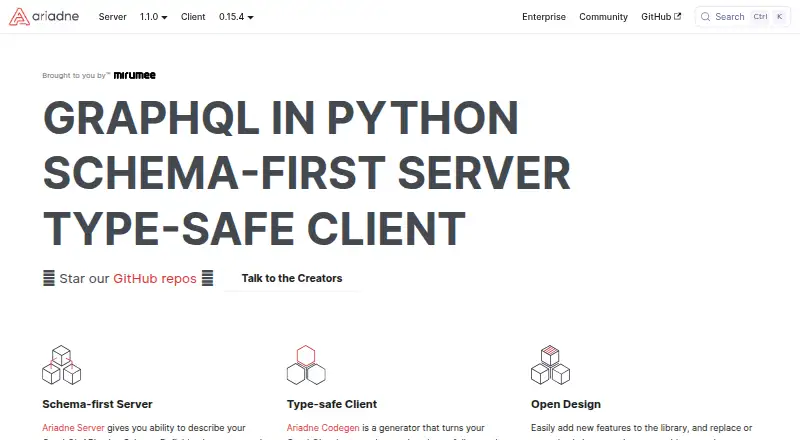
What Ariadne is
Ariadne is a free, open-source Python library for building GraphQL APIs with schemas defined in GraphQL Schema Definition Language (SDL). Developers connect schema fields to application logic through resolver functions. The server supports both asynchronous and synchronous query execution and can be served through WSGI or ASGI apps. It is designed to interoperate with web frameworks, with a Django integration example on its site.
Ariadne Codegen can generate a typed Python client and Pydantic models from a schema and operations, then validate generated client results against those models at runtime. An optional SQLAlchemy 2.0 integration supports synchronous sessions in WSGI and ASGI; AsyncSession is limited to ASGI and has a documented limitation involving sibling root fields. Ariadne also implements the GraphQL multipart request specification for uploads. Its default Upload scalar is write-only and accepts values passed through variables. The security documentation discusses denial-of-service and credential-leakage risks and offers mitigation guidance. Ariadne is self-hosted and includes an API explorer, client code generation, and operation testing.
Good
- Free and open source.
- Supports synchronous and asynchronous query execution.
- Provides WSGI and ASGI apps.
- Generates typed Python clients and Pydantic models.
- Includes an API explorer and operation testing.
Watch out
- Server language is Python.
- AsyncSession support is ASGI-only.
- AsyncSession has a sibling-root-field limitation.
Who it suits
Ariadne suits Python developers building self-hosted GraphQL APIs who want SDL schemas, resolver functions, and sync or async execution. It may also suit teams seeking generated typed clients or the listed framework and SQLAlchemy integrations.
Verdict
Ariadne brings schema-first GraphQL server capabilities and typed client generation to Python projects. Check its SQLAlchemy AsyncSession constraints against your application before choosing that integration.
Plans and prices
From Ariadne's own pricing page, checked 8 Oct 2026.
| Plan | Price | What it gives you |
|---|---|---|
| Ariadne | Free | Open-source Python GraphQL server and client libraries |
The facts
Each one read from Ariadne's own pages, with the date it was checked.
What it does
- Async and sync
- The server supports asynchronous query execution and also offers synchronous execution.checked 8 Oct 2026
- Client validation
- Generated client results are validated against generated Pydantic models at runtime.checked 8 Oct 2026
- File uploads
- Ariadne implements the GraphQL multipart request specification, and its default Upload scalar is write-only and supports values passed through variables.checked 8 Oct 2026
- Integrations
- The site describes interoperability with web frameworks and shows a Django integration example.checked 8 Oct 2026
- Purpose
- Ariadne is a Python library for building GraphQL APIs with a schema-first approach.checked 8 Oct 2026
- Resolvers
- Ariadne connects schema fields to application business logic through resolver functions.checked 8 Oct 2026
- Security
- Ariadne's security documentation says GraphQL APIs can carry risks including denial-of-service attacks and credential leakage, and provides mitigation guidance.checked 8 Oct 2026
- Server interfaces
- Ariadne provides WSGI and ASGI apps for serving GraphQL APIs.checked 8 Oct 2026
- Server schema
- Developers define API schemas using GraphQL Schema Definition Language (SDL).checked 8 Oct 2026
- SQLAlchemy integration
- An optional SQLAlchemy 2.0 integration supports synchronous sessions under WSGI and ASGI, while AsyncSession is ASGI-only and has a documented limitation for sibling root fields.checked 8 Oct 2026
- Support
- The site lists a project email address for community contact: [email protected].checked 8 Oct 2026
- Typed client
- Ariadne Codegen generates a typed Python client and Pydantic models from a GraphQL schema and operations.checked 8 Oct 2026
The company
- Headquarters
- Wrocław, Polandchecked 28 Sep 2026
- Maker
- The site credits Mirumee Software and Mirumee Labs; Mirumee's site gives its address as Wrocław, Poland and says it has championed open-source innovation for over 15 years.checked 8 Oct 2026
The full review of Ariadne
Overview
Ariadne is an open-source Python library for building GraphQL APIs with a schema-first workflow and generating typed Python clients. It is a strong fit for Python teams that want one contract to guide server implementation and client consumption. The trade-off is that database-session behavior and upload handling demand architectural attention.
Its self-hosted model keeps deployment under your control and avoids subscription limits, while the combination of synchronous and asynchronous execution supports different application designs. Teams choosing it should be comfortable owning operations, security controls, and integration decisions themselves.
Key features
Developers define API contracts in GraphQL Schema Definition Language, then attach resolver functions that connect fields to business logic. That separation makes the public shape of an API easier to review and coordinate across a Python project, but resolver quality and application policy still determine the actual behavior.
Ariadne executes queries synchronously or asynchronously and supplies both WSGI and ASGI applications. This gives conventional synchronous deployments and async-capable stacks a direct serving path. Web-framework interoperability is part of the design, with a Django integration example for teams already using that ecosystem.
Ariadne Codegen creates a typed Python client and Pydantic models from a GraphQL schema and its operations. Generated results are checked against those Pydantic models at runtime, providing a useful boundary for catching response-shape errors before they spread through client code. The approach suits teams willing to regenerate and review client code as schemas and operations evolve.
File handling follows the GraphQL multipart request specification. The default Upload scalar is write-only and accepts values supplied through variables, so applications should design upload mutations around that behavior rather than expecting ordinary readable scalar semantics.
Security guidance addresses denial-of-service risks and credential leakage. These warnings are practical boundaries, not automatic protection: teams remain responsible for applying the recommended mitigations to their deployment.
An optional SQLAlchemy 2.0 integration supports synchronous sessions under WSGI and ASGI. AsyncSession is restricted to ASGI and has a documented limitation when sibling root fields are involved, making that combination a poor fit for designs that depend on unrestricted parallel root-field handling.
Pricing
Ariadne costs nothing under its single Ariadne plan. It is open-source Python server and client software, with no free trial because the product is already free, and it is deployed self-hosted rather than through a hosted subscription.
This plan suits individual developers, teams, and organizations that can operate their own GraphQL service and want unrestricted access to the library rather than seat or usage billing. The price advantage comes with operational responsibility: hosting, security hardening, upgrades, and support are yours to manage.
Platforms
Ariadne is a Python server and client library for API projects, offered as self-hosted software and usable in Linux and web-oriented deployments. It includes an API explorer, client code generation, and operation testing capabilities. It is not a turnkey hosted endpoint; deployment remains part of the implementation work.
Who it's for
Choose Ariadne when a Python team wants SDL to define its GraphQL contract, resolver-based server logic, and generated typed clients in one workflow. It is especially appropriate for organizations already operating WSGI or ASGI services and for teams that value runtime validation through generated Pydantic models.
Look elsewhere if you need a managed GraphQL service, a non-Python server stack, or an integration that depends heavily on SQLAlchemy AsyncSession across sibling root fields. It is also a less suitable choice for teams unwilling to own GraphQL security and self-hosted operations.
Pros and cons
Pros
- Schema-first development: SDL makes the API contract explicit before resolver implementation.
- Flexible serving: Synchronous and asynchronous execution plus WSGI and ASGI apps cover common Python deployment patterns.
- Typed client workflow: Codegen produces Python clients and Pydantic models, with runtime result validation.
- Open-source economics: The plan is free at no cost, with self-hosted control and no seat quota stated.
- Broad integration surface: Framework interoperability, Django guidance, multipart uploads, an API explorer, and operation testing support a complete development workflow.
Cons
- Self-hosting burden: Infrastructure, security mitigation, and maintenance remain with the adopting team.
- Async SQLAlchemy constraint: AsyncSession is ASGI-only and limited for sibling root fields.
- Upload semantics: The default Upload scalar is write-only, which can require deliberate mutation and variable design.
- Generated-code upkeep: Typed clients help enforce response shapes but still require regeneration and coordination when schemas or operations change.
Alternatives
GraphQL Tools is a broader category for comparing GraphQL products. Altair GraphQL Client is a freemium, cross-platform client with a Basic plan for two team members, 20 queries, unlimited collections, and 10 revisions of query history; pick it when interactive client work matters more than building a Python server library.
Apollo Studio is a freemium API platform whose Free plan supports up to three developers, a router limited to 60 requests per minute, and one-day data retention; choose it for hosted GraphQL operations. Apollo Client is a free client option for Android, iOS, web, and extensions, with a Free plan for up to three developers and a self-hosted router capped at 60 requests per minute; choose it when client integration is the priority.
Hasura offers a freemium API platform; its Free plan allows two databases, 100MB of data passthrough per month, and up to 3M API requests per month, making it a better fit when those managed-style quotas match your project. Hot Chocolate is a free MIT-licensed GraphQL option for .NET-oriented teams.
GraphiQL is a free MIT-licensed project distributed as a React package, suited to embedding a GraphQL interface rather than implementing a Python server. GraphQL Hive has a free-forever Hobby plan with 1M operations per month, seven-day usage retention, and unlimited seats, projects, organizations, and schema pushes; choose it for hosted schema operations. Lighthouse is a free installable PHP package that requires Laravel or Lumen.
Verdict
Ariadne is the right choice for Python teams that want SDL-centered API design, flexible WSGI or ASGI serving, and generated typed clients without licensing fees. Choose it for control and an integrated server-client workflow; look elsewhere when managed hosting, another language, or unrestricted AsyncSession behavior is the deciding requirement.
Alternatives to Ariadne
- 1
Altair GraphQL Client
Free planWebExtensionLinuxmacOS7.4From $7.99 a month - 2

Apollo Client
Free planAndroidiOSWebAPI7.3From $5 a month - 3

Hasura
Free planWebAPILinuxSelf-hosted6.9Free plan - 4

GraphQL Hive
Free planWebAPISelf-hosted6.7From $20 a month - 5
PostGraphile
Free planWebAPISelf-hosted6.7From $25 a month - 6

WunderGraph Cosmo
Free planWebAPISelf-hosted6.7From $499 a month