
Harvey
Harvey is an AI platform for legal and professional services teams.
What Harvey is
Harvey is an AI platform for legal and professional services teams. It helps users research legal, regulatory, and tax questions, and answer questions, analyze documents, and draft or edit content with links to supporting sources. Its agents can plan and carry out complex legal work, while teams can use ready-made workflows or create their own. Vault organizes legal documents and supports analysis across thousands of documents. The platform lists more than 500 regional knowledge sources and integrations with tools such as Microsoft Word, Outlook, iManage, SharePoint, Google Drive, and APIs. Native iOS and Android apps support queries, document scanning, call transcription, and access to Vault and synced history. Listed security measures include SAML single sign-on, audit logs, IP allow-listing, and data lifecycle management. Harvey says customer inputs, outputs, and uploaded documents are not used to train underlying models by default, and lists data residency options in the EU or Switzerland, the US, and Australia. Pricing is on request.
Good
- Research covers legal, regulatory, and tax questions.
- Vault supports bulk analysis across thousands of documents.
- Answers can link to their sources.
- Native mobile apps include document scanning and call transcription.
Watch out
- Pricing is available on request.
- The listed pricing plan has no published price.
Who it suits
Harvey suits law firms, in-house legal teams, and legal or professional services organizations that need research, document analysis, drafting, or matter workspaces.
Verdict
Harvey brings legal research, document work, and workflows into one platform, with mobile apps and a range of integrations. Teams considering it will need to request pricing.
Plans and prices
From Harvey's own pricing page, checked 15 Oct 2026.
| Plan | Price | What it gives you |
|---|---|---|
| Enterprise | Priced on request | custom quote · demo required · no self-serve signup |
| Harvey | Priced on request | Pricing not listed; request a demo |
The facts
Each one read from Harvey's own pages, with the date it was checked.
What it does
- Agents
- Agents plan and execute complex legal work and return review-ready, cited results.checked 15 Oct 2026
- Agents and workflows
- Harvey agents can plan and perform complex legal work, while users can run pre-built workflows or build their own.checked 3 Oct 2026
- API access
- API tokens are created in workspace settings and can be assigned endpoint permissions; some accounts must contact support or a customer-success manager to enable tokens.checked 15 Oct 2026
- API and MCP
- A third-party integration registry reports a bearer-token REST API at api.harvey.ai and a hosted MCP server using OAuth.checked 15 Oct 2026
- Assistant
- Assistant can answer questions, analyze documents, draft and edit content, and link answers to the sources used.checked 3 Oct 2026
- Command Center
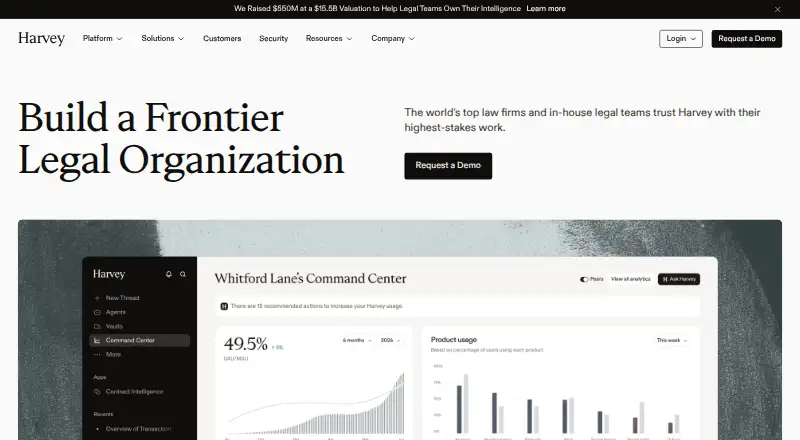
- Command Center provides adoption analytics, usage views and benchmarking for organizational rollouts.checked 15 Oct 2026
- Compliance
- Harvey lists SOC 2, CCPA, GDPR, AIUC-1, ISO 27001, ISO 27701 and ISO 42001 information on its platform site.checked 15 Oct 2026
- Contract Intelligence
- Contract Intelligence is designed for routine review, negotiation support and portfolio-level insights.checked 15 Oct 2026
- Customer support
- Harvey's support hub provides setup and admin guides, product help, integration articles, and ticket submission.checked 3 Oct 2026
- Data residency
- Harvey states that customers can keep data in EU or Switzerland, the United States, or Australia processing regions.checked 15 Oct 2026
- Data use
- Harvey says it does not use customer inputs, outputs, or uploaded documents to train underlying models by default.checked 3 Oct 2026
- Documentation
- The Help Center documents Assistant, Vault, Workflows, History and Library, plus uploading, retention, models, troubleshooting and MCP connections.checked 15 Oct 2026
- Funding news
- Harvey’s homepage announces a $550 million raise at a $15.5 billion valuation.checked 15 Oct 2026
- Integrations
- Officially listed integrations and context sources include Word, Outlook, iManage, LexisNexis, Rettsdata, NetDocuments, SharePoint, Google Drive, Aderant, Ironclad and APIs.checked 15 Oct 2026
- Intended users
- Harvey describes its customers as law firms, in-house legal teams, and legal and professional services organizations.checked 3 Oct 2026
- Knowledge
- Knowledge supports legal, regulatory and tax research across jurisdictions and domains.checked 15 Oct 2026
- Legal entity
- The platform agreement defines Harvey as Harvey AI Corporation, a Delaware corporation.checked 15 Oct 2026
- Legal research
- Harvey supports research across legal, regulatory, and tax questions, with more than 500 regional knowledge sources listed on its platform page.checked 3 Oct 2026
- License and hosting
- The commercial service is described as software-as-a-service, and its agreement prohibits attempts to reverse engineer the service or underlying systems.checked 15 Oct 2026
- Limit: accuracy
- G2 reviewers report that outputs sometimes require verification because of inaccuracies or hallucinations.checked 15 Oct 2026
- Limit: small-firm access
- A Reddit user reports that Harvey was not scheduling demos for small firms and describes the pricing as expensive and inflexible.checked 15 Oct 2026
The company
- Company facts
- LinkedIn lists Harvey as privately held, founded in 2022, headquartered in San Francisco and employing 1,001–5,000 people.checked 15 Oct 2026
- Headquarters
- United Stateschecked 23 Sep 2026
Money
- Limit: price transparency
- An independent review reports that Harvey publishes no rate, free tier or free trial and requires a sales conversation.checked 15 Oct 2026
The full review of Harvey
Overview
Harvey is a legal AI platform for firms and in-house teams whose work spans research, drafting, document analysis, and repeatable workflows. Its breadth is a strong fit for organizations with substantial legal workloads; teams that need a clearly priced, self-serve tool may prefer an alternative.
Key features
Harvey’s Assistant can answer questions, analyze documents, and draft or edit content, with links to the sources behind its answers. That source trail is valuable when lawyers need to check an output rather than rely on it at face value. Research covers legal, regulatory, and tax questions and draws on more than 500 regional knowledge sources.
Agents can plan and carry out complex legal work, while teams can use prepared workflows or build their own. This combination can support both common processes and work tailored to a particular organization, though it is most compelling for teams with enough recurring work to justify configuring workflows.
Vault organizes legal documents and supports bulk analysis across thousands of files, making it suited to large document sets. Matter workspaces, legal source access, document analysis, citations, and drafting tools round out its general legal offering.
Integrations include Microsoft Word, Outlook, iManage, NetDocuments, SharePoint, Google Drive, Aderant, Ironclad, email, and APIs. Native iOS and Android apps support queries, document scanning, call transcription, Vault access, and synced history. The range suits teams that work across existing systems and on mobile, rather than those seeking a narrowly focused research tool.
Pricing
Harvey is paid, with custom pricing. The Harvey plan requires a demo request; without a published price or seat and usage terms, prospective buyers should expect to discuss fit and cost directly before comparing budgets. There is no lower-cost plan or free-plan cap to weigh against the full offering.
That sales-led approach may suit organizations evaluating a platform across legal teams, but it is a drawback for individuals or smaller practices that want to compare fixed monthly costs before engaging.
Platforms
Harvey supports Android, iOS, web, API access, and an extension. Its native mobile apps add document scanning and call transcription alongside queries and access to Vault and synced history, while API and extension access can accommodate work beyond the browser.
Who it's for
Harvey is aimed at law firms, in-house legal departments, and legal and professional services organizations. It is best suited to teams that need several capabilities in one environment, especially research alongside document-heavy work and workflow automation. A buyer looking only for a simple, individually priced assistant may find its custom-pricing model and broad scope excessive.
Security controls include SAML single sign-on, audit logs, IP allow-listing, data lifecycle management, and 24/7 monitoring. Harvey says customer inputs, outputs, and uploaded documents are not used to train underlying models by default, and customers can keep data in the EU or Switzerland, the US, or Australia. Its security page lists SOC 2 II, CCPA, GDPR, AIUC-1, ISO 27001, ISO 27701, and ISO 42001. These controls and residency options are relevant for organizations with formal security and regional data requirements.
Pros and cons
- Pros: Legal research, source-linked answers, drafting, document analysis, and workflows sit in one platform, reducing the need to split those tasks across separate tools.
- Pros: Vault supports bulk analysis across thousands of documents, a practical strength for teams dealing with large collections.
- Pros: Broad integrations, mobile apps, regional data residency options, and listed security controls make it adaptable to organizational environments.
- Cons: Custom pricing requires a direct sales conversation, making early budget comparisons harder.
- Cons: Its wide feature set may be more than a solo practitioner or team with a single, narrow legal task needs.
Alternatives
For a paid legal AI option with a free trial and published Professional-plan limits of 5,000 credits per month, one seat, and 10,000 free upload pages per month before a 0.5-credit charge, consider Judicio; its listed platforms are macOS, web, and Windows. Choose Vincent by Clio if you want a paid option available on Android, iOS, and web.
OpusLaw is worth considering for buyers seeking a freemium web option; its listed Carta Actus plan costs $9.99 a month. LegitQuest also offers a freemium option, with web and API access and a free trial. For another paid web product, consider LegalFly.
Alice may suit teams looking for a paid product with a free trial across Linux, macOS, web, and Windows; its Core plan is €85 a month per user. Angus Intelligence is another paid option, with API, self-hosted, and web access and a Professional plan at $250 per seat per month. Trellis AI is an alternative for buyers considering a paid web product.
Browse the wider Legal AI Software category to compare more options.
Verdict
Harvey is a strong choice for law firms and in-house teams that want research, source-linked assistance, document work, and configurable workflows alongside broad integrations and organizational security controls. Its clearest drawback is the custom-pricing commitment: look elsewhere if a fixed price or a lightweight tool for one task matters more than a comprehensive platform.
Alternatives to Harvey
- 1

Clearbrief
Free planWebExtensionWindows7.5From $300 a month - 2
Zuva
Free planWebAPISelf-hosted7.5Free plan - 3

BriefCatch
WebExtensionmacOSWindows7.2From $60 a month - 4
Manupatra AI Search
AndroidiOSWebWindows6.9From ₹5,000 a year - 5
LegitQuest
WebAPI6.7 - 6

Alice
WebLinuxmacOSWindows6.6From €85 a month