Hadron
Hadron is an open-source, self-hosted system for storing events and coordinating multi-stage workflows.
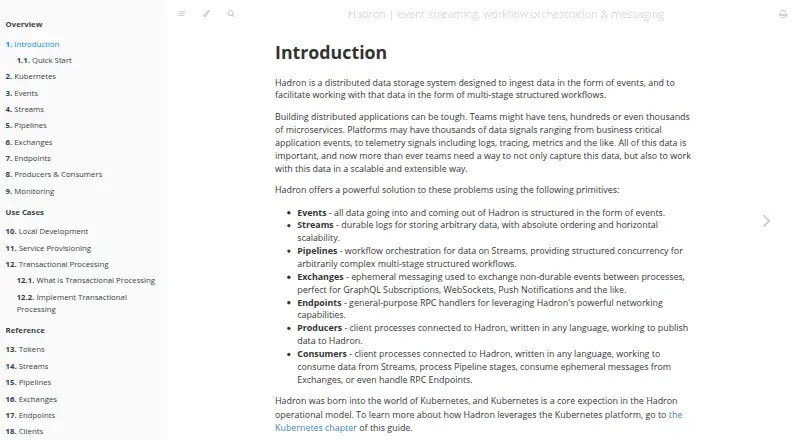
What Hadron is
Hadron is an open-source, self-hosted system for storing events and coordinating multi-stage workflows. Its Streams are immutable, append-only logs with ordering within each partition and horizontal scaling. Pipelines organize work over Stream data and can start when an event matches a configured type. Exchanges handle ephemeral messages, while Endpoints provide general-purpose RPC handlers. Hadron uses the CloudEvents 1.0 model for Stream records, Pipeline inputs and outputs, and ephemeral messages.
The system is designed for Kubernetes deployment and uses Helm and Kubernetes configuration resources. Stream retention can follow a configurable time policy that defaults to seven days, or keep data indefinitely; availability is maintained when at least one partition is running. Producers and Consumers can be written in any language, although the project lists a shared Rust client and CLI. Components expose Prometheus metrics over HTTP, with documented integration options for Prometheus scraping and the OTEL collector. Access Tokens produce JWTs signed with the Operator’s private RSA key, and permissions can be configured by resource. The CLI’s access from outside the Kubernetes cluster is still in progress, and Hadron Cloud is under construction.
Good
- Streams support horizontal scaling.
- Pipelines can trigger on matching event types.
- Retention can be time-limited or indefinite.
- Components expose Prometheus metrics over HTTP.
- Clients can be written in any language.
Watch out
- Deployment is designed for Kubernetes.
- The official shared client is Rust.
- CLI access from outside Kubernetes is in progress.
- Hadron Cloud is under construction.
Who it suits
Hadron suits teams building distributed applications with event or telemetry signals and multi-stage workflows, including those with many microservices. It is intended for self-hosted Kubernetes use.
Verdict
Hadron provides event storage, workflow orchestration, messaging, and RPC for Kubernetes deployments. Teams should account for its self-hosted model and the current limits on external CLI access and hosted service availability.
The facts
Each one read from Hadron's own pages, with the date it was checked.
What it does
- Access control
- Hadron authenticates with Tokens that produce JWTs signed with the Operator's private RSA key, with permissions configurable by resource.checked 4 Oct 2026
- Authentication
- Hadron authentication uses Tokens that the Operator processes into JWTs stored in Kubernetes Secrets.checked 11 Oct 2026
- CLI access limit
- The CLI documentation says access from outside the Kubernetes cluster is in progress.checked 11 Oct 2026
- Client library
- The official clients page lists a Rust client and says client libraries for other languages are planned as Hadron matures.checked 11 Oct 2026
- Clients
- Producers and Consumers can be written in any language, and the project maintains a shared Rust client and a CLI.checked 4 Oct 2026
- Event format
- Hadron uses CloudEvents 1.0 for data entering and leaving the system.checked 11 Oct 2026
- External access
- The CLI documentation says access from outside the Kubernetes cluster is in progress.checked 4 Oct 2026
- Hosted service
- The quick start describes Hadron Cloud as under construction and the hosted, fully managed option.checked 4 Oct 2026
- Hosted service status
- The quick start describes Hadron Cloud as under construction and hosted by the Hadron project team.checked 11 Oct 2026
- Installation
- The quick start installs the Hadron Operator with Helm and requires Helm version 3.7.0 or later for OCI usage.checked 11 Oct 2026
- Intended users
- The guide presents Hadron for distributed applications with many microservices and event or telemetry signals, and includes a local development use case.checked 11 Oct 2026
- Kubernetes
- Hadron is designed to run in Kubernetes, and its Operator manages cluster lifecycle tasks including upgrades, horizontal scaling, and access control.checked 11 Oct 2026
- Messaging and RPC
- Hadron describes Exchanges as ephemeral messaging between processes and Endpoints as general-purpose RPC handlers.checked 11 Oct 2026
- Monitoring
- Hadron components expose Prometheus metrics over HTTP, with documented integration options including Prometheus scraping and the OTEL collector.checked 4 Oct 2026
- Pipelines
- Pipelines orchestrate multi-stage workflows for Stream data, triggered when an event type matches a Pipeline trigger.checked 11 Oct 2026
- Product
- Hadron is a distributed data storage system for ingesting events and working with them in multi-stage structured workflows.checked 4 Oct 2026
- Purpose
- Hadron is a distributed event storage and messaging system for ingesting events and working with them in multi-stage workflows.checked 11 Oct 2026
- Retention
- Stream data retention supports a configurable time policy that defaults to seven days, or an indefinite retain policy.checked 4 Oct 2026
- Scaling and availability
- The documentation says Streams can scale horizontally and remain available when at least one partition is running.checked 4 Oct 2026
- Streams
- Streams are append-only immutable logs with absolute ordering per partition and configurable retention, which defaults to seven days.checked 11 Oct 2026
- TLS setup
- The quick start says cert-manager is optional and simplifies TLS certificate setup for Hadron's validating webhooks.checked 4 Oct 2026
Alternatives to Hadron
- 1

Aiven for Apache Kafka
Free planOpen sourceWebAPILinuxSelf-hosted7.9From $35 a month - 2
Apache RocketMQ
Free planOpen sourceAPILinuxmacOSSelf-hosted7.5Free plan - 3

Redpanda
Free planWebAPILinuxmacOS7.4Free plan - 4

Confluent Cloud
Free planWebAPILinux7.1From $385 a month - 5
Lightstreamer
Free planAndroidiOSWebAPI7.1Free plan - 6

Solace PubSub+ Event Broker
Free planWebAPILinuxSelf-hosted7.1Free plan