
Guardrails AI
Guardrails AI is an open-source Python framework for detecting, measuring, and reducing AI risks, as well as generating structured data from large language m…
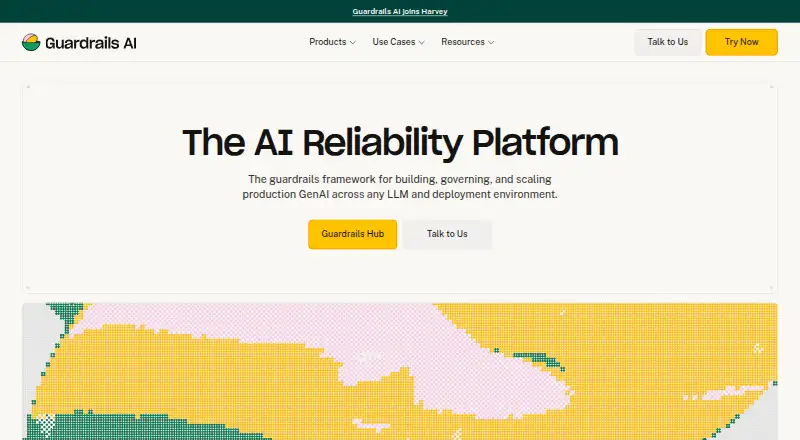
What Guardrails AI is
Guardrails AI is an open-source Python framework for detecting, measuring, and reducing AI risks, as well as generating structured data from large language models. It describes real-time protection against PII leaks, hallucinations, jailbreaks, and custom policy violations. Guardrails Hub offers more than 65 community-built validators for risks such as hallucinations, PII, jailbreaks, and content moderation. Validators are available as public PyPI packages without requiring an account or API key. The framework can run in a cloud environment or fully on-premises, works with any LLM, and is aimed at chatbots, RAG pipelines, and agent workflows. Its Detect PII validator uses Microsoft Presidio and can anonymize text when it identifies personal information. The maker says the framework is SOC 2 Type II certified and intended for regulated industries. Enterprise customers are stated to receive dedicated support and a 99.9% uptime SLA. Guardrails AI announced it joined Harvey on September 8, 2026.
Good
- Open-source Python framework.
- Works with any LLM.
- Runs in cloud or fully on-premises.
- More than 65 community-built validators.
- PII validator can anonymize detected text.
Watch out
- Enterprise support and uptime SLA are limited to enterprise customers.
- No price or pricing plan is stated.
Who it suits
Guardrails suits developers building chatbots, RAG pipelines, or agent workflows who need AI risk controls or structured LLM output. Its deployment options also suit teams that need cloud or on-premises operation.
Verdict
Guardrails combines risk detection and mitigation with structured-output support, and can run on-premises or in the cloud. Teams should consider whether its validator library covers their requirements.
The facts
Each one read from Guardrails AI's own pages, with the date it was checked.
The company
- Company status
- Guardrails AI announced that it joined Harvey, whose acquisition announcement is dated September 8, 2026.checked 5 Oct 2026
- Company update
- Guardrails AI announced on September 8, 2026 that it had joined Harvey; its post says the co-founders and team would join Harvey’s product and engineering organization.checked 4 Oct 2026
- Team and location
- The acquisition announcement describes Guardrails AI as San Francisco-based and says co-founders Shreya Rajpal and Zayd Simjee and the team joined Harvey's product and engineering organization.checked 5 Oct 2026
What it does
- Deployment
- Guardrails AI says the framework can run in a user's cloud or fully on-premises and supports chatbots, RAG pipelines, and agent workflows.checked 5 Oct 2026
- Enterprise support
- The AI Guardrails page states that enterprise customers receive dedicated support and a 99.9% uptime SLA.checked 4 Oct 2026
- Hub access
- Guardrails says API keys and accounts are no longer required to use its validators, which are available as public PyPI packages.checked 4 Oct 2026
- LLM and deployment support
- The framework says it works with any LLM and can run in a cloud environment or fully on-premises.checked 4 Oct 2026
- Model support
- The maker says Guardrails works with any LLM and names Meta and Anthropic as examples.checked 5 Oct 2026
- Open source
- Guardrails AI describes its framework as an open source, production-ready guardrails framework.checked 5 Oct 2026
- PII validator
- The Detect PII validator uses Microsoft Presidio and can anonymize text when it detects PII.checked 4 Oct 2026
- Pricing availability
- The official pages opened did not show a price or a pricing plan for Guardrails.checked 4 Oct 2026
- Product
- Guardrails is a Python framework for building reliable AI applications by detecting, quantifying, and mitigating risks and generating structured data from LLMs.checked 5 Oct 2026
- Purpose
- Guardrails is a Python framework that detects, quantifies, and mitigates AI risks and helps generate structured data from LLMs.checked 4 Oct 2026
- Release testing
- Snowglobe supports saved regression suites and error-rate tracking across repeated conversations per build.checked 5 Oct 2026
- Runtime protection
- The framework provides low-latency, real-time protection against PII leaks, hallucinations, jailbreaks, and custom policies.checked 5 Oct 2026
- Security and compliance
- The maker describes its framework as putting safety, compliance, and policy enforcement at the center of AI workflows.checked 5 Oct 2026
- Security claims
- The AI Guardrails page states that Guardrails is SOC 2 Type II certified and designed for regulated industries with strict data handling requirements.checked 4 Oct 2026
- Snowglobe connection
- Snowglobe connects to conversational agents through an API or SDK.checked 5 Oct 2026
- Snowglobe outputs
- Snowglobe can export eval datasets and clean JSONL fine-tuning data, including preference pairs and critique-and-revise triples.checked 5 Oct 2026
- Snowglobe simulation
- Snowglobe simulates varied user personas, intents, tones, goals, and adversarial tactics to expose chatbot failures and generate judge-labeled datasets.checked 5 Oct 2026
- Supported workflows
- The site names chatbots, RAG pipelines, and agent workflows as use cases.checked 4 Oct 2026
- Validator library
- Guardrails Hub lists 65 validators covering risks and tasks such as PII, jailbreaks, toxicity, factuality, formatting, and SQL validation.checked 5 Oct 2026
Alternatives to Guardrails AI
- 1

Enkrypt AI Guardrails
Free planWebAPISelf-hosted6.8From $1,608 a year - 2

GuardionAI
WebAPILinuxmacOS6.8 - 3

Azure AI Speech
Free planWebAPISelf-hosted6.7Free plan - 4
Silker AI Mobile Security
AndroidiOSWeb6.6From $19.50 a month - 5
Google Cloud Secret Manager
Free planWeb6.5From $0.02 a month - 6

Qpoint
Free planWebLinuxmacOSWindows6.5Free plan