
GripMock
GripMock is a free, open-source mock server for gRPC services.
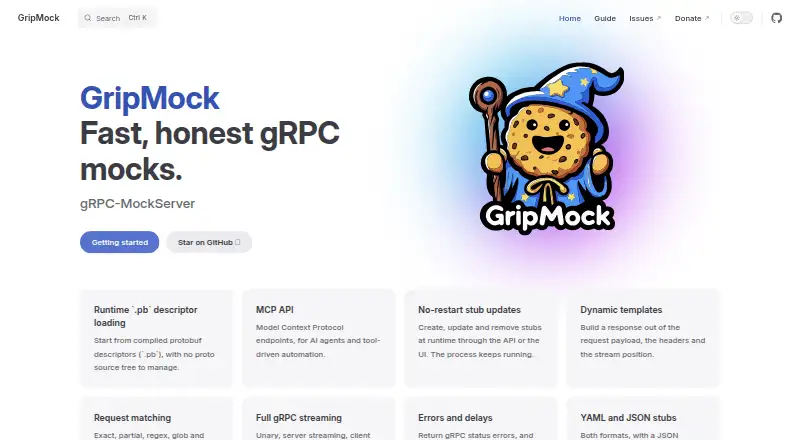
What GripMock is
GripMock is a free, open-source mock server for gRPC services. It returns responses defined in YAML or JSON, so a backend is not required. It can load .proto files or compiled .pb descriptors, including descriptors supplied to a running server without restarting it. Stub rules can match requests by input and headers, using conditions such as exact, partial, regex, glob, or any-of matching. GripMock supports unary, server-streaming, client-streaming, and bidirectional calls. Templates can build responses from request payloads, headers, and stream position, while stubs can also return gRPC errors or delayed responses for timeout checks. A web dashboard lists loaded and matched stubs and allows editing while the server runs. Installation options include Docker, release binaries, Homebrew, shell scripts, and Go; a Go SDK can run GripMock inside a test process. Additional capabilities include native TLS, optional mutual TLS, OTLP traces, a metrics endpoint, and MCP endpoints for AI agents and automation. It is MIT-licensed and can be used in local development, CI, and containerized test environments.
Good
- Mocks unary and all listed streaming call types.
- Edits stubs in a dashboard without restarting.
- Loads descriptors into a running server.
- Offers native TLS and optional mutual TLS.
- Free and MIT-licensed.
Watch out
- Requires users to provide mock responses in YAML or JSON.
- The documentation directs bug reports and questions to GitHub issues.
Who it suits
GripMock suits developers who need a gRPC mock server for local development, CI, or containerized tests. It can also fit workflows that need streaming calls, runtime stub editing, or TLS options.
Verdict
GripMock provides configurable gRPC responses, several stub-matching options, and runtime editing through a dashboard. Its installation and embedded SDK options support different development and test setups.
The facts
Each one read from GripMock's own pages, with the date it was checked.
What it does
- AI tooling
- GripMock provides Model Context Protocol endpoints for AI agents and tool-driven automation.checked 30 Sep 2026
- Deployment
- The project documents installation through Docker, release binaries, Homebrew, shell script, and Go install.checked 30 Sep 2026
- Descriptors
- GripMock can load compiled .pb descriptors, including from a running server without restarting it.checked 30 Sep 2026
- Dynamic responses
- Dynamic templates can build responses from request payloads, headers, and stream position.checked 30 Sep 2026
- Embedded SDK
- A Go SDK runs GripMock inside the test process, without starting a container or external binary.checked 30 Sep 2026
- Failure testing
- Stubs can return gRPC status errors or delay responses to exercise client timeouts.checked 30 Sep 2026
- Integrations
- The documentation lists a Model Context Protocol API, an official GitHub Actions integration, and OpenTelemetry trace export over OTLP.checked 30 Sep 2026
- Intended use
- The project describes Docker use for local development, CI, and containerized test environments.checked 30 Sep 2026
- License
- The project is released under the MIT License.checked 30 Sep 2026
- Matching
- Stub matching supports exact, partial, regex, glob, and header matching, with priority rules.checked 30 Sep 2026
- Metrics
- GripMock exposes a `/metrics` endpoint for Prometheus scraping.checked 30 Sep 2026
- Observability
- It can export traces over OTLP and exposes a /metrics endpoint for scraping.checked 30 Sep 2026
- Protocol files
- It can load `.proto` files or compiled `.pb` descriptors, including descriptors pushed to a running server without restarting it.checked 30 Sep 2026
- Purpose
- GripMock is a mock server for gRPC services that serves responses defined in YAML or JSON without a backend.checked 30 Sep 2026
- Runtime dashboard
- The dashboard at `http://localhost:4771/` lists loaded and matched stubs and allows editing without restarting the server.checked 30 Sep 2026
- Runtime editing
- The web dashboard can create, edit, and delete stubs, and show used and unused stubs.checked 30 Sep 2026
- Schema registry
- GripMock can start from a Buf Schema Registry module reference.checked 30 Sep 2026
- Security
- GripMock supports native TLS for gRPC and optional mutual TLS client-certificate authentication.checked 30 Sep 2026
- Streaming
- It supports unary, server-streaming, client-streaming, and bidirectional gRPC calls.checked 30 Sep 2026
- Stub matching
- Stubs can match requests by input and headers using equals, contains, matches, anyOf, and glob rules.checked 30 Sep 2026
- Support
- The documentation directs bug reports and questions to GitHub issues.checked 30 Sep 2026
- What it does
- GripMock is a mock server for gRPC services that serves responses defined in YAML or JSON without requiring a backend.checked 30 Sep 2026
The full review of GripMock
Overview
GripMock is a self-hosted mock server for teams building or testing gRPC services, especially when a live backend is unavailable or undesirable. Its strongest case is controlled testing: it can model request-dependent replies, streaming calls, and failure conditions without requiring a backend.
Deployment choices span standalone installations and a Go SDK embedded in the test process, though users should expect to run and manage the server themselves.
Key features
Matching and response control
Stubs can match request inputs and headers with exact, partial, regex, glob, and any-of rules, and priorities help decide between overlapping matches. This range supports tests that need to distinguish realistic request variants rather than return one fixed response. Dynamic templates can use payloads, headers, and stream position, while configurable status errors and delays let teams cover client error handling and timeout behavior.
Streaming and live editing
Support for unary, server-streaming, client-streaming, and bidirectional calls makes GripMock relevant beyond simple request-response tests. Its dashboard at http://localhost:4771/ shows loaded and matched stubs, including which remain unused, and permits creating, editing, and deleting stubs while the server runs. That is useful when adjusting a scenario during development, but it does not remove the need to own the server setup.
Service definitions and integrations
GripMock accepts .proto files and compiled .pb descriptors, including descriptors pushed from a running server without restarting it. It can also start from a Buf Schema Registry module reference. Docker, Homebrew, release binaries, shell script, and Go installation cover varied workflows, and an official GitHub Actions guide helps fit it into CI. A Go SDK can run GripMock inside the test process without a separate container or binary, a practical option for Go test suites that want fewer external moving parts.
Native gRPC TLS and optional mutual TLS client-certificate authentication address encrypted and certificate-authenticated setups. OTLP trace export and a Prometheus-scrapable /metrics endpoint provide observability hooks. MCP endpoints extend it to AI-agent and tool-driven automation, while gRPC-Web support and server reflection broaden its protocol-related capabilities.
Pricing
GripMock is free and open source under the MIT License, with no paid tiers or seat and quota distinctions described. That makes it straightforward to use across local development and CI without a software license cost; the trade-off is self-hosting and handling the server as part of your test environment. Bug reports and questions go through GitHub issues.
Platforms
GripMock is listed for Linux, macOS, and Windows, as well as web, API, and self-hosted use. The dashboard is accessed through the running server, while installation options include Docker, binaries, Homebrew, shell script, and Go.
Who it's for
GripMock suits gRPC developers and test engineers who need repeatable backend-independent scenarios, particularly teams covering streaming behavior, matching edge cases, failures, or timeouts. CI users can follow the Docker workflow, while Go teams can embed it in tests. It is a weaker fit for someone seeking a hosted mock service or a graphical gRPC client rather than a server they operate.
Pros and cons
- Pros: Flexible matching, dynamic replies, and error or delay controls support more varied tests than fixed-response stubs.
- Pros: All four gRPC call patterns are supported, with live dashboard editing and visibility into unused stubs.
- Pros: Multiple install paths, a Go SDK, GitHub Actions guidance, and schema-registry support fit different development and CI setups.
- Cons: The self-hosted deployment model means users must arrange and maintain the server environment.
- Cons: Questions and bug reports are directed to GitHub issues, rather than a stated dedicated support channel.
Alternatives
For a gRPC client interface rather than a mock server, consider grpcui, a free, MIT-licensed option for Linux, macOS, Windows, web, and self-hosted use. Kreya is another client-oriented alternative, with a free individual plan that limits request history to the latest request; it is freemium and not open source.
BloomRPC Extended is a free desktop alternative for Linux, macOS, and Windows. FintX offers a free open-source plan with unlimited gRPC clients, request autosave, import/export, per-method tabs, a JSON editor, and projects on Linux, macOS, and Windows.
Bandura provides a free plan for personal and commercial use without accounts, paid seats, or feature tiers, and lists a separate commercial licence. Evans is a free open-source gRPC client for Linux, macOS, and Windows; grpcmd is a free option for those same desktop platforms. ProtoCall is a freemium alternative for web, Windows, macOS, and Linux.
Browse more options in gRPC Tools.
Verdict
Choose GripMock if your priority is a self-hosted gRPC mock server with nuanced matching, streaming coverage, and practical failure controls. Its free MIT licensing and in-process Go SDK make it particularly compelling for development and automated tests. Look elsewhere if you need a hosted service or a gRPC client rather than a server to integrate into your environment.
Alternatives to GripMock
- 1
Kreya
Free planLinuxmacOSWindows7.1Free plan - 2

Bandura
Free planLinuxmacOSSelf-hostedWindows6.7$59 one-time - 3
grpcmd
Free planLinuxmacOSWindows6.7From $9 a year - 4

FintX
Free planLinuxmacOSWindows6.6Free plan - 5
grpcui
Free planWebLinuxmacOSSelf-hosted6.6Free plan - 6
protoc-gen-doc
Free planLinuxmacOSSelf-hostedWindows6.5Free plan