
GPT Store
GPT Store lets signed-in ChatGPT users find and use GPTs, which are versions of ChatGPT set up for particular purposes.
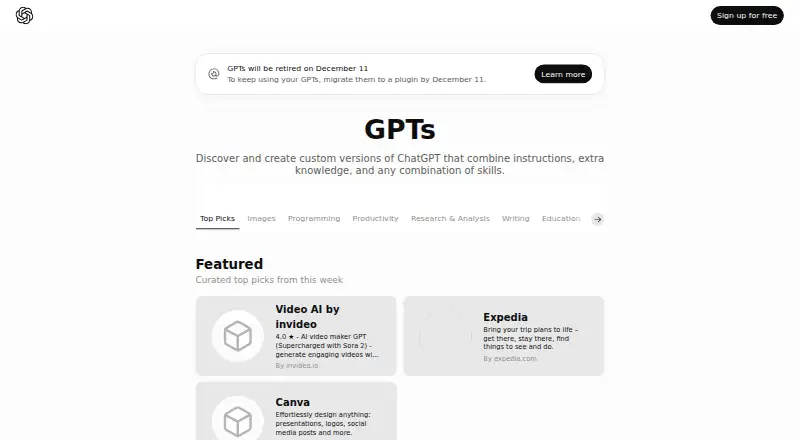
What GPT Store is
GPT Store lets signed-in ChatGPT users find and use GPTs, which are versions of ChatGPT set up for particular purposes. The Store features community and partner GPTs in categories such as writing, research, programming, education, and lifestyle. Users can also open GPTs through direct links or workspace settings. A GPT may use instructions, conversation starters, uploaded reference files, and capabilities such as web search or image generation. It can connect to outside services through apps or external API actions, but cannot use both in the same GPT. GPTs operate within ChatGPT and cannot be embedded in an external website or application. Each conversation starts without saved memory, custom instructions, or earlier conversations. Builders cannot see users’ individual conversations with their GPTs. If a GPT uses an app or external API, relevant input may be sent to that service. Publishing is unavailable to personal Free, Go, Plus, and Pro accounts; managed-workspace publishing depends on settings and permissions. Free access is listed, with limits on messages, uploads, image creation, and voice chats. OpenAI says retirement is planned for affected Enterprise workspaces on December 11, 2026.
Good
- Free access for signed-in users.
- Store includes five listed categories.
- GPTs can use uploaded reference files.
- Users can open GPTs through direct links.
- Builders cannot view individual user conversations.
Watch out
- Free access has message and creation limits.
- Personal Free, Go, Plus, and Pro accounts cannot publish GPTs.
- GPTs cannot be embedded in external websites or apps.
- Retirement is planned for affected Enterprise workspaces.
Who it suits
GPT Store suits ChatGPT users seeking purpose-specific assistants for areas such as writing, research, programming, education, or lifestyle. It can also suit builders who want to configure GPTs for use within ChatGPT, subject to publishing eligibility.
Verdict
GPT Store offers purpose-configured assistants for use within ChatGPT, with options to add knowledge, capabilities, or service connections. Check the publishing restrictions, data-sharing implications, and stated Enterprise retirement plan before relying on a GPT.
Plans and prices
From GPT Store's own pricing page, checked 30 Sep 2026.
| Plan | Price | What it gives you |
|---|---|---|
| Free | Free | GPT Store access for signed-in users · limited messages with uploads · limited image creation · limited voice chats |
| Go | — | More messages with tools · more uploads · more image creation · more voice chats · longer memory · per month |
| Plus | — | Advanced reasoning models · expanded messages and uploads · custom GPTs · limits apply · per month |
| Pro | — | Three usage tiers · expanded custom GPTs · unlimited features subject to abuse guardrails · per month |
The facts
Each one read from GPT Store's own pages, with the date it was checked.
What it does
- Browse and use
- Signed-in ChatGPT users can browse public GPTs, direct links, and GPTs shared with them or available through workspace settings.checked 30 Sep 2026
- Configuration
- A GPT can include instructions, conversation starters, uploaded reference files, capabilities such as web search or image generation, apps, or external API actions.checked 30 Sep 2026
- External deployment
- GPTs are designed to work in ChatGPT and cannot be embedded in an external website or application; OpenAI directs builders to its API for that use.checked 30 Sep 2026
- Integrations
- GPTs can connect to outside services through apps or to external APIs through actions, but a GPT can use apps or actions, not both at once.checked 30 Sep 2026
- Privacy
- GPT builders cannot view individual conversations users have with their GPTs.checked 30 Sep 2026
- Publishing eligibility
- Personal Free, Go, Plus, and Pro accounts cannot publish new GPTs; publishing in managed workspaces depends on workspace settings and permissions.checked 30 Sep 2026
- Purpose
- GPTs are ChatGPT versions configured for specific purposes using instructions, knowledge, and selected capabilities.checked 30 Sep 2026
- Retirement notice
- OpenAI says custom GPTs are planned for retirement, with retirement planned for affected Enterprise workspaces on December 11, 2026.checked 30 Sep 2026
- Store discovery
- The Store features GPTs from partners and the community, with categories including writing, research, programming, education, and lifestyle.checked 30 Sep 2026
- Third-party data
- When a GPT uses an app or external API, relevant input may be sent to that service, whose data handling OpenAI does not audit or control.checked 30 Sep 2026
- Training controls
- Business, Enterprise, and Edu data is not used for model training by default; consumer plan conversations may be used depending on opt-out settings.checked 30 Sep 2026
- Use limits
- GPTs do not use saved memory, custom instructions, or previous conversations, and each conversation starts fresh.checked 30 Sep 2026
The company
- Maker history
- OpenAI says it was founded in 2015 as a nonprofit.checked 30 Sep 2026
The full review of GPT Store
GPT Store is a catalog of purpose-configured assistants inside ChatGPT. It suits signed-in users looking for a ready-made helper or a no-code way to shape one; its chief appeal is variety, while its limits around publishing, continuity, and deployment matter for anyone building a lasting workflow.
Overview
The Store brings together partner and community GPTs across writing, research, programming, education, and lifestyle. Signed-in ChatGPT users can browse public GPTs, open direct links, or use GPTs shared with them or made available through workspace settings. That makes it a useful starting point for finding an assistant for a particular task without building from scratch.
GPTs are configured versions of ChatGPT, built around specific purposes with instructions, knowledge, and selected capabilities. They remain tied to ChatGPT, however: each conversation starts fresh, and GPTs do not draw on saved memory, custom instructions, or previous conversations. Builders who need to put an assistant on an external site or app will need OpenAI's API instead.
Key features
Builders can combine instructions and conversation starters with uploaded reference files, capabilities such as web search or image generation, and connections to outside services. Apps connect a GPT to services, while actions connect it to external APIs; a GPT can use one approach or the other, not both at once. This offers meaningful flexibility for no-code assistants, but the integration choice is a constraint for designs that need both.
Builders cannot see individual conversations users have with their GPTs. That protects users from direct conversation access by the creator, but it does not mean every interaction stays within ChatGPT: when a GPT uses an app or external API, relevant input may go to that service, whose data handling OpenAI does not audit or control.
Business, Enterprise, and Edu data is not used for model training by default. Consumer conversations may be used depending on opt-out settings, so users handling sensitive material should consider both their plan's training controls and any third-party connections.
Pricing
GPT Store access is free for signed-in users on the Free plan. Free costs nothing and includes limited messages with uploads, limited image creation, and limited voice chats. It is enough to explore GPTs, but the stated usage limits make it less suited to sustained, high-volume use.
ChatGPT Go has custom pricing, billed per month. It provides more messages with tools, uploads, image creation, and voice chats, along with longer memory. Plus also has custom pricing, billed per month; it adds advanced reasoning models, expanded messages and uploads, and custom GPTs, subject to limits. Pro has custom pricing, billed per month, and offers three usage tiers, expanded custom GPTs, and unlimited features subject to abuse guardrails. Go fits users seeking more headroom, Plus those wanting stronger reasoning and custom GPTs, and Pro users seeking the broadest stated usage. Personal Free, Go, Plus, and Pro accounts cannot publish new GPTs, so paying for these consumer plans does not solve that publishing restriction.
GPT Store access is free to use, but publishing from managed workspaces depends on workspace settings and permissions. That distinction matters to creators: browsing and using GPTs is broadly accessible to signed-in users, while publication requires an eligible route.
Platforms
GPTs are available through ChatGPT on the web, iOS, and Android, as well as through direct GPT links. They are not designed for embedding in external websites or applications, and there is no API access for GPT Store itself.
Who it's for
GPT Store works best for ChatGPT users who want a specialized assistant without code, or builders who want to configure one with reference files, capabilities, or a service connection. It is a weaker fit for personal-account creators who need to publish, teams requiring persistent context across conversations, or anyone who needs to deploy an assistant outside ChatGPT. OpenAI says custom GPTs are planned for retirement in affected Enterprise workspaces on December 11, 2026, a material caveat for organizations considering them as a long-term foundation.
Pros and cons
- Pros: Partner and community GPTs span several useful categories, giving users a ready-made option for focused tasks.
- Pros: No-code configuration can combine instructions, files, capabilities, and either apps or API actions.
- Pros: GPT builders cannot view individual user conversations.
- Cons: Conversations start fresh and cannot use saved memory, custom instructions, or prior chats.
- Cons: Personal Free, Go, Plus, and Pro users cannot publish new GPTs.
- Cons: Third-party app or API connections may receive relevant input, and their data handling is outside OpenAI's audit and control.
- Cons: GPTs cannot be embedded outside ChatGPT, and Enterprise retirement is planned for affected workspaces.
Alternatives
For a broader directory of agent marketplaces, browse AI Agent Marketplaces.
Choose Poe instead if you want a freemium service available across Android, iOS, macOS, Windows, web, and API. Its Free plan is free and includes a 200k-token context length.
AGENTIS is another freemium option, available on web and API.
Relevance AI offers a web-based Free plan at no cost with 100 credits per day, one user, and 10MB of knowledge.
AgenMart has a web-based free tier with 10,000 words of AI text usage per month and basic content optimization.
DeepNLP AI Agent Marketplace offers a free web and API plan to explore live agents across 30+ categories, with one agent deployment hosting and a live subdomain.
Microsoft 365 Copilot Agent Store is a paid alternative available across Android, iOS, macOS, web, and Windows; its Microsoft 365 Copilot Business plan is $21 a month, billed yearly, with an annual subscription that auto-renews and supports up to 300 users.
Oracle JD Edwards EnterpriseOne is a paid alternative with no free plan and web, iOS, and Android access.
AiCrate is a paid web option with a free trial; its Basic plan costs $9.99 a month and allocates 500 credits monthly.
Verdict
Choose GPT Store if you want to find or configure a task-specific assistant for use inside ChatGPT, especially when a ready-made GPT or simple no-code setup is enough. Look elsewhere if publishing from a personal account, persistent conversation context, or external deployment is essential; the Enterprise retirement plan is another reason not to make it the foundation of a long-lived workspace workflow.
Getting started
- Open the GPT Store at https://chatgpt.com/gpts.
- Sign in to ChatGPT to browse public GPTs.
- Choose a GPT in a Store category or open a direct GPT link.
- Use it through ChatGPT on the web, iOS, or Android.
Limits worth knowing
The Free plan includes limited messages with uploads, image creation, and voice chats. GPT conversations do not use saved memory, custom instructions, or previous conversations.
Questions
Is GPT Store free to use?
A Free plan is available at no cost. Signed-in users can access GPT Store, with limits on messages with uploads, image creation, and voice chats.
Which platforms support GPT Store?
GPT Store is available through ChatGPT on the web, Android, and iOS.
Can personal accounts publish GPTs?
Personal Free, Go, Plus, and Pro accounts cannot publish new GPTs. Publishing in managed workspaces depends on workspace settings and permissions.
Can a GPT connect to other services?
A GPT can connect through apps or external API actions, but it cannot use both at once. Relevant input may be sent to that service, whose data handling OpenAI does not audit or control.
Can GPT Store assistants be embedded in another app or website?
No. GPTs are designed for ChatGPT and cannot be embedded in an external website or application.
Who makes GPT Store, and what is its retirement notice?
GPT Store is part of ChatGPT, made by OpenAI, which says it was founded in 2015 as a nonprofit. OpenAI says retirement is planned for affected Enterprise workspaces on December 11, 2026.
Alternatives to GPT Store
- 1

Relevance AI
Free planWeb7.4From $19 a month - 2

Poe
Free planAndroidiOSWebAPI7.2Free plan - 3

AGENTIS
Free planWebAPI6.7From 36 ZAR a month - 4

AgenMart
Free planWeb6.5From $23 a month - 5
DeepNLP AI Agent Marketplace
Free planWebAPI6.5From $99 a year - 6

AiCrate
Web6.2From $99.99 a year