Gjalla
Gjalla is a free, open-source guitar amp simulator aimed at black metal and other raw styles.
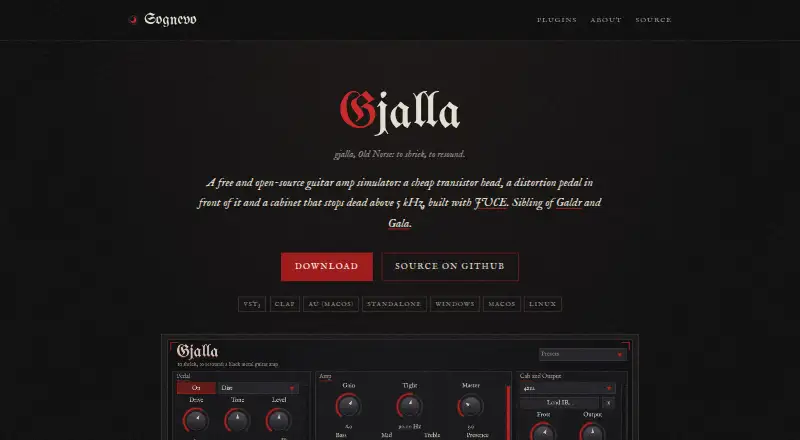
What Gjalla is
Gjalla is a free, open-source guitar amp simulator aimed at black metal and other raw styles. Its signal path includes input trim, noise gate, pedal, preamp, tone stack, power section, presence, cabinet, frost and output trim. The pedal has three voicings: 90s-style distortion, an HM-2-style chainsaw sound and starved transistor fuzz. Users can choose among three analytic cabinet voicings, load WAV or AIFF impulse responses up to 2 seconds, or disable the cabinet to use an external IR loader. Six factory presets, input and output meters, editable knob values, undo and redo, tooltips and a resizable interface are included. Gjalla reports 6 samples of latency to the host, stated as 0.13 ms at 48 kHz. Plugin formats are VST3 and CLAP, with AU on macOS; standalone builds are available for Windows, macOS and Linux. The software is licensed under GNU GPL version 3.0 or later. There is no packaged release yet: users are directed to build it from source or follow the GitHub releases page. A source build requires Git, CMake 3.22 or later and a C++20 compiler. The maker says it has no telemetry, network access, update checks or accounts.
Good
- Three pedal voicings and three cabinet voicings.
- Loads WAV or AIFF impulse responses up to 2 seconds.
- Available as plugin and standalone builds.
- No telemetry, network access, update checks or accounts.
Watch out
- No packaged release is available yet.
- Building requires Git, CMake 3.22 or later and C++20.
Who it suits
Gjalla suits guitarists seeking a free amp simulator focused on black metal and raw tones, whether as a plugin or standalone application. Building from source is currently necessary to use it, according to the maker.
Verdict
Gjalla offers a focused signal chain, cabinet choices and impulse-response loading across plugin and standalone formats. Its lack of a packaged release means users need to build from source for now.
Plans and prices
From Gjalla's own pricing page, checked 8 Oct 2001.
| Plan | Price | What it gives you |
|---|---|---|
| Free | Free | Free and open-source; GPLv3 or later |
The facts
Each one read from Gjalla's own pages, with the date it was checked.
What it does
- Build requirements
- Building from source requires Git, CMake 3.22 or later, and a C++20 compiler.checked 8 Oct 2001
- Cabinets and IRs
- It includes three analytic cabinet voicings and can load WAV or AIFF impulse responses up to 2 seconds, or disable the cabinet for an external IR loader.checked 8 Oct 2001
- Download status
- The maker says there is no packaged release yet and directs users to build Gjalla from source or watch the GitHub releases page.checked 8 Oct 2001
- Formats and operating systems
- It offers VST3, CLAP, AU on macOS, and standalone builds for Windows, macOS, and Linux.checked 8 Oct 2001
- Integrations
- Gjalla can be loaded in a DAW as VST3, CLAP, and, on macOS, AU; it also has a standalone version.checked 8 Oct 2001
- Latency
- The simulator reports 6 samples of latency to the host, stated as 0.13 ms at 48 kHz.checked 8 Oct 2001
- License
- Gjalla is licensed under the GNU GPL version 3.0 or later.checked 8 Oct 2001
- Pedal voicings
- The pedal has three voicings: a 90s distortion style, an HM-2 style chainsaw, and starved transistor fuzz.checked 8 Oct 2001
- Presets and controls
- It includes six factory presets, input and output meters, editable knob values, undo and redo, and a resizable GUI with tooltips.checked 8 Oct 2001
- Privacy
- The maker states that Gjalla has no telemetry, network access, update checks, or accounts.checked 8 Oct 2001
- Signal chain
- Its processing chain includes input trim, noise gate, pedal, preamp, tone stack, power section, presence, cabinet, frost, and output trim.checked 8 Oct 2001
- Support
- The maker invites users to open an issue on the plugin repository or email [email protected] for problems or feature requests.checked 8 Oct 2001
- What it does
- Gjalla is a free, open-source guitar amp simulator aimed at black metal and other raw styles.checked 8 Oct 2001
The company
- Maker and audience
- Sognevo describes itself as a one-person project making free, open-source audio plugins for black metal and other dark music.checked 8 Oct 2001
The full review of Gjalla
Gjalla is a free, open-source guitar amp simulator for black metal and other raw styles. It suits guitarists and producers seeking an intentionally abrasive signal path, impulse-response flexibility, and both plug-in and standalone operation on desktop systems. Its specialized voicings and privacy-first design are compelling, but obtaining it currently requires a source build rather than a ready-made installer.
Overview
Gjalla lays out a complete guitar-processing route: input trim, noise gate, pedal, preamp, tone stack, power section, presence, cabinet, frost, and output trim. That structure lets you shape the sound across the main gain, equalization, power-amp, ambience and output stages instead of relying on one simplified amp control. The focus is clearly aggressive and dark production, so it is a better fit for extreme textures than for players wanting a broad collection of conventional clean and boutique amp sounds.
Sognevo is a one-person project dedicated to free, open-source audio plugins for black metal and related dark music. Gjalla is released under the GNU GPL version 3.0 or later. The maker states that the software has no telemetry, network access, update checks, or accounts, which benefits privacy-conscious musicians and anyone who wants software that can be built and inspected independently.
Key features
Specialized distortion chain
The pedal section provides three deliberately different starting points: a 1990s distortion voicing, an HM-2-style chainsaw voicing, and starved-transistor fuzz. These cover abrasive saturation, the cutting chainsaw character associated with extreme metal, and degraded, sputtering fuzz. They are useful when a narrow set of harsh sounds is exactly what you need, but they do not substitute for a large pedal catalogue if your work spans many genres.
Cabinets and impulse responses
Three analytic cabinet voicings are included, and Gjalla can load WAV or AIFF impulse responses up to two seconds. You can also bypass its cabinet section when using an external IR loader. That combination gives beginners usable internal options while allowing experienced producers to bring established cabinet captures into the chain. The two-second ceiling is ample for typical cabinet impulses, though users with longer convolution material will need another approach.
Workflow and latency
Six factory presets provide starting points, while input and output meters make level management visible. Knob values are editable, and undo and redo reduce the cost of experimentation. A resizable interface with tooltips makes the controls more practical to learn. The host-reported latency is six samples, stated as 0.13 ms at 48 kHz, so the design is suitable for responsive tracking where monitoring delay matters.
Formats and availability
Gjalla loads as VST3 and CLAP, with AU support on macOS, and it also runs as a standalone application. Windows, macOS, and Linux are supported. The important qualification is distribution: there is no packaged release yet. Users must build from source or monitor the GitHub releases page. A source build requires Git, CMake 3.22 or later, and a C++20 compiler, which makes Gjalla a better fit for technically comfortable users than for anyone expecting a conventional download-and-install process.
Pricing
The Free plan costs nothing and includes the free, open-source GPLv3-or-later software. There is no free trial because the product itself is free, and no paid tier, seat charge, renewal, or usage quota is stated. This is the straightforward choice for anyone willing to build the application and work within its focused feature set; users who need a packaged installer are paying in setup effort rather than money.
Platforms
Gjalla supports Windows, macOS, and Linux. On desktop DAWs it is available in VST3 and CLAP, plus AU on macOS, and a standalone build is provided for all three operating systems. The broad operating-system coverage is valuable for mixed-platform studios, while the missing packaged release remains the main practical obstacle.
Who it's for
Choose Gjalla if you make black metal or other raw music, want HM-2-style, vintage-distortion, or starved-fuzz directions, and value direct control over cabinets and impulse responses. It also fits privacy-conscious users who do not want accounts, telemetry, network access, or update checks, and open-source users comfortable with GPL software and source compilation. Look elsewhere if you need extensive genre-spanning amp libraries, a polished installer, or a workflow built around commercial support and ready-to-run releases.
Pros and cons
- Pros: Focused pedal voicings target harsh and degraded tones rather than generic presets.
- Pros: WAV and AIFF IR loading, three analytic cabinets, and cabinet bypass support both included and external speaker workflows.
- Pros: Six-sample reported latency, meters, editable values, undo/redo, tooltips, and a resizable GUI support practical recording work.
- Pros: Free GPLv3-or-later licensing, no accounts, and no telemetry or network behavior reduce cost and privacy concerns.
- Cons: No packaged release means building with Git, CMake 3.22 or later, and a C++20 compiler before use.
- Cons: The sound palette is intentionally narrow, so it is not a replacement for a broad amp-and-effects collection.
Alternatives
Amp Locker is the better pick when you want a free Linux, macOS, or Windows starting point with a Prestige 1950 amp, seven pedals, and seven rack effects, plus individually purchasable modules you own outright.
GENOME suits users who want a free introductory tier with four TSM-Ai amplifiers, 14 pedals, five DynIR cabinets, and four studio effects, with a paid full edition at 89.99 USD once.
Neural Amp Modeler is worth choosing for a free, open-source amp-modeling project with Linux, macOS, Windows, and web support.
AmpForge is another free, open-source plugin for Linux, Windows, and macOS.
Soundshed Guitar is a free cross-platform option released under the AGPL-3.0 license, with no licensing or extra purchases.
Amped makes more sense if you prefer a free single-amp Roots edition and an optional commercial library, while Amplifikation 360 is the alternative for a freemium commercial ecosystem from Kuassa.
Browse all guitar amp software for a wider category comparison.
Verdict
Gjalla is an excellent match for technically confident extreme-metal guitarists who want a free, private, open-source simulator with targeted distortion voicings, IR support, and genuinely low reported latency. Choose it for that focused signal chain and flexible cabinet workflow; choose another amp suite if building from source or working within a deliberately narrow raw-metal palette is a deal-breaker.
Alternatives to Gjalla
- 1
Amped
Free planAPImacOSWindows7.3€39.99, paid once - 2

Helix Stadium Native
Free planAPImacOSWindows7.3$99.99, paid once - 3
IK Multimedia ReSing
Free planmacOSWindows7.3$129.99, paid once - 4

GENOME
Free planiOSmacOSWindows6.9$89.99, paid once - 5
Amp Locker
Free planLinuxmacOSWindows6.6From $5 a month - 6

Amplifikation 360
Free planmacOSWindows6.6$25, paid once