GEPA
GEPA is a free, open-source engine for optimizing prompts, code, configurations, agent architectures, policies, and other artifacts expressed as text.
What GEPA is
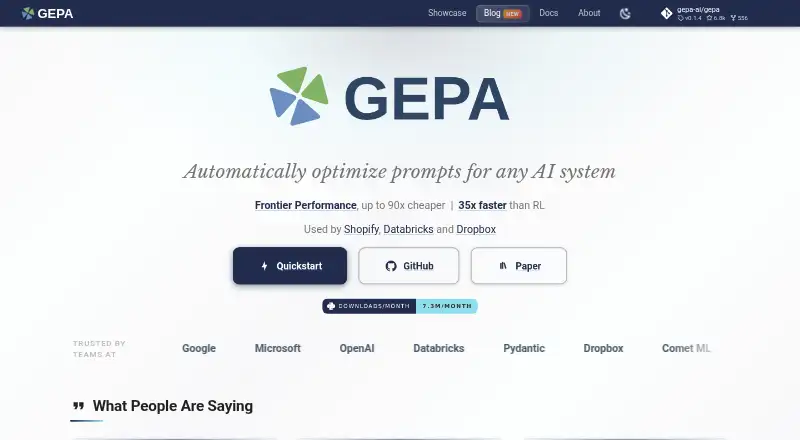
GEPA is a free, open-source engine for optimizing prompts, code, configurations, agent architectures, policies, and other artifacts expressed as text. It uses execution traces and evaluator feedback to guide LLM reflection, targeted changes, and selection of candidates across a Pareto frontier. Its optimize_anything API can work with any system through a user-written evaluator, without requiring DSPy or another framework. GEPA can optimize API-only models such as GPT, Claude, and Gemini without access to model weights. Integrations include DSPy, MLflow, Comet ML Opik, Pydantic AI, OpenAI Cookbook, Hugging Face Cookbook, and Google ADK; built-in adapters cover workflows including RAG, MCP, TerminalBench, and LangChain. Human-readable traces help explain prompt changes and debug agent behavior. Users can cap metric calls and configure stop conditions. The project says improvements can occur with as few as three examples and recommends 30–300 for best results. GEPA is a self-hosted Python package, installable with pip, and listed under the MIT license. It does not inherently optimize for short prompts, though length can be included as an objective.
Good
- Works with user-written evaluators and any system.
- Can optimize API-only models without model weights.
- Human-readable traces explain optimization changes.
- Includes configurable metric caps and stopping conditions.
- Free and open source under MIT license.
Watch out
- Does not inherently optimize for short prompts.
- Requires a user-written evaluator for arbitrary systems.
- Project recommends 30–300 examples for best results.
Who it suits
GEPA may suit developers optimizing systems with expensive rollouts, scarce data, or API-only models. It is also relevant when interpretable optimization traces are useful.
Verdict
GEPA offers a flexible, trace-guided way to optimize text-based system components, with adapters for several frameworks and workflows. Its prompt-length limitation matters when concise prompts are a primary goal.
Plans and prices
From GEPA's own pricing page, checked 9 Oct 2026.
| Plan | Price | What it gives you |
|---|---|---|
| GEPA | Free | Open-source Python package · install with pip · MIT license |
The facts
Each one read from GEPA's own pages, with the date it was checked.
What it does
- Agent skill
- The repository includes a GEPA Agent Skill for coding agents including Claude Code, Cursor, VS Code/Copilot, Codex, and Gemini CLI.checked 9 Oct 2026
- Best-fit workloads
- GEPA is presented as a fit for expensive rollouts, scarce data, API-only models, or cases where human-readable optimization traces are useful.checked 9 Oct 2026
- Budget controls
- Users can cap metric calls and configure timeout, no-improvement, score-threshold, signal, file, and composite stop conditions.checked 4 Oct 2026
- Built-in adapters
- Built-in adapters include Default, Confidence, DSPy Full Program, Generic RAG, MCP, TerminalBench, AnyMaths, and LangChain adapters.checked 4 Oct 2026
- Comparison caveat
- The site says gradient-based methods remain effective when data is abundant and there are 100,000 or more cheap rollouts.checked 9 Oct 2026
- Data needs
- The FAQ says GEPA can show improvements with as few as three examples and recommends aiming for 30–300 examples for best results.checked 4 Oct 2026
- Data scale limit
- The site says GEPA can work with as few as three examples and describes 100–500 evaluations as a use case for expensive rollouts.checked 9 Oct 2026
- Development
- GEPA is developed at UC Berkeley Sky Computing Lab through a research collaboration involving UC Berkeley, MIT, Stanford, and Databricks.checked 9 Oct 2026
- Framework flexibility
- The optimize_anything API can work with any system through a user-written evaluator, without requiring DSPy or another framework.checked 4 Oct 2026
- How it works
- It uses LLM reflection on execution traces to diagnose failures, propose targeted changes, and select candidates using a Pareto frontier.checked 9 Oct 2026
- Installation
- The project’s documented install command is `pip install gepa`.checked 9 Oct 2026
- Integrations
- The project lists integrations with DSPy, MLflow, Comet ML Opik, Pydantic AI, OpenAI Cookbook, Hugging Face Cookbook, and Google ADK.checked 4 Oct 2026
- Interpretability
- GEPA provides human-readable optimization traces that show why prompts changed and can help debug agent behavior.checked 4 Oct 2026
- License
- The GitHub repository lists the project under the MIT license.checked 9 Oct 2026
- Model access
- GEPA can optimize API-only models such as GPT, Claude, and Gemini without requiring access to model weights.checked 9 Oct 2026
- Notable limitation
- GEPA does not inherently optimize for short prompts; its prompts may be longer unless prompt length is included as an optimization objective.checked 4 Oct 2026
- Optimization method
- It uses execution traces and evaluator-provided diagnostic feedback to guide LLM reflection, targeted mutations, and Pareto-aware candidate selection.checked 4 Oct 2026
- Purpose
- GEPA is a framework for optimizing prompts, code, agent architectures, configurations, and other text parameters against evaluation metrics.checked 9 Oct 2026
- Security and compliance
- The opened official pages provide no security or compliance certification claims.checked 4 Oct 2026
- Support
- The project points users to its documentation, GitHub issues, and a Discord community.checked 9 Oct 2026
- Supported systems
- The project documents adapters for DSPy, RAG, MCP, TerminalBench, and LangChain.checked 9 Oct 2026
- Trace feedback
- Evaluators can provide error messages, profiling data, and reasoning logs as feedback for optimization.checked 9 Oct 2026
- Use cases
- The site lists production, coding agent, healthcare, research, and AI safety applications among its GEPA case studies.checked 9 Oct 2026
The company
- Maker and origin
- GEPA is developed at UC Berkeley Sky Computing Lab through a research collaboration between UC Berkeley, MIT, Stanford, and Databricks.checked 4 Oct 2026
Alternatives to GEPA
- 1
Vellum
Free planOpen sourceAndroidiOSWebAPI8.7From $30 a month - 2

Agenta
Free planOpen sourceWebAPISelf-hosted8.0From $29 a month - 3
Latitude
Free planOpen sourceWebAPILinuxSelf-hosted7.7From $99 a month - 4
VantagePrompt
Free planWeb7.3From $3 a month - 5

PromptLayer
Free planWebAPISelf-hosted7.0From $49 a month - 6
PromptWizard
Free planAPILinuxmacOSSelf-hosted6.8Free plan