
Forio
Forio builds interactive simulations for training and higher education, giving learners a way to practice skills through experience.
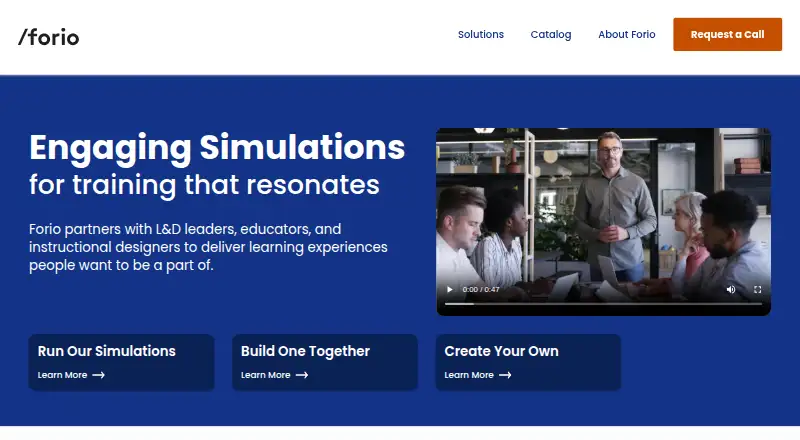
What Forio is
Forio builds interactive simulations for training and higher education, giving learners a way to practice skills through experience. Epicenter is its platform for building learning simulations, with model-driven interfaces, cohort management, and secure deployment. Ready-Made simulations cover business learning and support individual, team-based, and asynchronous formats. Forio also works with customers on tailored simulations and says customers own the resulting intellectual property. Performer lets teams create branded role-play exercises with scoring criteria, facilitator dashboards, and AI feedback for select exercises. Epicenter supports Python, R, and Julia models as well as Vensim and Stella, and provides Flow.js, Epicenter.js, and REST APIs. It can connect LLMs and AI libraries through Python or APIs. Epicenter Personal is free. Performer Business costs $7,200 a year, plus a one-time set-up and training fee of $2,700. Several other offerings require contacting sales.
Good
- Supports individual, team, and asynchronous learning formats
- Epicenter supports Python, R, Julia, Vensim, and Stella
- Performer includes scoring and facilitator dashboards
- Epicenter Personal is free
Watch out
- Epicenter Personal has zero end-user authentication
- Professional costs $1,970 a year
- Several plan prices require contacting sales
Who it suits
Forio is aimed at educators, instructional designers, and learning and development leaders building simulation-based learning. Its options cover teams seeking ready-made business exercises, role-play activities, or tailored simulations.
Verdict
Forio offers simulation tools and ready-made or custom learning experiences, with modeling and API options in Epicenter. The free Personal tier has no end-user authentication, and paid plan prices vary by offering.
Plans and prices
From Forio's own pricing page, checked 15 Oct 2026.
| Plan | Price | What it gives you |
|---|---|---|
| Epicenter Personal | Free | unlimited public and private projects · community forum support · 0 authenticated projects |
| Ready-Made Simulations | Priced on request | team-based simulation library · corporate training and leadership development · per seat; annual licenses available for 100+ seats |
| Epicenter Professional | $1,970 a year | 200 end users · 5 authenticated projects · annual |
| Performer setup and training | $2,700, paid once | Business and Enterprise plans · one-time |
| Epicenter Business | $4,770 a year | 1,000 end users · 10 authenticated projects · enhanced support · annual |
| Performer Business | $7,200 a year | 50 users · unlimited client-developed content · admin and facilitator logins · SSO integration · priority support · annual |
| Epicenter Enterprise | Priced on request | 1,000+ end users · unlimited authenticated projects · custom SSO · custom SLAs |
| Custom Simulations | Priced on request | Fully tailored simulation developed with Forio’s team · Talk to sales |
| Performer Enterprise | Priced on request | 50+ users · unlimited client-developed content · custom SLAs · expert simulation advisors |
The facts
Each one read from Forio's own pages, with the date it was checked.
What it does
- AI coaching
- Performer offers AI-generated learner feedback for selected exercises, including strengths, gaps and next-step guidance.checked 15 Oct 2026
- AI integrations
- Epicenter can connect LLMs and AI libraries through Python or APIs for feedback, scoring and coaching.checked 15 Oct 2026
- API versioning
- The REST documentation identifies v2 as current and recommended for new projects, while the default remains v1.checked 15 Oct 2026
- Audience
- Forio identifies learning and development leaders, educators, and instructional designers as audiences for its simulation offerings.checked 29 Sep 2026
- Availability claim
- Forio advertises 99.9% worldwide uptime.checked 15 Oct 2026
- Catalog size
- The homepage lists 59 simulations and more than 1,000 simulations created since 2001.checked 15 Oct 2026
- Custom development
- Forio collaborates with customers to develop tailored simulations, and says the customer owns the resulting intellectual property.checked 29 Sep 2026
- Documentation depth
- The documentation provides separate learning paths for administrators, simulation authors and app developers, plus model references and tutorials.checked 15 Oct 2026
- Epicenter scale
- Forio says its Epicenter platform has supported more than 10 million learners.checked 15 Oct 2026
- Independent educational use
- MERLOT describes Forio's Near Beer Game as a supply-chain exercise involving orders, inventory and raw materials over 25 simulated weeks.checked 15 Oct 2026
- Independent partner description
- Wharton's Learning Lab calls Forio a leading provider of custom business-school simulations and says Epicenter supports simulation, data-exploration and predictive-analytics applications.checked 15 Oct 2026
- Integrations
- Epicenter can connect LLMs and AI libraries through Python or APIs, and its pricing page lists SAML/LTI authentication for applicable plans.checked 29 Sep 2026
- Interface Builder
- Epicenter includes a template-driven Interface Builder intended to let authors create interfaces without coding.checked 15 Oct 2026
- JavaScript SDK
- Forio supplies JavaScript libraries that wrap Epicenter API calls in TypeScript functions.checked 15 Oct 2026
- License terms
- Forio's ready-to-run simulations are provided under a revocable, non-exclusive, non-transferable license that prohibits copying, modification, reverse engineering and redistribution.checked 15 Oct 2026
- Limit: advancement
- A Glassdoor reviewer says the small company size can mean limited advancement opportunities.checked 15 Oct 2026
- Limit: workload and structure
- Glassdoor reviewers mention hard work, an unstructured environment and the possibility of feeling overwhelmed without defined task lists.checked 15 Oct 2026
- LinkedIn specialties
- LinkedIn lists simulations, visualization, games, predictive analytics and training simulations among Forio's specialties.checked 15 Oct 2026
Where it runs
- Browser requirements
- Recent Chrome, Firefox, Safari and Edge are supported; Opera is explicitly unsupported.checked 15 Oct 2026
- Epicenter platform
- Epicenter is a developer-grade platform for building learning simulations with model-driven interfaces, cohort management, and secure deployment.checked 29 Sep 2026
The company
- Company history
- Forio was founded in 2001 by Will Glass-Husain and Michael Bean after they met at MIT's Sloan System Dynamics Lab.checked 15 Oct 2026
- Founded
- 2001checked 28 Sep 2026
- Headquarters
- Burlingame, California, USAchecked 28 Sep 2026
- LinkedIn company profile
- LinkedIn lists Forio as privately held, founded in 2001, headquartered in San Francisco and employing 11–50 people.checked 15 Oct 2026
The full review of Forio
Overview
Forio is a simulation platform for training and higher education, with ready-made business exercises, tools for building custom learning experiences, and bespoke development. It is best suited to educators and learning teams that need learners to practice in interactive scenarios rather than work through passive material. Its breadth is a strength, but Epicenter’s free tier cannot authenticate end users, so it is not a free route to running a private learner-facing project.
Founded in 2001, Forio focuses on strategy simulations and supports multiplayer use, assessment, instructor dashboards, advanced scenario customization, and hybrid deployment.
Key features
Build, adapt, and deliver
Epicenter is the most flexible option for teams building simulations: it combines model-driven interfaces and cohort management with secure deployment. Models can be written in Python, R, or Julia, and the platform supports Vensim and Stella. Flow.js, Epicenter.js, and REST APIs give developers several ways to connect models and interfaces. That range is useful for technical teams working with existing models; it is a heavier fit for organizations that simply want a ready-to-run exercise.
Epicenter can connect to LLMs and AI libraries through Python or APIs. Forio describes OAuth 2.0 security and role-based project access, with cloud or on-premises deployment. A customer can also host a project's interface on its own web server while using Epicenter APIs. SAML/LTI authentication is available on applicable plans, but the free Personal tier includes no end-user authentication and no authenticated projects.
Ready-made and role-play learning
Ready-Made Simulations cover business learning topics and support individual, team-based, and asynchronous formats. They offer a faster path than commissioning or developing a simulation, though the offering centers on a library rather than a custom-built experience. Performer is aimed at teams creating branded role-play exercises; scoring criteria, facilitator dashboards, and AI feedback for select exercises support structured practice and review.
For customers with a distinct learning scenario, Forio also develops tailored simulations and says customers own the resulting intellectual property. This is the most bespoke route, but requires working with Forio rather than configuring a standard library exercise.
Pricing
Forio uses a freemium model, but its offerings have separate pricing and units, so the headline paid-from figure does not describe every product.
- Epicenter Personal: Free, with unlimited public and private projects and community forum support. It has zero end-user authentication and zero authenticated projects, making it appropriate for building or exploring projects, not serving authenticated learners.
- Ready-Made Simulations: Starting at $168 per seat, once. It provides immediate access to the team-based business simulation library; annual licenses are available for 100+ seats. The per-seat entry point suits a defined group, while larger cohorts can use annual licensing.
- Epicenter Professional: $1,970/year, with 200 end-user authentication and 5 authenticated projects. This is the entry paid tier for teams that need authenticated delivery, but its project and authentication allowances are finite.
- Epicenter Business: $4,770/year, with 1,000 end-user authentication and 10 authenticated projects. It raises both limits for broader programs, at a substantially higher annual commitment.
- Performer Business: $7,200/year for 50 users, plus a one-time set-up and training fee of $2,700. Teams should account for that initial fee alongside the annual subscription.
- Performer Enterprise: Custom pricing for 50+ users, unlimited client-developed content, additional content development, SSO integration, priority support, custom SLAs, and simulation advisors. It fits larger teams needing content and service beyond the Business package.
- Epicenter Enterprise: Custom pricing for 1,000+ end-user authentication, unlimited authenticated projects, custom SSO options, custom SLAs, and simulation advisors. It is the high-scale option when Business limits are insufficient.
- Custom Simulations: Custom pricing for a fully tailored simulation developed with Forio's team.
Platforms
Forio's listed platforms are web, API, and self-hosted. Self-hosting applies to a project's user interface on a customer's web server while the project continues to use Epicenter APIs; it is not a claim that the full platform runs independently of Epicenter.
Who it's for
Forio is a strong fit for learning and development leaders, educators, and instructional designers who need strategy-focused practice, team participation, assessment, or instructor oversight. Technical teams can use Epicenter's model and API options to build their own simulations; organizations with less development capacity can start with Ready-Made Simulations or engage Forio for custom work. It is less suitable for anyone seeking a no-cost authenticated learning deployment, or a simple low-commitment product without project limits or implementation costs.
Pros and cons
- Pro: Epicenter supports multiple modeling languages, established modeling tools, and several APIs, giving developer teams room to integrate existing work.
- Pro: Ready-made, role-play, and custom-development routes address different levels of content and customization need.
- Pro: Cloud, on-premises, and customer-hosted interface options accommodate different deployment arrangements.
- Con: Personal has no end-user authentication or authenticated projects, so private learner delivery requires a paid tier.
- Con: Professional and Business cap both authentication and project counts; teams should match those allowances to cohort size and program scope.
- Con: Performer Business adds a $2,700 one-time set-up and training fee to its $7,200/year subscription.
Alternatives
For a business simulation directory, start with Business Simulation Software. Choose Marketplace Simulations instead for individual microsimulations priced at $8 per student once, with 10–25-minute exercises students can replay. AnyLogic is another freemium option, with web, Windows, macOS, and Linux platforms.
GoVenture is worth comparing if you want an option with a free trial rather than a free plan. MonsoonSIM is a paid option with a free trial and a $20 per learner, 6-month Education single-course subscription. SimVenture is a paid alternative with a £50 annual personal license.
OrgSimulator is another freemium web option. Revas Business Simulation Games is a paid web option with a free trial. SD Games Online is a paid web alternative for academic and corporate simulation use.
Verdict
Choose Forio when your learning program needs interactive strategy practice and you value a choice between ready-made content, developer-led simulation building, and custom work. Its modeling flexibility and deployment options are compelling for technical or institution-scale teams. Look elsewhere if you need authenticated learner delivery without a paid subscription, or if the project's authentication and seat costs outweigh the value of simulation-based learning.
Getting started
- Visit https://forio.com/.
- Choose whether to start with Epicenter, Ready-Made Simulations, Performer, or custom simulation development.
- Use Epicenter Personal for free access to unlimited public and private projects.
- Choose a paid plan based on its authentication, project, or user allowance.
- For enterprise or custom simulation options, contact sales.
Limits worth knowing
Epicenter Personal includes no end-user authentication and no authenticated projects. Epicenter Professional includes 200 end-user authentication and five authenticated projects; Epicenter Business includes 1,000 and 10, respectively.
Questions
Is there a free plan?
Yes. Epicenter Personal is free and includes unlimited public and private projects, with no end-user authentication or authenticated projects.
How much do the paid plans cost?
Epicenter Professional is $1,970 per year, Epicenter Business is $4,770 per year, and Performer Business is $7,200 per year plus a one-time $2,700 set-up and training fee.
Which platforms does Forio support?
The listed platforms are API, self-hosted, and web. Customers can host an Epicenter project's user interface on their own web server while using Epicenter APIs.
What models and APIs does Epicenter support?
Epicenter supports Python, R, and Julia models, as well as Vensim and Stella. It provides Flow.js, Epicenter.js, and REST APIs.
Can Forio create a tailored simulation?
Yes. Forio collaborates with customers on tailored simulations and says the customer owns the resulting intellectual property. Custom Simulations require contacting sales.
Alternatives to Forio
- 1
The Business School
Free planWebmacOSWindows7.6£49 one-time - 2

AnyLogic
Free planWebAPILinuxmacOS7.3Free plan - 3
ExtendSim
WebAPISelf-hostedWindows7.2From $10,000 a year - 4
OrgSimulator
Free planWeb7.2$50 one-time - 5

MonsoonSIM
AndroidiOSWeb6.8From $4,000 a year - 6

GoVenture
WebLinuxmacOSWindows6.7From $14 a year