
FindIP
Findip provides patent search for AI workflows through a browser-based playground and a REST API for embedding search in other services.
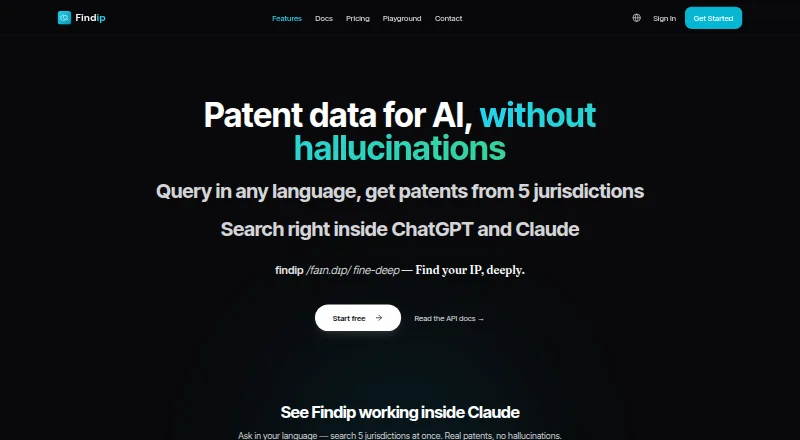
What FindIP is
Findip provides patent search for AI workflows through a browser-based playground and a REST API for embedding search in other services. Its database covers published patents from the United States, China, Japan, Korea, and Europe. Full-text search covers publications from 2001 onward, and China from 2010; unpublished patents are excluded. Semantic search matches by meaning rather than exact keywords. Queries can be written in English, Korean, Japanese, Chinese, or German across all five jurisdictions. Other search options find visually similar patent drawings or similar DNA, RNA, and protein sequences; image and sequence results can be reranked by topic. Findip says results are existing publications that can be checked by publication number. Its MCP connection supports Claude Desktop and Web and ChatGPT during beta. The Free plan costs nothing and includes 30 search credits and all APIs. Text search uses one credit; image search, sequence search, and trend analysis use two. Basic costs $45 a month, excluding tax, and includes 300 monthly credits. Free, Basic, and Pro plans list a limit of 60 requests per minute; Enterprise has a custom limit.
Good
- Covers published patents in five jurisdictions.
- Semantic search works across five query languages.
- Includes image and biological-sequence search.
- REST API and MCP connection support integrations.
- Free plan includes 30 search credits and all APIs.
Watch out
- Unpublished patents are excluded.
- China full-text coverage starts in 2010.
- Basic costs $45 a month, excluding tax.
- Free plan lists a 60 requests-per-minute limit.
Who it suits
Findip suits patent researchers and developers building patent search into AI workflows or other services. Its language options and drawing or sequence search may help users working across the listed jurisdictions and search types.
Verdict
Findip combines patent search options, API access, and an AI-oriented playground, with a free plan for limited credit use. Its coverage is restricted to published records, and search credits and request limits should be considered before choosing a plan.
Plans and prices
From FindIP's own pricing page, checked 15 Oct 2026.
| Plan | Price | What it gives you |
|---|---|---|
| Free | Free | 30 search credits · all APIs · US/CN/JP/KR/EP · re-ranking · $0/mo |
| Basic | $45 a month | 300 search credits/month · all APIs · US/CN/JP/KR/EP · re-ranking · email support · $45/mo, excl. tax |
| Team Basic | $45 a month | 300 credits/member/month · team dashboard · unified billing · self-service seat changes · five jurisdictions · $45/seat/mo, excl. tax |
| Pro | $135 a month | 1,000 search credits/month · single user · all APIs · US/CN/JP/KR/EP · re-ranking · priority support · $135/mo, excl. tax |
| Team Pro | $135 a month | 1,000 credits/member/month · team dashboard · unified billing · self-service seat changes · priority support · five jurisdictions · $135/seat/mo, excl. tax |
| Enterprise | Priced on request | custom credits · custom pricing · custom contract and billing · negotiated support · agreed features and infrastructure · Contact us |
The facts
Each one read from FindIP's own pages, with the date it was checked.
What it does
- API access
- REST API keys are issued on request, and the endpoint reference is provided when an API key is issued.checked 28 Sep 2026
- API access process
- REST API keys are issued on request and the full endpoint reference is supplied separately after issuance.checked 15 Oct 2026
- Claude and ChatGPT
- The MCP connection officially supports Claude Desktop/Web and ChatGPT during beta.checked 15 Oct 2026
- Contact
- Findip lists [email protected] for product, technical, billing, and API inquiries.checked 28 Sep 2026
- Coverage
- It covers published patents from the US, China, Japan, Korea, and Europe; full-text search covers publications from 2001 onward, and China from 2010.checked 28 Sep 2026
- Coverage limit
- Unpublished patent applications are excluded from the indexed data.checked 15 Oct 2026
- Credit expiry
- Unused search credits do not roll into the next billing cycle.checked 15 Oct 2026
- Credit metering
- Text searches consume one credit, while image searches, sequence searches and trend analysis consume two; details and document fetches consume none.checked 15 Oct 2026
- Credit usage
- Text search costs one credit; image search, sequence search, and trend analysis cost two, while details, drawings, document fetches, and MCP resources cost zero.checked 28 Sep 2026
- Data coverage
- The database covers published US, Chinese, Japanese, Korean and European patents, with full-text coverage from 2001 and China coverage from 2010.checked 15 Oct 2026
- Data limitation
- Coverage is based on published office data, so unpublished patents are excluded.checked 28 Sep 2026
- Deep Research integration
- ChatGPT Deep Research can call Findip search and fetch tools repeatedly to assemble source-cited patent reports.checked 15 Oct 2026
- DNA and sequence search
- The product searches biotechnology patents by DNA, RNA or protein sequence similarity.checked 15 Oct 2026
- Drawing search
- Users can upload a patent drawing to find visually similar figures and combine the image with a text description.checked 15 Oct 2026
- Independent coverage lookup
- The directory lists a coverage tool that returns indexed document counts and date ranges for KR, US, CN, JP and EP.checked 15 Oct 2026
- Independent directory description
- KeenEthics' MCP directory describes Findip as conversational patent search with trend analysis, claim and section lookup, and landscape analysis.checked 15 Oct 2026
- Independent tool listing
- The KeenEthics listing records ten Findip tools, including search, fetch, applicant resolution, coverage lookup, patent details and drawings.checked 15 Oct 2026
Where it runs
- Browser access
- A browser Playground lets a newly created free account search without installing software.checked 15 Oct 2026
- Independent applicant matching
- The directory says Findip resolves multilingual applicant names into canonical entity IDs before company-filtered searches.checked 15 Oct 2026
The company
- Company business
- The registry classifies the company in professional, scientific and technical services, with technology brokerage and analysis as its main product.checked 15 Oct 2026
- Company founding
- The registry gives a registration date of 20 September 2007.checked 15 Oct 2026
- Company size
- The registry reports 16 employees.checked 15 Oct 2026
- Company status
- The registry lists LEEONIPL as an active Korean corporation and small business.checked 15 Oct 2026
- Headquarters
- The registry lists the head office at 108 Sapyeong-daero, Seocho-gu, Seoul, South Korea.checked 15 Oct 2026
The full review of FindIP
Overview
FindIP is a patent-search service with a browser playground and a REST API for AI workflows. It best suits researchers and product teams who need semantic, image, or biological-sequence search across several patent offices. Its breadth of search modes and published-record verification are useful strengths, but the published-patent boundary and credit caps matter.
Coverage spans published patents from the US, China, Japan, Korea, and Europe. Full-text search reaches publications from 2001 onward, and China from 2010. Queries can be made in English, Korean, Japanese, Chinese, or German across all five jurisdictions. Semantic search matches by meaning rather than exact wording, and FindIP says results correspond to existing publications in its database that can be checked by publication number.
Search is limited to published office data, excluding unpublished patents. That makes FindIP unsuitable when a workflow depends on unpublished filings or broader coverage than these five jurisdictions.
Key features
Search beyond keywords
Semantic search can surface relevant text when terminology differs from a query, a practical advantage for exploratory work across languages. Drawing search identifies visually similar patent images; combining an image with text can focus ranking on a topic. Sequence search covers similar DNA, RNA, or protein sequences and can also rerank matches by topic. These specialized modes distinguish FindIP from a text-only search tool, though they consume credits faster than text search.
API and AI connections
The REST API supports embedding patent search in other services. API keys are issued on request, with the endpoint reference provided when a key is issued, so teams should factor in that access step when planning integration. The MCP connection officially supports Claude Desktop and Web and ChatGPT during beta, through the shared endpoint mcp.findip.ai.
Text search costs one credit; image search, sequence search, and trend analysis cost two. Details, drawings, document fetches, and MCP resources cost no credits. The 60-requests-per-minute limit applies to Free, Basic, and Pro; Enterprise has a custom limit. Claim analysis, patent clustering, and patent family analysis are also supported.
Pricing
FindIP is freemium, with paid plans from $45/mo. The free plan includes 30 search credits, all APIs, five jurisdictions, and reranking. It is a reasonable way to assess search fit, but the small credit allowance makes sustained or image- and sequence-heavy use difficult. Free receives community support.
Basic costs $45 a month, billed excluding tax, for 300 credits per month, all APIs, five jurisdictions, reranking, and email support. It suits a single user with moderate usage; its credit ceiling is the main constraint. Team Basic is also $45 a month, billed excluding tax, and provides 300 credits per member per month, five jurisdictions, a team dashboard, unified billing, and self-service seat changes. The per-member allowance and shared administration make it the more suitable entry point for teams.
Pro costs $135 a month, billed excluding tax, for one user, 1,000 monthly credits, all APIs, five jurisdictions, reranking, and priority support. It fits an individual with heavier search needs who values faster support, but it remains a single-user plan. Team Pro is $135 a month, billed excluding tax, and offers 1,000 credits per member per month, a team dashboard, unified billing, self-service seat changes, and priority support. Enterprise has custom search credits and pricing, a custom contract and billing, negotiated support, and features and infrastructure by agreement; it is the option for requirements that call for a negotiated setup rather than a fixed allowance.
All plans share five-jurisdiction coverage. The listed rate limit remains 60 requests per minute on Basic and Pro, as on Free, so paying more raises credit capacity rather than that request ceiling. Contact is available at [email protected] for product, technical, billing, and API inquiries.
Platforms
FindIP is available on web, Android, and iOS, as well as through its API. The browser playground serves direct exploration, while API access is the route for embedding search in other services.
Who it's for
FindIP is a strong fit for patent researchers and AI product teams that need multilingual semantic search, drawing similarity, sequence matching, or an API-backed workflow across the five covered jurisdictions. The plan structure gives individuals a clear credit progression and teams per-member allowances with unified billing. It is a weaker choice for users who need unpublished filings, jurisdictions beyond the five listed, or a higher request rate on standard plans.
Pros and cons
- Pros: Semantic, image, and sequence search cover different discovery tasks, including biological sequences.
- Pros: Five-language queries span all five jurisdictions, with publication-number verification for results.
- Pros: Free includes all APIs, and team plans add per-member credits and centralized billing.
- Cons: Published records only exclude unpublished patents.
- Cons: Image and sequence searches use two credits each, so the free allowance can be consumed quickly.
- Cons: Free, Basic, and Pro all have a 60-requests-per-minute limit; Pro increases credits, not that listed rate limit.
- Cons: API keys require a request, adding a step before integration.
Alternatives
For a broader AI patent-search comparison, browse AI Patent Search Software.
- GoVeda is worth considering if a free-forever plan with 220M+ patents worldwide and unlimited AI semantic searches matters more than FindIP's image and sequence search options.
- Patently may suit an individual who wants a free web plan with asset search, patent-family browsing, and chat with Onardo.
- PatSnap is an alternative for users seeking technical research features such as AI technical Q&A, TRIZ innovation generation, and technical research reports.
- The Lens is a fit for readers who value free anonymous browsing or an academic workspace.
- AcclaimIP suits buyers looking for per-seat annual licensing with a quote-based price.
- XLSCOUT is another paid option with a free trial.
- Orbit Intelligence is an alternative for users whose analysis needs align with its record limits and business-oriented metrics.
- Patent77 is another freemium option.
Verdict
Choose FindIP if your work benefits from AI-oriented patent search across five jurisdictions, especially its drawing and sequence modes, and you can work within credit and request limits. Its API and team plans make it practical to incorporate into a product workflow or shared research practice. Look elsewhere if unpublished filings, wider jurisdiction coverage, or a higher standard-plan request rate is essential.
Getting started
- Visit https://findip.ai/en and open the browser-based playground.
- Choose the Free plan or a paid plan; Basic is $45 a month, excluding tax.
- For REST API access, request an API key; the endpoint reference is provided when the key is issued.
- Connect through MCP using mcp.findip.ai with Claude Desktop or Web, or ChatGPT during beta.
Limits worth knowing
The free plan includes 30 search credits. Text search uses one credit; image search, sequence search, and trend analysis use two. Free, Basic, and Pro list a 60-requests-per-minute limit, and unpublished patents are excluded from coverage.
Questions
Does FindIP have a free plan?
Yes. The Free plan costs nothing and includes 30 search credits, all APIs, five jurisdictions, and reranking.
What does Basic cost?
Basic costs $45 a month, billed excluding tax, and includes 300 search credits per month.
Which jurisdictions are covered?
FindIP covers published patents from the US, China, Japan, Korea, and Europe. Full-text search starts in 2001, and in China in 2010.
Which platforms are available?
FindIP lists Android, API, iOS, and web.
Which AI clients support MCP?
FindIP officially supports Claude Desktop and Web and ChatGPT during beta.
How do I get API access?
REST API keys are issued on request. FindIP provides the endpoint reference when it issues an API key.