FFplay
The facts below are what the maker publishes about FFplay, checked and dated. Our editors have not written about it yet.
The facts
Each one read from FFplay's own pages, with the date it was checked.
What it does
- Audio and video
- It can display video, audio waveforms, or audio frequency bands, and can disable audio, video, or subtitles.checked 8 Oct 2026
- Decoding
- Options let users choose audio, video, and subtitle decoders, and enable hardware accelerated decoding.checked 8 Oct 2026
- Dependencies
- FFplay uses the FFmpeg libraries and the SDL library.checked 8 Oct 2026
- Distribution
- The FFmpeg project provides source code; its download page links to third parties for compiled packages and executables.checked 8 Oct 2026
- Download availability
- FFmpeg provides source code and links to third-party compiled builds for Linux, Windows, and macOS.checked 8 Oct 2026
- Filtering
- FFplay accepts video and audio filtergraphs through its -vf and -af options.checked 8 Oct 2026
- Filters
- FFplay accepts video and audio filter graphs for processing the input during playback.checked 8 Oct 2026
- Hardware acceleration
- FFplay documents hardware accelerated decoding through -hwaccel, which also enables the Vulkan renderer automatically.checked 8 Oct 2026
- Integrations
- FFplay uses FFmpeg libraries, which the project says can also be used by applications.checked 8 Oct 2026
- Intended use
- The project describes FFplay as mostly a testbed for FFmpeg APIs.checked 8 Oct 2026
- Notable limit
- FFmpeg provides source code itself; its download page links to third parties for compiled executable files.checked 8 Oct 2026
- Playback
- FFplay can play audio and video, with show modes for video, audio waves, and audio frequency bands.checked 8 Oct 2026
- Playback controls
- While playing, users can pause, mute, toggle fullscreen, and quit with keyboard shortcuts.checked 8 Oct 2026
- Purpose
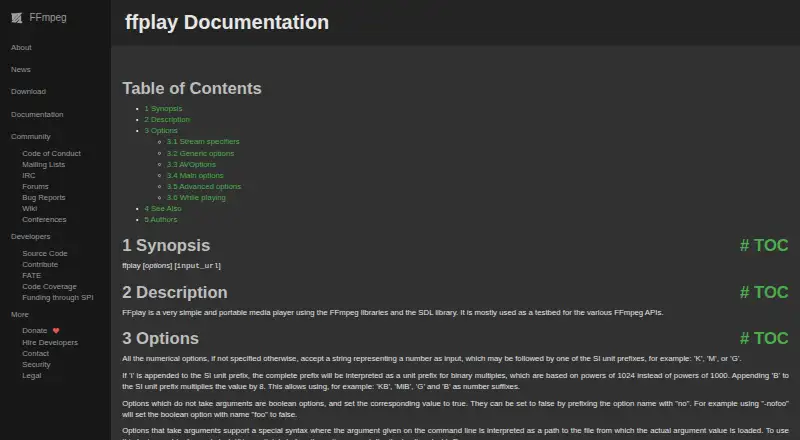
- FFplay is a simple, portable media player that uses the FFmpeg libraries and SDL, and is mostly used as a testbed for FFmpeg APIs.checked 8 Oct 2026
- Release verification
- FFmpeg releases are cryptographically signed, and the project recommends verifying their authenticity.checked 8 Oct 2026
- Rendering
- FFplay uses SDL and can use a Vulkan renderer when built with libplacebo.checked 8 Oct 2026
- Security
- The project says security is a high priority, code review considers security, and it provides updates to stable releases when new security issues are found.checked 8 Oct 2026
- Security reporting
- The project asks vulnerability reporters to submit human verified, reproducible security issues to its security email address.checked 8 Oct 2026
- Seeking
- FFplay supports seeking by time or bytes, and time seeking generally goes to the nearest seek point rather than an exact position.checked 8 Oct 2026
- Support
- The ffmpeg-user mailing list is for general user questions about FFmpeg command-line tools including ffplay.checked 8 Oct 2026
- Vulnerability reporting
- The project requests that security reports include human validation and a reproducible testcase, and says automated submissions are not accepted.checked 8 Oct 2026
Where it runs
- Platforms
- The FFmpeg project says it compiles, runs, and passes its testing infrastructure across Linux, Mac OS X, Microsoft Windows, BSDs, and Solaris.checked 8 Oct 2026
Alternatives to FFplay
- 1

Infuse
Free planiOSmacOS7.4From $16.99 a year - 2
RealPlayer
Free planAndroidiOSmacOSWindows7.4From $4.99 a month - 3
ALLPlayer
Free planAndroidiOSWindows7.1$1.40 one-time - 4
mpv
Free planAndroidAPILinuxmacOS7.1Free plan - 5
Flowplayer
AndroidiOSWebAPI7.0$99 one-time - 6
Dragon Player
Free planOpen sourceLinux6.9Free plan