
Fabric Order Management
Fabric Order Management provides order and inventory services for commerce businesses, with tools for retailers handling sales across channels and fulfillmen…
What Fabric Order Management is
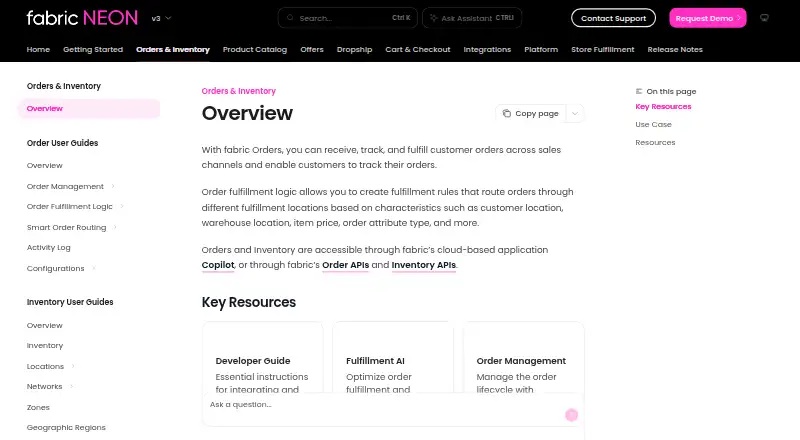
Fabric Order Management provides order and inventory services for commerce businesses, with tools for retailers handling sales across channels and fulfillment across multiple locations. Staff can search, filter, and sort orders, then review customer, payment, total, status, and timing details. Order records include delivery summaries and item status across the lifecycle. Products can be added while an order is in Hold, Confirmed, Partially allocated, or Created status, but not after it becomes Allocated. Fulfillment rule sets direct orders to locations using factors such as geography, warehouse location, item price, and order attributes. Smart Order Routing uses selected goals and operational constraints to guide routing recommendations. Inventory networks provide an aggregate available-to-promise view, while locations hold store and warehouse information. Orders can be fulfilled from multiple locations, including partial fulfillment at order or item level. Fabric offers the service through its cloud-based Copilot application and APIs, with real-time event updates through self-service webhooks. The documentation lists order, inventory, shipment, payment, return, and related API endpoints. Pricing is on request.
Good
- Supports partial fulfillment from multiple locations
- Routing rules use location and order criteria
- Provides order and inventory APIs
- Offers real-time updates through self-service webhooks
Watch out
- Products cannot be added after Allocated status
- Editing orders requires elevated privileges
- Pricing is available only on request
Who it suits
It is intended for omnichannel retailers, particularly those managing complex fulfillment networks. It may suit teams that need order visibility, routing rules, and inventory information across multiple locations.
Verdict
Fabric Order Management combines order visibility, fulfillment routing, and inventory information for multi-channel retail workflows. Check its order-status editing limits and access requirements against your processes.
Plans and prices
From Fabric Order Management's own pricing page, checked 4 Oct 2026.
| Plan | Price | What it gives you |
|---|---|---|
| Fabric Order Management | Priced on request | Enterprise order and inventory management; request a demo for details |
The facts
Each one read from Fabric Order Management's own pages, with the date it was checked.
What it does
- Access
- Orders and Inventory are available through Fabric’s cloud-based Copilot application and through its Order and Inventory APIs.checked 4 Oct 2026
- Access controls
- The Orders interface requires Viewer, Orders & Inventory Editor, or Administrator privileges; editing existing orders requires Orders & Inventory Editor or Administrator privileges.checked 3 Oct 2026
- APIs
- The documentation lists Orders API endpoints for orders, allocations, shipments, tracking, invoices, payments, returns, and related workflows, along with Inventory endpoints.checked 3 Oct 2026
- Channels and workflows
- The Orders service has default order types for Storefront, Call Center, Point of Sale, iOS, Android, and International workflows.checked 3 Oct 2026
- Compliance
- A Fabric blog page states that Fabric is PCI DSS Level 6 and SOC 2 Type 2 compliant.checked 4 Oct 2026
- Connector security
- Fabric says AWS Secret Manager handles values passed between standard connectors and keeps them encrypted, and the connectors’ official SDKs send and receive encrypted data.checked 4 Oct 2026
- Fulfillment rules
- Fulfillment rule sets direct orders to locations using characteristics such as geography, warehouse location, item price, and order attributes.checked 3 Oct 2026
- Integrations
- Fabric lists standard connectors for Stripe, Algolia, Constructor.io, and Avalara; the integration guide says custom integrations are not supported at this time.checked 4 Oct 2026
- Integration setup
- Standard integrations cover common use cases, do not support code customizations, and can be configured within 24 hours.checked 4 Oct 2026
- Inventory visibility
- Networks provide an aggregate inventory view with available-to-promise numbers, and locations centralize store and warehouse information.checked 4 Oct 2026
- Monitoring
- Fabric monitors standard integrations internally using metrics such as latency and recommends the connector’s own dashboard for more direct monitoring.checked 4 Oct 2026
- Order changes
- Users can add products to orders in Hold, Confirmed, Partially allocated, or Created status; orders can no longer be updated with added products after reaching Allocated status.checked 3 Oct 2026
- Order details
- Order details include order summaries, customer and payment details, delivery summaries, and item status across the order lifecycle.checked 3 Oct 2026
- Order management
- Fabric Orders lets retailers receive, track, and fulfill customer orders across sales channels, with customer order tracking.checked 4 Oct 2026
- Order visibility
- The Manage Orders view lets users search, filter, and sort orders and review order numbers, customers, totals, statuses, payment, and creation time.checked 3 Oct 2026
- Pricing availability
- The official pages opened in this research did not state a price for Fabric Order Management.checked 3 Oct 2026
- Product purpose
- Fabric Orders & Inventory provides order management and inventory services for commerce businesses.checked 3 Oct 2026
- Routing
- Order fulfillment rules can route orders to locations based on customer or warehouse location, item price, order attributes, and other criteria.checked 4 Oct 2026
- Smart routing
- Smart Order Routing uses selected fulfillment goals and operational constraints to guide routing recommendations, with performance shown in a dashboard.checked 3 Oct 2026
- Split shipments
- The product supports fulfillment from multiple locations and allows partial fulfillment at order or item level.checked 4 Oct 2026
- Support
- The integration guide directs customers with questions to Fabric Customer Success.checked 4 Oct 2026
- Target users
- Fabric describes its OMS as designed for omnichannel retailers and presents it for retailers managing complex fulfillment networks.checked 4 Oct 2026
The company
- Founded
- 2017checked 28 Sep 2026
- Headquarters
- San Francisco, California, United Stateschecked 28 Sep 2026
Alternatives to Fabric Order Management
- 1
SalesWarp Labor Management
Free planAndroidiOSWebAPI8.1From $499 a month - 2

Openship
Free planOpen sourceWebAPISelf-hosted7.7From $49 a month - 3
Microsoft Dynamics 365 Sales
AndroidiOSWebAPI7.6 - 4

Ordoro
Free planWebAPI7.5From $59 a month - 5
Orderwerks
AndroidiOSWebAPI7.0From $60 a month - 6
EMERGE
Free planWeb6.9Free plan