European Digital Credentials for Learning
European Digital Credentials for Learning provides tools to create, issue, view, store, share, and verify digital records of learning.
What European Digital Credentials for Learning is
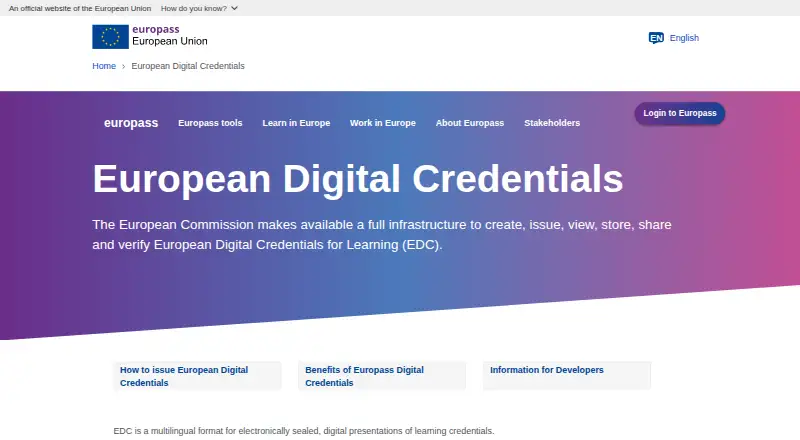
European Digital Credentials for Learning provides tools to create, issue, view, store, share, and verify digital records of learning. Credentials can represent degrees, diplomas, micro-credentials, participation certificates, and other learning records. Organisations can build reusable templates with the Online Credential Builder, then issue from those templates or submit existing JSON credentials through the EDC Issuer for sealing and delivery. Credentials can be sent by email or to Europass and other wallets that follow the EDC standard; holders can share links when their wallet supports that option. The viewer checks format, seal, owner, revocation, accreditation, and validity. Credentials use JSON-LD aligned with W3C Verifiable Credential v1.1 and the European Learning Model, and must carry an advanced or qualified electronic seal. The infrastructure says it does not store the personal information layer added for recipients. The service is freely available to organisations and institutions. Issuing through the web tools requires the free NexU software, which runs only on Windows.
Good
- Supports degrees, diplomas, micro-credentials, and other records.
- Reusable credential templates can be created online.
- Viewer checks validity, revocation, accreditation, and seal.
- Issuer, Viewer, and Wallet components are open source.
- Infrastructure says it does not store recipient personal information layer.
Watch out
- Issuing through the web tools requires NexU on Windows.
- Credentials require an advanced or qualified electronic seal.
- Link sharing depends on wallet support.
Who it suits
The infrastructure suits institutions, organisations, and companies that want to issue learning credentials aligned with European standards. It may also fit teams that need recipients to share credentials through compatible wallets and have their validity checked.
Verdict
European Digital Credentials for Learning offers an end-to-end credential workflow with authenticity checks and standards-aligned formats. Organisations should account for the electronic-seal requirement and Windows-only NexU requirement for web issuing.
Plans and prices
From European Digital Credentials for Learning's own pricing page, checked 7 Oct 2026.
| Plan | Price | What it gives you |
|---|---|---|
| European Digital Credentials for Learning infrastructure | Free | Freely available to organisations and institutions · issuing requires an eIDAS-compliant electronic seal and NexU on Windows |
The facts
Each one read from European Digital Credentials for Learning's own pages, with the date it was checked.
What it does
- Credential builder
- The Online Credential Builder lets organisations create reusable credential templates.checked 7 Oct 2026
- Credential types
- Credentials can represent degrees, diplomas, micro-credentials, participation certificates and other learning records.checked 7 Oct 2026
- Data handling
- The EDC infrastructure states that it never stores the personal information layer added for credential recipients.checked 7 Oct 2026
- Intended users
- Any institution, organisation or company that wishes to issue credentials aligned with European standards can use the tools.checked 7 Oct 2026
- Issuing formats
- The EDC Issuer can issue from Online Credential Builder templates or accept existing credentials in JSON format for sealing and sending.checked 7 Oct 2026
- Open source
- The Issuer, Viewer and Wallet components are available as open-source software for integration into an organisation's own infrastructure.checked 7 Oct 2026
- Purpose
- The infrastructure provides tools to create, issue, view, store, share and verify European Digital Credentials for Learning.checked 7 Oct 2026
- Security and trust
- Credentials must be sealed with an advanced or qualified electronic seal, and the seal's integrity is checked when the credential is viewed.checked 7 Oct 2026
- Standards and integrations
- The infrastructure issues JSON-LD credentials aligned with W3C Verifiable Credential v1.1 and uses the European Learning Model.checked 7 Oct 2026
- Support
- The Commission offers guidance and technical assistance for digitising more complex credentials and lists an EDC support email for questions.checked 7 Oct 2026
- Verification
- The viewer automatically checks credential authenticity and validity, including format, seal, owner, revocation, accreditation and validity checks.checked 7 Oct 2026
- Wallets and sharing
- Credentials can be sent by email or to Europass and other EDC standard-compliant wallets, and holders can share them using links when their wallet supports that feature.checked 7 Oct 2026
Where it runs
- Platform requirement
- Issuing credentials with the web tools requires the free NexU software, which the page says can run only on Windows devices.checked 7 Oct 2026
Alternatives to European Digital Credentials for Learning
- 1
Awero
Free planAndroidiOSWebAPI8.0From €110 a year - 2
Blockcerts
Free planOpen sourceAndroidiOSWebAPI7.7Free plan - 3

SimpleCert
Free planWebAPImacOSWindows7.7From $19 a month - 4
Certifier
Free planWebAPI7.4From $49 a month - 5

CanCred Factory
Free planAndroidiOSWebAPI7.3From C$495 a year - 6
CertSeal
Free planWebAPISelf-hosted7.3From $390 a year