Blockcerts
Blockcerts is an open-source project and standard for creating, issuing, holding, and checking blockchain-based credentials and official records.
What Blockcerts is
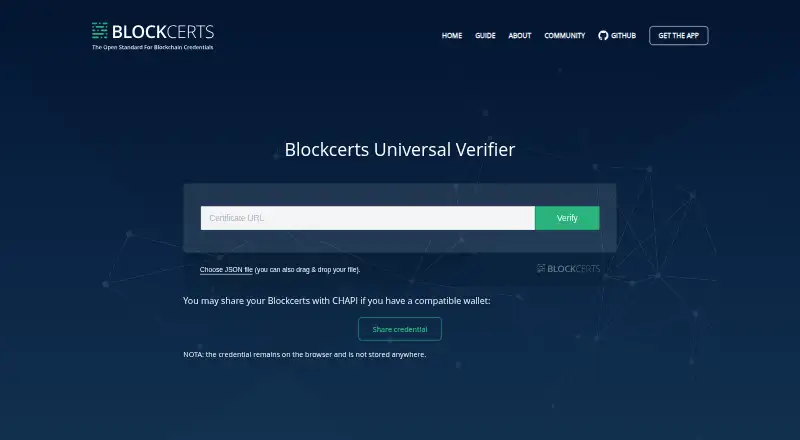
Blockcerts is an open-source project and standard for creating, issuing, holding, and checking blockchain-based credentials and official records. Its intended uses include civic records, academic credentials, professional licenses, and workforce development. Recipients can use the app to receive, import, keep, and share credentials; a private passphrase supports ownership and recovery. A verifier checks issuer signatures and certificate data, including whether a credential has expired or been revoked, and can be integrated into other software. Developers have Python tools for credential creation and issuance, a JavaScript verification library for Node.js or browsers, and a standalone web verifier. Issuers can use Bitcoin or Ethereum through the issuer library, while the standard is designed to work across blockchains. The blockchain holds a one-way hash of certificate data rather than recoverable original data. Issued certificates cannot be changed; issuers can revoke incorrect credentials or issue a replacement batch. The app is free, though Bitcoin batch issuance may involve a variable network transaction fee.
Good
- Free app for recipients.
- Credentials can be checked independently.
- Verification checks expiry and revocation.
- Supports Bitcoin and Ethereum issuance.
- Available on web, Android, and iOS.
Watch out
- Bitcoin batch issuance may incur network fees.
- Issued certificates cannot be edited.
- Selective disclosure requires separate certificates for different detail levels.
Who it suits
Blockcerts suits institutions issuing credentials and people who need to receive, hold, share, or verify them. It also offers tools for developers integrating verification or issuance.
Verdict
Blockcerts combines recipient credential management with tools for issuance and independent verification. Consider the variable Bitcoin transaction fee and the need to revoke or replace, rather than edit, an incorrect certificate.
Plans and prices
From Blockcerts's own pricing page, checked 9 Oct 2026.
| Plan | Price | What it gives you |
|---|---|---|
| Blockcerts | Free | Free app; issuing certificates may incur blockchain transaction fees |
| Blockcerts App | Free | recipient wallet · credential import and sharing · independent verification · Free |
The facts
Each one read from Blockcerts's own pages, with the date it was checked.
Where it runs
- App privacy
- Apple's listing says the developer reports that the iOS wallet collects no data.checked 15 Oct 2026
- Limit: iOS crashes
- Apple App Store reviewers reported startup crashes and described the app as unusable for them.checked 15 Oct 2026
What it does
- Blockchain support
- The standard began with Bitcoin, expanded to Ethereum and is designed to work across additional public or private blockchains.checked 15 Oct 2026
- Community implementation burden
- A forum response says adopters must assemble separate components and understand addresses, public keys and wallet funding for a production deployment.checked 15 Oct 2026
- Developer libraries
- The project provides cert-tools for creating certificates, cert-issuer for issuing them, cert-verifier-js for browser or Node verification, and a standalone verifier component.checked 15 Oct 2026
- Developer tools
- The project provides Python tools for creating and issuing credentials, a JavaScript verification library for Node.js or browsers, and a standalone web verifier.checked 9 Oct 2026
- Documentation depth
- The official guide includes introduction, FAQ, quick start, recipient guidance, standards alignment and roadmap sections, supplemented by repository READMEs and examples.checked 15 Oct 2026
- Identity limit
- Blockcerts verifies claims and cryptographic ownership but does not itself prove that a public key belongs to a particular person or organization.checked 15 Oct 2026
- Immutability
- Issued certificates cannot be edited; an issuer can revoke an incorrect credential or issue a new batch.checked 9 Oct 2026
- Immutability limit
- Issued certificates cannot be edited; an issuer must revoke an incorrect certificate and issue another one.checked 15 Oct 2026
- Integrity and revocation
- Verification checks issuer signatures and certificate data and can check whether a credential has expired or been revoked.checked 9 Oct 2026
- Integrity checks
- Verification checks the issuer signature, certificate data, blockchain receipt and whether the credential is expired or revoked.checked 15 Oct 2026
- License
- Core public repositories such as cert-issuer, cert-verifier-js and blockcerts-verifier are published under the MIT License.checked 15 Oct 2026
- Limit: credential import errors
- A Google Play reviewer reported repeated errors when adding school credentials even after receiving a replacement one-time code.checked 15 Oct 2026
- Limit: installation friction
- A Google Play reviewer said the app would not download on a phone and required a Chromebook workaround.checked 15 Oct 2026
- Limit: phone migration
- A Google Play reviewer reported difficulty moving different degrees between old and new phones.checked 15 Oct 2026
- News: Blockcerts v3
- Blockcerts v3 was announced on December 13, 2021 with alignment to W3C Verifiable Credentials and support for issuer decentralized identifiers.checked 15 Oct 2026
- News: Hyland acquisition
- Hyland acquired Learning Machine effective February 1, 2020 and continued its blockchain credentialing work.checked 15 Oct 2026
- Notable deployment
- MIT's 2017 pilot gave 111 graduates the option to receive Blockcerts Wallet digital diplomas alongside traditional credentials.checked 15 Oct 2026
- Origin
- MIT Media Lab and Learning Machine developed the open-source Blockcerts toolkit during 2016.checked 15 Oct 2026
The company
- Credential ownership
- Recipients control their credentials through a wallet and can share them without relying on the issuing institution for each verification.checked 15 Oct 2026
- Maker stewardship
- The project says Learning Machine is now Hyland Credentials and that Hyland is its primary ongoing steward.checked 15 Oct 2026
Money
- Issuance cost
- A Bitcoin transaction is used per certificate batch, and the transaction fee varies with network fees; the cert-issuer fee is configurable.checked 15 Oct 2026
- Issuing cost
- Issuing a Bitcoin batch involves a network transaction fee that varies with the recommended fee and can be configured in cert-issuer.checked 9 Oct 2026
The full review of Blockcerts
Blockcerts is an open-source standard and software ecosystem for issuing, holding and checking blockchain-based credentials. It is aimed at schools, public agencies, licensing bodies and workforce programs that want recipients to control portable records. The strongest case is independent verification across systems; the trade-off is that issuance is deliberately difficult to undo.
Overview
Blockcerts covers the full credential lifecycle: an issuer creates and publishes a record, a recipient stores and shares it, and a verifier checks it without relying solely on the issuer’s own database. Its intended uses include civic records, academic credentials, professional licences and workforce-development achievements. The open standard and open-source approach suit organisations that need integration flexibility or want to avoid locking recipients into one commercial platform.
Key features
The Blockcerts app lets recipients receive, import, hold and share credentials. A private passphrase supports ownership and recovery, so the recipient remains responsible for access rather than treating the credential as a document that exists only in an issuer portal.
Issuers get Python tools for creating and issuing credentials, while a JavaScript verification library works in Node.js or browsers. A standalone web verifier handles independent checks, and the universal verifier can be embedded in existing software. That combination is useful for institutions with their own student, licensing or HR systems, although implementation still requires technical resources.
Verification checks issuer signatures and certificate data, and can detect expiry or revocation. Issued certificates cannot be edited: an issuer must revoke an incorrect credential or issue a replacement batch. That protects the integrity of an accepted record, but requires a clear correction process before publication. Selective disclosure currently means issuing separate certificates for high-level and detailed information; one certificate that reveals only chosen fields is a future possibility rather than the current model.
The issuer library supports Bitcoin and Ethereum, and the standard is designed to operate across blockchains. It aligns with W3C Verifiable Credentials, Data Integrity and Controlled Identifiers, including Decentralized Identifiers. The chain stores a one-way hash of certificate data, not the original record, so the underlying information cannot feasibly be reconstructed from that hash.
Bitcoin batch issuance carries a variable network transaction fee based on the recommended fee and configurable in cert-issuer. The public community forum provides a place for technical questions, discussion and news. Hyland is the primary steward, with contributions invited from other collaborators.
Pricing
Blockcerts — free. The software and app are free, making this the right fit for institutions that can manage their own implementation or use the open tools directly. Free does not mean cost-free issuance: Bitcoin batches may incur network transaction fees, and the amount varies. There are no paid tiers or seat quotas given, so the main financial consideration is the blockchain fee and the technical work required to operate an issuing workflow.
Platforms
Blockcerts supports Android, iOS and web use, with API access and self-hosted deployment. The browser-based verifier and developer libraries also make it practical to connect checking to Node.js, browser applications or existing institutional software.
Who it's for
Choose Blockcerts if you issue credentials that must remain portable, independently verifiable and usable beyond your own service. It is particularly suitable for education, government records, professional licensing and workforce programmes with technical staff and a need for open standards. It is less suitable when nontechnical administrators need a tightly managed, all-in-one hosted service, or when certificates must be edited after publication rather than revoked and replaced.
Pros and cons
Pros
- Recipient ownership: Passphrase-backed storage lets recipients hold and share their own credentials.
- Independent verification: Signatures, data integrity, expiry and revocation can be checked without trusting a single presentation copy.
- Integration options: Python, JavaScript, web-verifier and self-hosting tools accommodate custom systems.
- Open standards: W3C alignment and multi-blockchain design support portability.
- Privacy-aware anchoring: Only a one-way hash is stored on the blockchain.
Cons
- Corrections are operationally final: An incorrect certificate must be revoked or replaced, not edited.
- Issuance can cost extra: Bitcoin network fees fluctuate by recommended transaction fee.
- Selective disclosure is limited: Fine-grained disclosure currently requires separate certificates.
- Technical burden: Issuer libraries and self-hosted options favour organisations able to manage integration.
Alternatives
For a broader directory of credentialing tools, see Credentialing Software.
- Awero suits users wanting free personal or organisation accounts on Android, iOS and web, with paid custom-look setup.
- CanCred Factory is a freemium Android, iOS, web and API option with a free plan and trial.
- OpenCred is a free MIT-licensed desktop or self-hosted Docker alternative.
- POK fits organisations seeking unlimited free Web2 credentials and optional pay-as-you-go blockchain verification.
- Open Badge Passport is a free open-source choice for personal-use badges on Android, iOS and web.
- Certifier offers a hosted API and web workflow with a free annual credential allowance and paid upgrades.
- CertSeal provides hosted or self-hosted plans, including a free quota of 100 certificates per year.
- CREDEBL is a free open-source API, self-hosted and web option with community support.
Verdict
Blockcerts is a strong choice for institutions that value recipient-controlled, portable credentials and independent verification, especially when they can support custom integration. Look elsewhere if you need editable certificates, turnkey administration or predictable issuance costs without variable blockchain fees.
Alternatives to Blockcerts
- 1

Awero
Free planAndroidiOSWebAPI8.0From €110 a year - 2

SimpleCert
Free planWebAPImacOSWindows7.7From $19 a month - 3
Certifier
Free planWebAPI7.4From $49 a month - 4

CanCred Factory
Free planAndroidiOSWebAPI7.3From C$495 a year - 5
CertSeal
Free planWebAPISelf-hosted7.3From $390 a year - 6
Openbadges.me
Free planWebAPI7.3From $55 a month