
Eat App
Eat App is a cloud-based platform for restaurant reservations, table management, and guest relationship management.
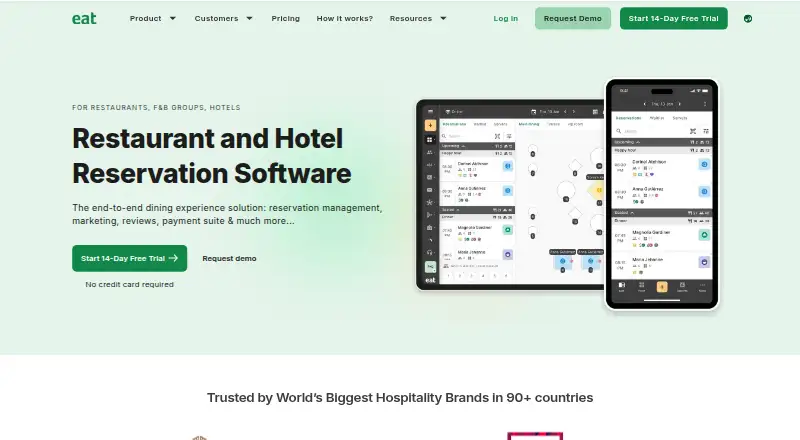
What Eat App is
Eat App is a cloud-based platform for restaurant reservations, table management, and guest relationship management. It accepts real-time bookings around the clock through a venue’s website, social media, and its partner network. Staff can organize tables in timeline, grid, floor, or list views, with capacity controls and pacing tools. Guest profiles can record preferences, visit history, and spend; CRM tools can segment those profiles for email and SMS campaigns. Reports cover busy periods, no-shows, waitlists, guest trends, and spending patterns.
Its integrations directory includes POS, voice, payment, booking-channel, hotel or PMS, and printer integrations, with examples including Lightspeed, Google, Instagram, Stripe, and Mews. Eat App is available on the web, Android, and iOS. Its mobile and iPad apps support offline use and sync automatically when an internet connection is available. The Free plan costs nothing and allows 100 guests monthly. Eat App says it has SOC 2 Type II and ISO/IEC 27001:2022 certifications and is GDPR compliant.
Good
- Accepts real-time reservations through websites, social media, and partner network.
- Offers timeline, grid, floor, and list table views.
- Guest profiles capture preferences, history, and spend.
- Reports cover no-shows, waitlists, guest trends, and spending.
- Mobile and iPad apps support offline use and sync.
Watch out
- Free plan is limited to 100 guests monthly.
- Payment integration is shown as a $39/mo add-on.
- POS integration is shown as a $39/mo add-on.
Who it suits
Eat App suits restaurants, cafés, hotels, bars, breweries, nightlife venues, and hospitality groups that need reservation and table-management tools. Its guest profiles, marketing segmentation, and reporting may also suit teams looking to track guest patterns and run targeted campaigns.
Verdict
Choose Eat App if you need reservations, table controls, guest CRM, and reporting in one platform, with offline support on mobile and iPad. Look elsewhere if the Free plan’s 100 monthly guests are too few or if the listed integration add-on rates do not suit your needs.
Plans and prices
From Eat App's own pricing page, checked 5 Oct 2026.
| Plan | Price | What it gives you |
|---|---|---|
| Free | Free | 100 guests monthly · $0/mo |
| Lite | $99 a month | Unlimited guests · 200 WhatsApp messages · $99/mo; yearly option $69/mo |
| Core | $199 a month | Full suite · 500 WhatsApp messages · white-labeling and marketing suite · Core AI · $199/mo; yearly option $159/mo |
| Pro | $389 a month | Everything in Core · 1500 WhatsApp messages · shared group database · POS and payments integration · private success manager · Pro AI · $389/mo; yearly option $299/mo |
| Enterprise | Priced on request | For multi-venue groups · complete AI package included · Let's talk |
The facts
Each one read from Eat App's own pages, with the date it was checked.
What it does
- Audience
- Eat App describes the product as serving restaurants, cafés, hotels, bars, breweries, nightlife venues, and hospitality groups.checked 5 Oct 2026
- Data protection
- The company says data is encrypted in transit with TLS 1.2+ and at rest with AES-256, with role-based access controls and regular access reviews.checked 5 Oct 2026
- Floor management
- Its table-management tools include timeline, grid, floor, and list views, capacity controls, and pacing tools.checked 5 Oct 2026
- Guest CRM
- Guest profiles can capture preferences, history, and spend, while CRM tools segment guests for targeted email and SMS campaigns.checked 5 Oct 2026
- Integrations
- The integrations directory lists POS, voice, payment, booking-channel, hotel/PMS, and printer integrations, including Lightspeed, Google, Instagram, Stripe, and Mews.checked 5 Oct 2026
- Offline use
- The mobile and iPad apps support offline use and automatically sync when an internet connection is available.checked 5 Oct 2026
- Online bookings
- The platform accepts 24/7 real-time online reservations through a website, social media, and its partner network.checked 5 Oct 2026
- Product
- Eat App is a cloud-based restaurant reservation and table management platform combining reservations, table management, and guest CRM.checked 5 Oct 2026
- Reliability
- Eat App says it uses redundant infrastructure, daily backups, 24/7 monitoring, and a tested incident response plan.checked 5 Oct 2026
- Reporting
- Analytics and reports cover busy periods, no-shows, waitlists, guest trends, and spending patterns.checked 5 Oct 2026
- Security
- Eat App states it has SOC 2 Type II and ISO/IEC 27001:2022 certifications and is GDPR compliant.checked 5 Oct 2026
- Support
- The Pro plan includes a private success manager, and Enterprise features include support for SSO/SCIM, audit logs, and granular permission management.checked 5 Oct 2026
The company
- Company
- Eat App says it was founded in 2015 and has major offices in the UAE, United States, and India.checked 5 Oct 2026
- Founded
- 2015checked 23 Sep 2026
Money
- Plan limits
- The pricing page limits the Free plan to 100 guests monthly, and add-on rates shown include $39/mo for payment integration and $39/mo for POS integration.checked 5 Oct 2026
The full review of Eat App
Eat App is a cloud platform that combines restaurant reservations, table control, guest records, and operational reporting. It is best suited to hospitality operators that want these jobs connected across service and marketing, rather than a simple booking widget. Its offline-capable mobile and iPad apps are a practical advantage for venues that cannot rely on a continuous connection.
Overview
Eat App accepts real-time reservations 24 hours a day through a venue’s website, social media, and its partner network. The product serves restaurants, cafés, hotels, bars, breweries, nightlife venues, and hospitality groups, so it can accommodate different service models. That broad scope is most valuable when a business will use table operations and guest data as well as online bookings.
Founded in 2015, Eat App has major offices in the UAE, the United States, and India. Its cloud approach is complemented by Android, iOS, and web access, with mobile and iPad apps continuing offline and synchronising once a connection is restored.
Key features
Reservations and floor management
Staff can work in timeline, grid, floor, or list views instead of being tied to one calendar layout. Capacity controls and pacing tools help match incoming demand to available tables and service capacity. This is a stronger fit for venues actively managing seating flow than for an operator who only needs an online reservations form.
Guest CRM and reporting
Guest profiles record preferences, visit history, and spending. Segmentation supports targeted email and SMS campaigns, turning reservation data into a tool for repeat-guest outreach. Analytics cover busy periods, no-shows, waitlists, guest trends, and spending patterns, giving managers evidence for staffing, follow-up, and demand planning.
Integrations, offline operation, and protection
The integration directory covers POS, voice, payment, booking-channel, hotel and property-management, and printer connections, including Lightspeed, Google, Instagram, Stripe, and Mews. Add-on charges matter: the pricing page shows $39/mo for payment integration and $39/mo for POS integration. Mobile and iPad offline support protects service continuity, with automatic sync when connectivity returns.
Eat App states that it holds SOC 2 Type II and ISO/IEC 27001:2022 certifications and complies with GDPR. It says data is protected with TLS 1.2 or higher in transit, AES-256 at rest, role-based access controls, regular access reviews, redundant infrastructure, daily backups, 24/7 monitoring, and a tested incident-response plan. Pro adds a private success manager; Enterprise supports SSO/SCIM, audit logs, and granular permissions.
Pricing
A 14-day trial is available, and paid service starts at $69/mo on annual billing. The Free plan costs $0/mo and permits 100 guests monthly. That is useful for a small or low-volume venue validating the workflow, but the cap makes it unsuitable once demand regularly exceeds that level.
Free and Lite
Lite costs $99/mo, or $69/mo with yearly billing, and removes the guest ceiling with unlimited guests while including 200 WhatsApp messages. It is the sensible step up for a single venue that needs ongoing reservations but does not require the broader suite. The trade-off is the smaller messaging allowance and fewer advanced capabilities than higher tiers.
Core and Pro
Core is $199/mo, or $159/mo yearly. It adds the full suite, 500 WhatsApp messages, white-labeling, a marketing suite, and Core AI, making it a better match for operators building structured guest marketing around reservations. Pro costs $389/mo, or $299/mo yearly, and adds everything in Core, 1,500 WhatsApp messages, a shared group database, POS and payments integration, a private success manager, and Pro AI. Multi-venue operators and teams needing centralised guest data will get more from Pro, although integration charges can increase the total.
Enterprise
Enterprise uses custom pricing and is aimed at multi-venue groups, with the complete AI package included. The plan is the appropriate route for organisations that also need SSO/SCIM, audit logs, and granular permission management.
Platforms
Eat App runs on Android, iOS, and the web. Its mobile and iPad applications support offline work and sync automatically when internet access returns.
Who it's for
Choose it for restaurants and hospitality groups that need reservations, seating controls, guest CRM, reporting, and integrations in one system. It is less suitable for a very small venue that will stay below 100 monthly guests, or for a business wanting only a basic booking page without paid add-ons.
Pros and cons
Pros
- Connected operations: Reservations, floor views, pacing, CRM, and reporting serve the same workflow.
- Useful guest intelligence: Preferences, history, spend, segmentation, and campaign tools support targeted retention work.
- Offline continuity: Mobile and iPad apps keep working during connection loss and sync later.
- Enterprise safeguards: Stated certifications, encryption, backups, monitoring, and advanced access controls address larger operators’ governance needs.
Cons
- Free-plan ceiling: 100 guests per month is restrictive for a busy venue.
- Extra integration cost: POS and payment connections are each shown at $39/mo.
- Higher tiers are costly: Core and Pro prices target established operations rather than occasional or single-purpose users.
- Messaging quotas remain: Lite, Core, and Pro include 200, 500, and 1,500 WhatsApp messages respectively.
Alternatives
For broader operational comparisons, see Restaurant Table Management Software, Restaurant Management Software, and Restaurant Reservation Software.
- Wix is a general website platform with a free plan and web, mobile, and API access; choose it when site building is the priority.
- SpotOn Restaurant combines POS hardware and software, ordering, payments, table layouts, menu management, and reporting under a paid model with a two-year minimum term.
- HungerRush offers restaurant POS and online-ordering options, including a qualifying one-location starter plan.
- Odoo Point of Sale suits businesses wanting a wider business suite, with a one-app free option and unlimited users.
- Resos is an alternative reservation platform with a 350-booking monthly Basic plan and paid add-ons.
- TableSat has a free profile-focused tier without online bookings and paid plans for more capability.
- Wix Restaurants Table Reservations is free to install, while online bookings require an upgraded Wix site plan.
- bavoli offers a free web plan with unlimited reservations and waitlists, plus limited texting and phone-agent usage.
Verdict
Eat App is a strong choice for hospitality operators that want reservation intake, table control, guest marketing, analytics, and offline mobile access in one platform. Its main reason to look elsewhere is cost structure: the Free cap is low for busy venues, and paid tiers plus integration add-ons quickly become a substantial commitment.
Getting started
- Visit https://restaurant.eatapp.co/.
- Choose the Free plan or review the paid plans, including annual options.
- Use the 14-day trial if you want to try the service before selecting a plan.
- Access Eat App on the web, Android, or iOS.
Limits worth knowing
The Free plan is capped at 100 guests monthly. The Lite plan includes 200 WhatsApp messages; higher listed tiers include 500 on Core and 1,500 on Pro.
Questions
Is Eat App free?
Yes. The Free plan costs nothing and is limited to 100 guests monthly.
How much do paid plans cost?
Listed monthly prices are $99 for Lite, $199 for Core, and $389 for Pro; Enterprise is listed as “Let’s talk.”
Is there a free trial?
Yes, a 14-day trial is listed.
Which platforms does Eat App support?
Eat App is available on Android, iOS, and the web. Its mobile and iPad apps support offline use and sync when a connection is available.
What integrations are available?
Its directory lists POS, voice, payment, booking-channel, hotel/PMS, and printer integrations, including Lightspeed, Google, Instagram, Stripe, and Mews.
What security measures does Eat App state it has?
Eat App says it is SOC 2 Type II and ISO/IEC 27001:2022 certified and GDPR compliant. It says data is encrypted in transit with TLS 1.2+ and at rest with AES-256, with role-based access controls and regular access reviews.
Alternatives to Eat App
- 1

Anolla
Free planAndroidiOSWebAPI8.1From €11.99 a month - 2

Resos
Free planAndroidiOSWebAPI8.1From €23 a month - 3
Favouritetable
Free planAndroidiOSWebAPI7.9From £69 a month - 4
Toast
Free planAndroidiOSWebAPI7.6From $69 a month - 5

TabTake Reservations
Free planWebAPI7.5From £49 a month - 6
simpleERB
Free planAndroidiOSWeb7.2From £21 a month