Draft Ally
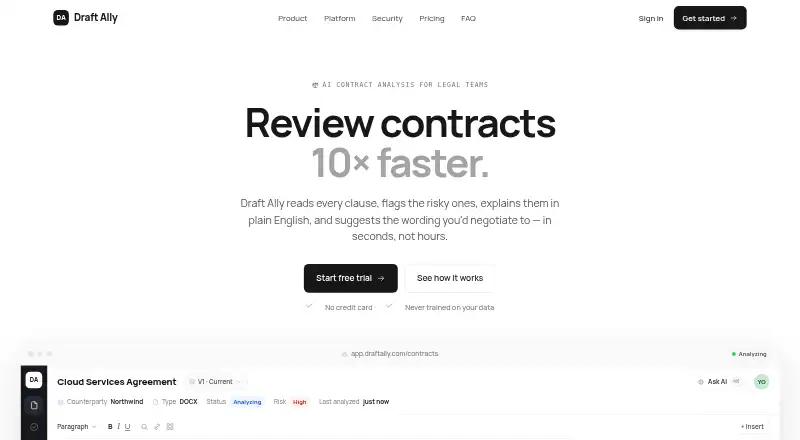
Draft Ally provides AI contract analysis for legal teams through a web platform and API.
What Draft Ally is
Draft Ally provides AI contract analysis for legal teams through a web platform and API. It examines clauses across 34 risk categories from legal, financial, compliance, and data privacy perspectives, then flags risks, explains them in plain English, and suggests negotiation wording. Pro and Team users can create playbooks with their own standards and fallback positions. Editing includes redlines and track changes that export to Word as native tracked changes. Real-time collaboration offers live cursors, presence, and comments. The workspace includes contract search, workflow dashboards, version comparison, obligation tracking, and multi-party e-signature. Draft Ally syncs with Ironclad and DocuSign and provides a REST API and webhooks. It accepts Word .docx files up to 25MB. The Solo plan is free and allows five contracts per month across 10 risk categories. Pro costs $499 a month. Draft Ally states its findings are not legal advice and do not replace lawyers.
Good
- Screens clauses across 34 risk categories.
- Explains flagged risks and suggests negotiation wording.
- Exports redlines as native Word tracked changes.
- Includes real-time collaboration and comments.
- Solo plan is free.
Watch out
- Solo allows five contracts per month.
- Solo covers 10 risk categories.
- Supports Word .docx files up to 25MB.
- Findings are not legal advice.
Who it suits
Draft Ally is aimed at legal teams reviewing contracts and coordinating negotiation work. Its playbooks and shared workspace may suit teams that want to apply their own standards and collaborate on edits.
Verdict
Draft Ally combines clause analysis with editing, collaboration, and contract workflow features. The free Solo tier is limited by monthly contract volume and risk-category coverage, and its findings do not replace legal advice.
Plans and prices
From Draft Ally's own pricing page, checked 14 Oct 2026.
| Plan | Price | What it gives you |
|---|---|---|
| Solo | Free | 5 contracts / month · 10 risk categories · plain-English explanations · Word (.docx) upload · $0/mo |
| Pro | $499 a month | Unlimited contracts · suggested redlines · custom playbooks · negotiation talking points · $499/user · mo |
| Team | Priced on request | Everything in Pro · SSO & audit logs · shared playbooks · obligation tracking · dedicated support · Custom |
The facts
Each one read from Draft Ally's own pages, with the date it was checked.
What it does
- Analysis output
- The product flags risky clauses, explains them in plain English and suggests negotiation wording.checked 1 Oct 2026
- API
- The maker says customers can build on a REST API and webhooks.checked 14 Oct 2026
- Auditability
- Audit logs track and allow export of views, edits, and exports.checked 14 Oct 2026
- Collaboration
- The workspace provides real-time cursors, presence indicators, and comments.checked 14 Oct 2026
- Documentation availability
- The opened maker pages expose product and privacy information but no public SDK, self-hosting instructions, open-source repository, or detailed developer documentation.checked 14 Oct 2026
- Document support
- The documented upload format is Word .docx, with a 25MB size limit.checked 14 Oct 2026
- Editing
- Draft Ally supports redline and track-changes editing with export to Word.checked 1 Oct 2026
- Encryption
- The maker states that data is encrypted in transit and at rest and isolated by tenant.checked 14 Oct 2026
- E-signature
- Built-in e-signature supports signing by multiple parties.checked 14 Oct 2026
- File support
- Word documents (.docx) up to 25MB are supported, and redlines export as native tracked changes.checked 1 Oct 2026
- Identity and access
- Enterprise controls include SSO/SAML for Okta, Azure AD, and Google, plus SCIM provisioning and role-based access.checked 14 Oct 2026
- Independent directory distinction
- GetApp's page is for Ally.io, an OKR product, and reports 4.6 out of 5 from 37 reviews; it is not Draft Ally.checked 14 Oct 2026
- Independent directory review method
- GetApp says its reviews are verified by in-house moderators and provider data is checked by its research team.checked 14 Oct 2026
- Independent G2 rating context
- The G2 Draft seller page shows 4.7 out of 5 stars from 21 reviews for the listed Draft products, not Draft Ally.checked 14 Oct 2026
- Independent listing check
- G2's Draft seller page lists Draft.io, Draft, and a Draft service; it does not show Draft Ally among those products.checked 14 Oct 2026
- Integrations
- The site names synchronization with Ironclad and DocuSign.checked 14 Oct 2026
- Legal status
- Draft Ally states that its findings are not legal advice and do not replace lawyers.checked 1 Oct 2026
- Legal-use limitation
- The maker says findings are considerations rather than legal advice or directives and do not replace lawyers.checked 14 Oct 2026
- Model training
- The maker says customer contracts are never used to train models.checked 14 Oct 2026
- Negotiation assistant
- The negotiation assistant drafts counter-proposals and emails.checked 14 Oct 2026
- Obligation tracking
- The product tracks renewals and deadlines.checked 14 Oct 2026
Where it runs
- App-store distinction
- The Chrome Web Store page found for Draftly is a LinkedIn extension rated 4.8 out of 5 from 26 ratings, published by Digital Gratified FZ-LLC; it is not Draft Ally.checked 14 Oct 2026
- Gartner platform scope
- Gartner Peer Insights says it provides more than 895,000 Gartner-verified ratings and reviews across enterprise software and services.checked 14 Oct 2026
The company
- Company identity
- The opened Draft Ally pages do not state a legal company name, headquarters, founding year, employee count, funding, or owner.checked 14 Oct 2026
The full review of Draft Ally
Draft Ally is a cloud contract-analysis workspace that pairs clause review with editing and workflow tools. It is best suited to legal teams that want to apply consistent negotiation standards and coordinate contract work in one place. Solo offers a narrow, capped entry point; the broader review and playbook features require a substantial paid commitment.
Overview
Draft Ally reviews clauses through legal, financial, compliance and data-privacy lenses, then flags risks, explains them in plain English and proposes negotiation wording. Its appeal is the connection between analysis and the rest of the contract process: users can move from identified issues to redlining, collaboration and tracking without treating review as a standalone scan.
Its findings are not legal advice and do not replace a lawyer. The product is a tool for supporting review, not making legal judgments on a team's behalf.
Key features
Clause analysis and negotiation
The platform screens clauses across 34 risk categories, but Solo covers only 10. That makes the free tier suitable for limited-volume evaluation, not a full picture of Draft Ally's risk coverage. Pro and Team users can create playbooks with their own standards and fallback positions; Pro also includes suggested redlines and negotiation talking points. Those tools matter most to teams that already have preferred positions to apply consistently.
Draft Ally supports clause extraction, risk identification and term comparison. It accepts Word documents (.docx) up to 25MB, and exported redlines retain native Word tracked changes. That is a practical fit for teams whose contract work centers on Word, but the supported file format is limited to DOCX.
Editing, collaboration and workflow
Redline and track-changes editing, real-time collaboration with live cursors, presence and comments, and Word export help keep review and drafting together. The workspace also includes contract search, a workflow dashboard, version comparison, obligation tracking and multi-party e-signature. This breadth can reduce handoffs for teams managing contracts through review and execution; it may be more than needed for a user who only wants clause analysis.
Draft Ally syncs with Ironclad and DocuSign and offers a REST API and webhooks. Security controls include SSO/SAML with Okta, Azure AD and Google, SCIM provisioning, role-based access and exportable audit logs. Contracts are encrypted in transit and at rest, isolated by organization, and not used to train models, according to Draft Ally. Document content is sent through the OpenAI API to generate analysis and is not used to train OpenAI models, according to the privacy policy.
Pricing
Draft Ally is freemium, with a free trial also available. The Solo plan costs nothing and allows five contracts per month across 10 risk categories. It includes plain-English explanations and DOCX upload. The cap and reduced category coverage make it a low-commitment way to assess the analysis, but not a substitute for the wider Pro review.
Pro costs $499 a month and includes unlimited contracts, suggested redlines, custom playbooks and negotiation talking points. The paid entry price is steep for an individual or low-volume practice; it makes more sense for teams that will use the uncapped volume and negotiation tools regularly. Team has custom pricing and includes everything in Pro, plus SSO and audit logs, shared playbooks, obligation tracking and dedicated support. Its additional controls and shared standards are aimed at organizations with broader collaboration or administration needs.
Platforms
Draft Ally is available on the web and through an API, with cloud deployment. Its document workflow is centered on DOCX rather than a broad range of file formats.
Who it's for
Draft Ally is a strong fit for legal teams that work in Word, want clause-level risk explanations and suggested negotiation language, and need collaboration and contract tracking alongside review. Pro is most relevant when unlimited monthly volume and custom playbooks justify its price; Team is the better fit when shared playbooks, SSO, audit logs or dedicated support are priorities.
Solo is better for someone assessing the product or reviewing a small number of contracts. Teams needing a lower-cost paid plan, or users working primarily with formats beyond DOCX, should look elsewhere.
Pros and cons
- Pros: Clause review spans 34 risk categories and four lenses, giving legal teams a broad structure for identifying issues.
- Pros: Native tracked-change exports, collaboration tools and workflow features connect analysis to contract editing and follow-through.
- Pros: Custom playbooks let Pro and Team users apply their own standards and fallback positions.
- Cons: Solo is limited to five contracts monthly and 10 risk categories, restricting its usefulness for ongoing comprehensive review.
- Cons: Pro costs $499 a month, a high threshold for individuals and teams with modest contract volume.
- Cons: DOCX is the supported document format, limiting flexibility for teams whose contracts arrive in other formats.
Alternatives
Browse Contract Analysis Software for more options. Consider eBrevia if self-hosted deployment is important; it offers web and API access and custom-quote pricing. LegalOn is worth considering for teams seeking a Word add-in, web access, DOC, DOCX and PDF support, and a Core Review plan with 135+ playbooks; it has no free plan, though a free trial is available. Spellbook offers a Word add-in and Associate, with custom pricing based on team size, and may suit teams looking for that combination rather than Draft Ally's workflow workspace.
DocJuris is another paid option, with a platform fee sized to contract volume and enabled apps and unlimited users. Robin AI offers web and extension access, while Tiro offers extension and web access. Pactly may suit users seeking a lower-priced entry point: its Essentials plan is $99 a month on an annual plan billed monthly, with a one-user minimum, three smart templates and 10 AI contract reviews per month. PactSage offers a free plan with daily scan and analysis limits, two contracts, two drafts per month and one seat, making it another option for light use.
Verdict
Choose Draft Ally if your legal team wants clause-level analysis tied directly to Word redlining, collaboration and contract tracking, and can make regular use of Pro's playbooks and unlimited volume. The main reason to look elsewhere is the price: $499 a month is a considerable step up from Solo, whose five-contract cap and 10-category coverage make it a limited long-term option.
Getting started
- Open https://draftally.com/
- Use the web platform or API
- Start with the free Solo plan or free trial
- Upload Word (.docx) contracts up to 25MB
- Move to Pro for unlimited contracts and custom playbooks
- Connect Ironclad or DocuSign, or use the REST API and webhooks
Limits worth knowing
Solo allows five contracts per month and covers 10 risk categories. Pro removes the contract quota and adds suggested redlines, custom playbooks and negotiation talking points; Team adds shared playbooks, obligation tracking, SSO, audit logs and dedicated support, with its price not listed.
Questions
Is there a free plan?
Yes. Solo costs nothing and includes five contracts monthly, 10 risk categories, plain-English explanations and Word uploads.
How much does Pro cost?
Pro costs $499 a month and includes unlimited contracts, suggested redlines, custom playbooks and negotiation talking points.
Which platforms are supported?
Draft Ally is available on the web and through an API, with cloud deployment.
What files can I upload?
Word documents in .docx format are supported up to 25MB, and redlines export as native tracked changes.
Does it integrate with other systems?
It can sync with Ironclad and DocuSign and provides a REST API and webhooks.
Are customer contracts used for model training?
Draft Ally says customer contracts are never used to train models. Its privacy policy says document content is sent through the OpenAI API to generate analysis and is not used to train OpenAI models.
Alternatives to Draft Ally
- 1
ClauseShift
Free planAndroidWebWindows7.7From $9 a month - 2
PactSage
Free planAndroidWebAPI7.6From 7.52 CHF a month - 3

ClauseShield
Free planWeb7.3From $15 a year - 4

ClearTerm
Free planWeb7.2From $9 a month - 5

Gavel
WebAPImacOSWindows7.0From $417 a year - 6
Pactly
WebAPImacOSWindows6.9From $99 a month