DNF
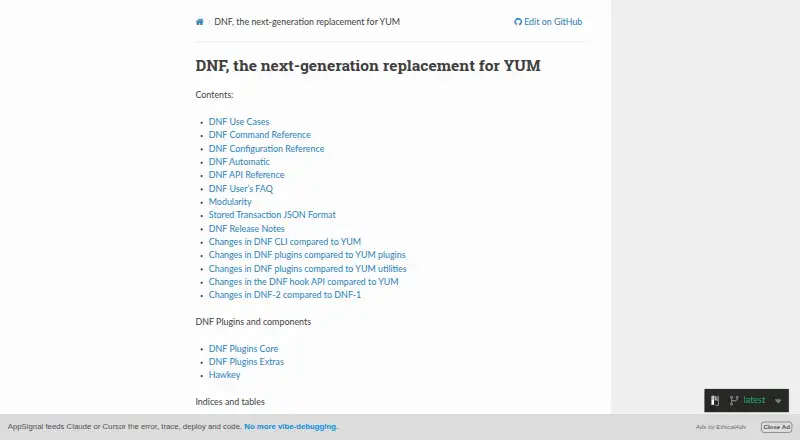
The facts below are what the maker publishes about DNF, checked and dated. Our editors have not written about it yet.
The facts
Each one read from DNF's own pages, with the date it was checked.
What it does
- API stability
- The documented Python API follows semantic versioning, and undocumented API elements may change between releases.checked 12 Oct 2026
- Automation
- DNF Automatic can check for updates and be configured to notify, download packages, or download and install them using systemd timers.checked 12 Oct 2026
- Compatibility caveat
- DNF and YUM can be installed side by side, but they do not share transaction data, which can limit decisions such as autoremove.checked 12 Oct 2026
- Dependency resolution
- Yeschecked 22 Sep 2026
- Deprecated feature
- DNF documentation says modularity is deprecated and its functionality will be removed in a future DNF5 release.checked 12 Oct 2026
- Developer API
- DNF provides a Python API for plugins and applications that embed DNF to perform package management tasks.checked 12 Oct 2026
- Install packages
- The install command installs requested packages and their dependencies, and can also accept module or group specifications.checked 12 Oct 2026
- Intended users
- A documented use case is for system administrators to ensure an operating system has specified packages, files, providers, or groups.checked 12 Oct 2026
- License
- Fedora's package page lists DNF's licenses as GPL-2.0-or-later AND GPL-1.0-only.checked 12 Oct 2026
- Maintainers
- Fedora's package page lists five maintainers: jmracek, dmach, jrohel, pkratoch, and mblaha.checked 12 Oct 2026
- Offline installation
- Yeschecked 22 Sep 2026
- Operational caveat
- The FAQ says DNF and YUM do not share additional data about installed packages and transactions, which can limit how completely autoremove handles dependencies when both are used.checked 12 Oct 2026
- Package formats
- RPM packages; modulemd modules; comps groups and environmentschecked 22 Sep 2026
- Package management
- DNF lets users install packages from repositories or local RPM files, including packages selected by version, URL, group, or provided file path.checked 12 Oct 2026
- Package queries
- DNF can list RPM packages filtered by whether they are installed, available, extra, obsolete, recent, or upgrades.checked 12 Oct 2026
- Package removal
- The remove command can uninstall specified packages and remove older versions of duplicated packages.checked 12 Oct 2026
- Private registry auth
- Yeschecked 22 Sep 2026
- Purpose
- DNF is a package manager for RPM-based Linux distributions and replaces YUM.checked 12 Oct 2026
- Python API
- The Python API is intended for plugins that extend a system's DNF installation and applications that embed DNF for package management tasks.checked 12 Oct 2026
- Reporting
- DNF Automatic can report results through standard output, custom commands, email, or a message of the day file.checked 12 Oct 2026
- Repositories
- DNF uses enabled repositories to obtain package data and can cache their metadata.checked 12 Oct 2026
- Security updates
- DNF Automatic can be configured to consider only updates with an issued security advisory.checked 12 Oct 2026
- Transaction history
- The history command displays past transactions and can act on that information when history recording is enabled.checked 12 Oct 2026
Where it runs
- Supported platforms
- RPM-based Linux distributionschecked 22 Sep 2026
Alternatives to DNF
- 1

OPSI
Free planOpen sourceWebAPILinuxmacOS8.4From €4.99 a year - 2

Patch My PC
Free planWebmacOSSelf-hostedWindows7.7From $3.50 a year - 3

Homebrew
Free planLinuxmacOSWindows6.9Free plan - 4
Chocolatey
LinuxmacOSWindows6.7From $18 a year - 5

Nix
Free planLinuxmacOSSelf-hostedWindows6.7Free plan - 6
Npackd
Free planLinuxWindows6.3Free plan