deep-recover
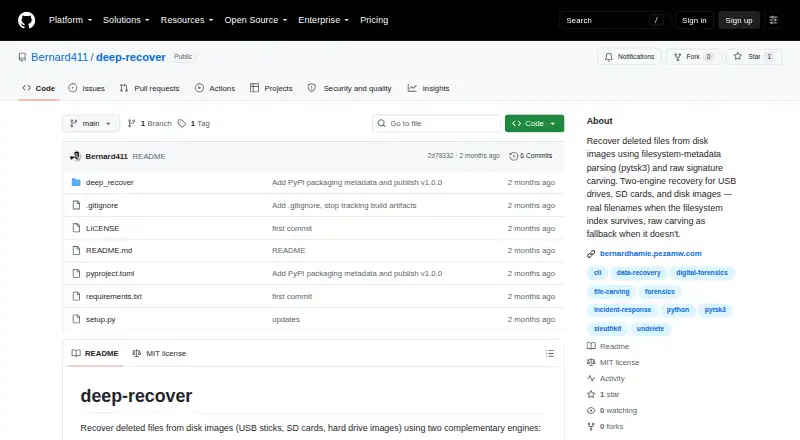
The facts below are what the maker publishes about deep-recover, checked and dated. Our editors have not written about it yet.
Plans and prices
From deep-recover's own pricing page, checked 12 Oct 2026.
| Plan | Price | What it gives you |
|---|---|---|
| deep-recover | Free | MIT-licensed CLI; filesystem-metadata engine requires optional pytsk3 dependency |
The facts
Each one read from deep-recover's own pages, with the date it was checked.
What it does
- Authorized use
- The README says to use the tool only on media you own or have explicit written authorization to examine.checked 12 Oct 2026
- Carving formats
- Built-in carving supports JPG, PNG, GIF, PDF, ZIP-based formats, GZIP, BMP, MP4, SQLite, and WAV.checked 12 Oct 2026
- Encryption
- The project says it does not defeat encryption, and data recovered from an encrypted volume without its key remains unreadable ciphertext.checked 12 Oct 2026
- Input
- The CLI accepts disk image files and is intended to run against an image rather than a live mounted device.checked 12 Oct 2026
- Installation
- The README gives pip installation instructions and says the metadata engine is an optional extra that requires pytsk3.checked 12 Oct 2026
- License
- The repository identifies the project as MIT licensed.checked 12 Oct 2026
- Limit: encryption
- The tool does not break encryption; recovered data from an encrypted volume without its key remains unreadable ciphertext.checked 12 Oct 2026
- Limit: overwritten data
- Recovery only works while file data has not been overwritten, and the README says SSD TRIM can erase the recovery opportunity shortly after deletion.checked 12 Oct 2026
- Limits
- Recovery depends on data not being overwritten; SSD TRIM may erase deleted data, and carving fragmented files can produce corrupted output.checked 12 Oct 2026
- Memory card recovery
- Yeschecked 19 Sep 2026
- Metadata recovery
- The metadata engine uses pytsk3 to read FAT, NTFS, and ext2/3/4 filesystem structures and can recover original filenames, sizes, and timestamps when the data remains intact.checked 12 Oct 2026
- Optional dependency
- The metadata engine is optional; if pytsk3 fails to install, the tool falls back to carving-only mode.checked 12 Oct 2026
- Performance
- The carving engine reads the source in 8 MB chunks with an overlap window rather than loading the entire image into memory.checked 12 Oct 2026
- Purpose
- deep-recover recovers deleted files from disk images using filesystem metadata parsing and raw signature carving.checked 12 Oct 2026
- Recovery engines
- It runs metadata recovery and signature carving by default, then de-duplicates results by content hash.checked 12 Oct 2026
- Recovery sources
- USB sticks,SD cards,hard drive images,disk imageschecked 19 Sep 2026
- Supported input
- The CLI accepts disk image files and advises imaging a device before recovery instead of operating on a live device.checked 12 Oct 2026
- Use case
- The README describes the tool as a learning and utility project and recommends mature alternatives for production forensic work.checked 12 Oct 2026
Money
- Free plan
- Yeschecked 19 Sep 2026
The company
- Maker
- The GitHub profile identifies Bernard Hamie as a full-stack engineer and cybersecurity specialist.checked 12 Oct 2026
Alternatives to deep-recover
- 1
EaseUS Data Recovery Wizard
Free planAndroidiOSmacOSWindows9.0Free plan - 2

Disk Drill
Free planmacOSWindows8.4From $89 a year - 3
MiniTool Power Data Recovery
Free planmacOSWindows8.2From $89 a year - 4
DoYourData Recovery
Free planiOSmacOSWindows8.2From $69 a year - 5
AOMEI FastRecovery
Free planWindows8.1Free plan - 6

Hetman Partition Recovery
LinuxmacOSWindows7.9$97.95 one-time