DebtBook
DebtBook is cloud-based software for finance teams managing debt, cash, leases and subscriptions.
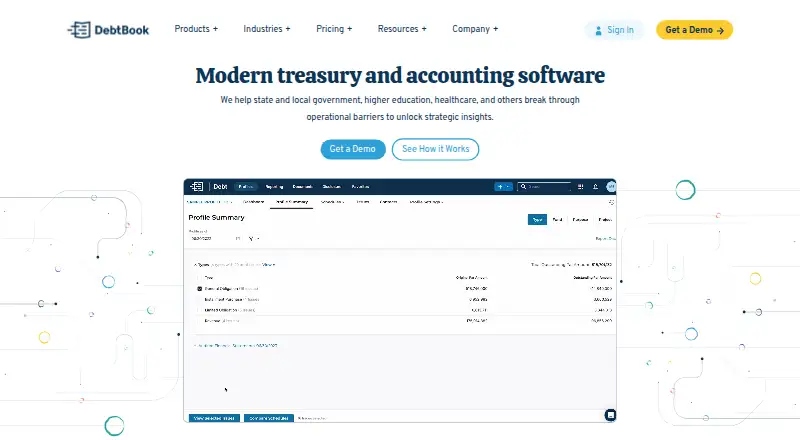
What DebtBook is
DebtBook is cloud-based software for finance teams managing debt, cash, leases and subscriptions. It is purpose-built for government and nonprofit organizations, including public finance teams in higher education and healthcare. Its Treasury Management System brings debt, cash and investments together. Debt Management centralizes debt data and supports accounting, year-end reporting, payment schedules, continuing disclosure, refunding tracking and new issue structuring. Cash Management includes forecasting, fraud detection, cash positioning, transaction categorization and forecast-to-actual variance analysis. Lease and Subscription Management supports tracking, accounting and reporting for arrangements under GASB 87, GASB 96 and ASC 842. Other listed offerings include contract and investment management. ERP integration is available as a Debt Accounting add-on, while Cash Management supports direct API and SFTP bank integrations. DebtBook lists SOC 1 and SOC 2 Type 1 and 2, and CSA STAR Level One certifications. Pricing depends on organizational size and needs, requires a custom quote, and there is no free trial.
Good
- Unifies debt, cash and investments
- Supports reporting for GASB 87, GASB 96 and ASC 842
- Cash Management includes forecasting and fraud detection
- Plans include ongoing expert support
- Lists SOC and CSA STAR certifications
Watch out
- Pricing requires a custom quote
- No free trial is offered
- Starter is limited to 15 agreements and two users
Who it suits
DebtBook suits government and nonprofit finance teams, including teams in higher education and healthcare. It is relevant to organizations managing debt, cash, leases, subscriptions or investments.
Verdict
DebtBook brings several finance workflows into a web-based platform designed for public and nonprofit organizations. Since pricing is quote-based and there is no trial, teams should clarify plan fit before committing.
Plans and prices
From DebtBook's own pricing page, checked 4 Oct 2026.
| Plan | Price | What it gives you |
|---|---|---|
| Cash Management Platform | Priced on request | Cash forecasting · Fraud detection · Cash positioning · Bank statement integration · Direct API and SFTP bank integrations · Add-ons available · Custom quote; billing term not stated |
| Complete | Priced on request | Unlimited agreements · unlimited users · all Starter features · AI data entry · ERP export format · automatic materiality determination · saved reports · payment reporting · reconciliation · milestones · SBITA project management |
| Contract Management | Priced on request | Unlimited users and guests · Unlimited contract storage · AI-powered contract processing · Contract collection · Reporting tools · Custom quote; billing term not stated |
| Debt Management Platform | Priced on request | Refunding history · net debt service · variable-rate debt · commercial paper · draw-down facilities · defeased debt service · DTC reporting · maturity tables · payment reporting · document management · schedules and allocations |
| Investment Management | Priced on request | Integrated cash forecasts · Scenario-based portfolio analysis · GASB 31, 40, and 72 compliance and reporting tools · Automated custodian and pricing feeds · Add-ons available · Custom quote; billing term not stated |
| Starter | Priced on request | Up to 15 agreements · 2 users · automated GL functionality · determination questions · schedule creation · journal-entry exports · audit-note exports · change management · account/reporting settings |
The facts
Each one read from DebtBook's own pages, with the date it was checked.
What it does
- AI features
- The product advertises AI data entry, AI-supported reporting configuration and an AI analyst named Marty.checked 21 Oct 2026
- API integration
- The cash API integration uses Koxa’s proprietary open-banking platform and restricts use to documented functions.checked 21 Oct 2026
- Availability commitment
- The service-level addendum targets 99.9% quarterly uptime and offers subscription extensions as service credits when targets are missed.checked 21 Oct 2026
- Bank connectivity
- Cash Management offers direct bank APIs and SFTP connections, with banking data supplied through external providers.checked 21 Oct 2026
- Cash features
- Cash Management supports cash forecasting, fraud detection, cash positioning, transaction categorization, and forecast-to-actual variance analysis.checked 4 Oct 2026
- Cash forecasting
- Cash Management supports rolling forecasts, manual or statistical updates, debt-service integration and forecast-to-actual analysis.checked 21 Oct 2026
- Cash positioning
- The cash product shows balances across accounts, categorizes transactions and can alert users when balances cross thresholds.checked 21 Oct 2026
- Contract management
- Contract Management provides centralized storage, contract collection, AI processing, renewal tracking, reporting and spend visibility.checked 21 Oct 2026
- Debt features
- Debt Management centralizes debt data and supports accounting, year-end reporting, payment schedules, continuing disclosure, refunding tracking, and new issue structuring.checked 4 Oct 2026
- Debt management
- The debt product centralizes debt records, schedules, payments, refunding history, variable-rate debt, commercial paper, documents and reporting.checked 21 Oct 2026
- Documentation and training
- The company provides a support center, knowledge articles, videos, webinars, live training and a DebtBook University library.checked 21 Oct 2026
- Fraud detection
- Cash Management monitors connected bank accounts for unusual or unauthorized transactions and flags potential fraud.checked 21 Oct 2026
- Funding and investors
- Crunchbase lists Elephant and CreativeCo among DebtBook’s investors and identifies Charlotte, North Carolina as headquarters.checked 21 Oct 2026
- Implementation
- DebtBook publishes implementation guides targeting go-live within 120 days or less and also supports partner-led implementations.checked 21 Oct 2026
- Integrations
- The pricing page lists ERP integration as a Debt Accounting add-on and direct API and SFTP bank integrations for Cash Management.checked 4 Oct 2026
- Investment management
- Investment Management provides portfolio analysis, maturity alignment, compliance reporting, benchmarking and custodian or pricing feeds.checked 21 Oct 2026
- Lease and subscription accounting
- Lease and Subscription Management automates GASB 87, GASB 96 and ASC 842 tracking, accounting and reporting workflows.checked 21 Oct 2026
- Lease and subscription compliance
- Lease and Subscription Management supports tracking, accounting, and reporting for GASB 87, GASB 96, and ASC 842 arrangements.checked 4 Oct 2026
- Licence and hosting
- DebtBook grants customers limited access to proprietary application services; its terms prohibit copying, derivative works, reverse engineering and source-code extraction.checked 21 Oct 2026
- Limit: contract controls
- A Trustpilot reviewer said contract tracking numbers are not auto-assigned and required fields cannot be selectively disabled.checked 21 Oct 2026
The company
- Company facts
- LinkedIn lists the company as privately held, founded in 2019, headquartered in Charlotte, North Carolina, with 51–200 employees.checked 21 Oct 2026
- Company identity
- The legal entity is Fifth Asset, Inc., doing business as DebtBook; LinkedIn shows the brand now operating as Monetary.checked 21 Oct 2026
- Headquarters
- Charlotte, North Carolina, United Stateschecked 28 Sep 2026
- Independent company profile
- Inc. lists DebtBook as a 2019-founded Charlotte software company led by Tyler Traudt and ranked No. 252 on the 2025 Inc. 5000.checked 21 Oct 2026
The full review of DebtBook
Overview
DebtBook is cloud software for managing debt, cash, leases, subscriptions, and investments. It is best suited to government and nonprofit finance teams, including those in higher education and healthcare. Its strongest appeal is the breadth of public-sector workflows in one platform; custom pricing and no trial make it a harder choice for teams that need to evaluate costs or fit before engaging.
Key features
Debt Management centralizes debt data and covers accounting, year-end reporting, payment schedules, continuing disclosure, refunding tracking, and new issue structuring. That scope suits teams managing recurring obligations and financing activity, rather than organizations looking only for a basic debt register.
The Treasury Management System brings debt, cash, and investments together. Cash Management adds forecasting, fraud detection, cash positioning, transaction categorization, and forecast-to-actual variance analysis. Those tools address both day-to-day visibility and planning, while the breadth is most useful to teams managing several treasury workflows. Bank statement integration is part of the Cash Management Platform; direct API and SFTP bank integrations are also offered. ERP integration is an add-on for Debt Accounting, so teams that rely on ERP connectivity should include it in their requirements and quote.
Lease and Subscription Management supports tracking, accounting, and reporting for GASB 87, GASB 96, and ASC 842 arrangements. Investment Management includes integrated cash forecasts, scenario-based portfolio analysis, compliance and reporting tools for GASB 31, 40, and 72, and automated custodian and pricing feeds. Contract Management adds contract collection, AI-powered processing, unlimited contract storage, and reporting tools. Together, these modules make DebtBook relevant to organizations managing both financing and related compliance work, but teams needing only one narrow function may not benefit from the platform's wider scope.
DebtBook cites SOC 1 Type 1 and 2, SOC 2 Type 1 and 2, and CSA STAR Level One certifications. It also describes using recognized security frameworks, continuous monitoring, and regular third-party assessments. The company guides implementation and aims to have teams operational within 90 days or less. Every plan includes ongoing support from DebtBook experts.
Pricing
DebtBook uses custom pricing based on organizational size and needs, and offers no free trial. There is no published billing term, so teams should clarify the quote's scope and terms before committing.
- Starter: Custom quote for up to 15 total agreements and 2 users. It includes full automated GL functionality, determination questions, schedule creation, journal entry and audit note exports, change management, and account and reporting settings. The agreement and user caps make this the narrower fit for smaller teams; growing organizations may need the higher tier.
- Complete: Custom quote with unlimited agreements and users. It includes Starter functionality plus AI data entry, ERP export format, automatic materiality determination, saved reports, payment reporting, reconciliation, milestones, and SBITA project management. The uncapped agreements and seats suit larger or expanding teams, while the quote-based price requires a direct comparison with the budget.
- Debt Management Platform: Custom quote for refunding history, net debt service, variable rate, commercial paper, draw down facilities, DTC reporting, payment reporting, document management, schedules, and allocations; add-ons are available. It fits teams focused on debt operations and reporting.
- Cash Management Platform: Custom quote for forecasting, fraud detection, cash positioning, bank statement integration, and direct API and SFTP bank integrations; add-ons are available. It is the focused option for cash visibility and banking workflows.
- Contract Management: Custom quote with unlimited users and guests, unlimited contract storage, AI-powered contract processing, contract collection, and reporting tools. The uncapped access and storage suit teams handling contract workflows at scale.
- Investment Management: Custom quote for integrated cash forecasts, scenario-based portfolio analysis, GASB 31, 40, and 72 compliance and reporting tools, and automated custodian and pricing feeds; add-ons are available. It targets teams that need investment analysis and compliance alongside treasury work.
ERP integration is an add-on for Debt Accounting, and add-ons are also available on several platform plans. Teams should confirm which integrations and extras are included in their particular quote.
Platforms
DebtBook is web-based, making it a fit for teams working through a browser. Its listed capabilities include cash visibility, liquidity planning, payment workflows, investment management, debt management, and financial risk tools.
Who it's for
DebtBook is aimed at government and nonprofit finance teams, especially public finance groups in higher education and healthcare. It is a strong fit when an organization needs connected debt and treasury functions alongside lease, subscription, contract, or investment management. Teams seeking a free trial, transparent prices, or only a single general-purpose finance function should compare other options.
Pros and cons
- Pros: Debt, cash, lease, subscription, contract, and investment workflows can be managed across one platform, reducing the need to assemble separate tools for those functions.
- Pros: The plan structure includes an entry tier with explicit limits and a Complete tier with unlimited agreements and users, giving teams a clear capacity distinction to discuss in a quote.
- Pros: Ongoing expert support is included in every plan, and implementation guidance is designed to get teams operational within 90 days or less.
- Cons: There is no free trial and every plan uses custom pricing, so teams cannot assess the product through a trial or compare published plan prices.
- Cons: Starter is capped at 15 agreements and 2 users, which can constrain organizations with more contracts or collaborators.
- Cons: ERP integration is an add-on for Debt Accounting, so it may add cost and requires confirmation during quoting.
Alternatives
For teams comparing category options, see Treasury Management Software and Lease Accounting Software.
- FIS Data Integrity Manager is a paid web option without a free plan; consider it as another web-based product to evaluate.
- Kyriba is a paid treasury option spanning Android, iOS, API, and web, with custom pricing available by requesting a demo; it may suit teams prioritizing those platform choices.
- titanTreasury is a paid option for teams considering self-hosted, web, or Windows deployment.
- Sanchay Treasury OS is a paid Android and web option with pricing available by requesting a demo.
- Nomentia Smart Treasury Suite is a paid API and web modular suite, with custom pricing through sales; it suits teams wanting to select solutions around business priorities and requirements.
- Spektra by TMS is a paid, modular platform available self-hosted or on the web, with guided implementation and no free trial; consider it if self-hosting or implementation guidance matters.
- Bond is a paid API and web option with a custom enterprise plan; consider it as another product to assess through a demo.
- Finastra KTP Corporate Treasury Innovation is a paid web option with custom pricing; contact Finastra or an account manager about fit.
Verdict
DebtBook is a strong candidate for government and nonprofit teams that want debt, cash, and related compliance workflows under one roof, with expert support and implementation guidance. Its breadth is the main reason to choose it; the absence of a trial and quote-only pricing are the main reasons to look elsewhere if teams need to validate fit or cost before engaging.
Alternatives to DebtBook
- 1

LeaseAccounting.app
Free planAndroidiOSWeb7.9From €149 a month - 2
iLeasePro
Free planWebAPI7.4From $149 a month - 3
Planon
AndroidiOSWebAPI6.9 - 4

Lucanet
WebAPILinuxSelf-hosted6.8 - 5

ZenTreasury
WebAPI6.8From €799 a month - 6
16Leases
Free planiOSWebLinuxmacOS6.7Free plan