
Common App
Common App helps students explore colleges, submit applications, and navigate admission steps.
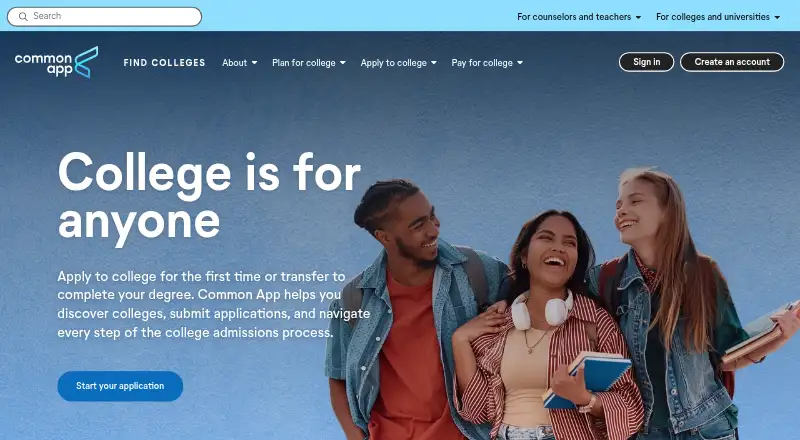
What Common App is
Common App helps students explore colleges, submit applications, and navigate admission steps. It serves first-year and transfer students and lets users explore 1,100+ colleges. Its first-year guidance covers gathering materials, creating an account, adding colleges, engaging supporters, reviewing requirements, planning essays, and submitting an application. Accounts can roll over from year to year, and answers in My Common Application can be saved for use in later years.
Students who complete a profile may receive non-binding direct admission offers from participating colleges before submitting an application. Applying through the program to colleges where a student has received a direct admission offer is free. Otherwise, each college sets whether it charges an application fee and how much; many colleges do not charge one. Qualifying students may be eligible for a Common App fee waiver, subject to participating colleges’ policies. Common App is a nonprofit membership organization focused on access, equity, and integrity in college admission. It is available on web, Android, and iOS, and lists integrations with CRM, SIS, and school counseling platforms, as well as embedded services including SlideRoom and UStrive.
Good
- Students can explore 1,100+ colleges.
- Supports both first-year and transfer applicants.
- Accounts and application answers can roll over year to year.
- Direct-admission applications are free through the program.
- Available on web, Android, and iOS.
Watch out
- Application fees may vary by college.
- Fee waivers depend on eligibility and college policies.
- No free trial.
Who it suits
Common App suits first-year and transfer students exploring colleges and organizing applications. It may also help applicants who qualify for fee waivers or receive participating-college direct admission offers.
Verdict
Common App provides a shared route for exploring colleges and working through application steps, with resources for first-year and transfer students. Application fees are set by colleges, though direct-admission applications through the program are free.
Plans and prices
From Common App's own pricing page, checked 7 Oct 2026.
| Plan | Price | What it gives you |
|---|---|---|
| Common App | Free | College application platform; college application fees vary by institution |
| Common App student application | Free | Application fees may be charged by individual colleges · Up to 20 colleges in the first-year list · No charge |
The facts
Each one read from Common App's own pages, with the date it was checked.
What it does
- Account rollover
- Accounts can roll over between years so users can begin exploring and save answers before applying.checked 15 Oct 2026
- Account security
- Common App requires account verification and recommends unique passwords, signing out after sessions and not sharing credentials.checked 15 Oct 2026
- Advisor access
- Applicants can invite up to three advisors to review an in-progress application and track progress; advisors submit no forms.checked 15 Oct 2026
- API scope
- The published Recommender API includes endpoints for assigning and inviting teachers, saving teacher profiles, checking form status and retrieving recommendation PDFs.checked 15 Oct 2026
- College options
- The site says students can explore 1,100+ Common App colleges.checked 7 Oct 2026
- College search
- The service lets applicants search for colleges, filter results and add schools to a personal list.checked 15 Oct 2026
- Direct admissions
- Completing basic profile information can make students eligible for admission offers from participating colleges before they submit an application.checked 15 Oct 2026
- Direct admissions fees
- Applying to colleges where a student has received a direct admission offer is free through the program.checked 7 Oct 2026
- Documentation
- Help resources are split among first-year applicant, transfer applicant, recommender and counselor support centers, with guides and toolkits.checked 15 Oct 2026
- Embedded services
- Common App identifies SlideRoom and UStrive among its embedded integrations.checked 7 Oct 2026
- Fee waivers
- The Common App fee waiver is available to students who meet qualifying criteria, and participating colleges set their own waiver policies.checked 7 Oct 2026
- Financial-aid resources
- Common App provides financial-aid and scholarship research resources, including fee-waiver guidance.checked 15 Oct 2026
- Funding
- Crunchbase lists a grant funding round with Lumina Foundation as investor, but the amount is obfuscated.checked 15 Oct 2026
- Integrations
- Counselors using a Common App integration partner submit school forms through that partner rather than directly in the recommender system.checked 15 Oct 2026
- Limit: coverage
- Independent guides note that major institutions such as MIT and University of California schools do not use Common App, so separate applications may be required.checked 15 Oct 2026
Where it runs
- Application fees
- Each college chooses whether to charge an application fee and how much to charge; many colleges do not charge one.checked 7 Oct 2026
- Application sections
- The first-year application includes profile, family, education, testing, activities, writing and courses-and-grades sections.checked 15 Oct 2026
- Application steps
- The first-year application guide covers gathering materials, creating an account, adding colleges, engaging supporters, understanding requirements, planning essays, and submitting an application.checked 7 Oct 2026
The company
- Company founding
- LinkedIn lists the organization as founded in 1975.checked 15 Oct 2026
- Company legal name
- Crunchbase lists the legal name as The Common Application, Inc.checked 15 Oct 2026
- Company status
- Common App describes itself as a nonprofit membership organization.checked 15 Oct 2026
- Founded
- 1975checked 28 Sep 2026
- Headquarters
- Arlington, Virginia, United Stateschecked 28 Sep 2026
- Headquarters and size
- LinkedIn lists Arlington, Virginia as headquarters and a company size of 51–200 employees.checked 15 Oct 2026
The full review of Common App
Common App combines college discovery with application tools for first-year and transfer students. It is best suited to applicants considering participating colleges who want a shared place to manage application steps. Its strongest advantage is reusable application answers; its limits are that college participation, requirements, and fees still shape each application.
Overview
Students can explore more than 1,100 colleges and work through application tasks in one platform. The first-year guide covers gathering materials, adding colleges, understanding requirements, planning essays, engaging supporters, and submitting. Common App also supports applicant communications, document collection, and decision workflows, giving students a structure for managing the process rather than treating every step as separate.
Accounts can roll over from year to year, and answers in My Common Application can be saved year over year. That is useful for students applying across cycles, though saved answers do not remove the need to follow each college's own requirements.
Common App is a non-profit membership organization focused on access, equity, and integrity in college admission. It serves transfer applicants as well as first-year students, with separate online support routes for each.
Key features
College discovery and application steps
Exploring participating colleges and organizing application tasks in one place makes Common App a sensible starting point for students applying to multiple member colleges. Its first-year guide provides a clear sequence from gathering materials to submission; students still need to account for institution-specific requirements.
Fees and direct admission
Each college decides whether to charge an application fee and sets its amount, and many colleges charge none. Qualifying students can seek a Common App fee waiver, but participating colleges determine their own waiver policies. Students who complete their profile may receive non-binding direct-admission offers from participating colleges before applying; applications to colleges where they receive such an offer are free through the program. This can reduce costs for those students, but it does not make other college applications free.
School and service integrations
Common App lists connections to CRM and student information system providers including Slate, Ellucian, and TargetX, as well as school counseling platforms such as Naviance, Cialfo, BridgeU, Maia Learning, and Xello. SlideRoom and UStrive are identified as embedded integrations. These connections matter most to applicants whose schools or application activities use those services.
Privacy and support
Its privacy policy addresses personal-information collection and use, sharing, retention, and data security practices. First-year and transfer applicants each have an online support route.
Pricing
Common App uses a freemium model. The Common App plan costs nothing and provides the college application platform; college application fees vary by institution. There is no free trial. The free platform is a strong fit for students applying through participating colleges, while applicants should budget separately for any fees their colleges charge. Qualifying students may pursue a fee waiver, subject to participating colleges' policies.
Platforms
Common App is available on Android, iOS, and the web, so applicants can use it across mobile and browser-based devices.
Who it's for
Common App is the right choice for first-year and transfer students exploring its participating colleges and looking for a shared application route with saved answers and structured steps. Students should look elsewhere or supplement it when their target colleges do not participate, or when a school needs a broader admissions-management system rather than an applicant-facing platform.
Pros and cons
- Pros: Year-over-year account rollover and saved answers can reduce repeated data entry across application cycles.
- Pros: Direct-admission offers can provide a free application route to participating colleges that make an offer.
- Pros: Separate first-year and transfer support routes reflect its service to both applicant groups.
- Cons: College fees and waiver policies vary by institution, so the free platform does not guarantee free applications.
- Cons: Direct-admission offers are non-binding and only apply to participating colleges, so they are not a substitute for checking each school's application requirements.
Alternatives
Admissions Software is a useful category starting point for comparing admissions platforms.
Choose BlueBic Online Admissions if you need a platform with a free starter plan that covers unlimited students and classes, or a paid Service Plan priced at 1,200 NGN, paid once.
AdmitCue may suit a web-focused admissions workflow with a free plan that includes up to 1,000 student applications and 5,000 student enquiries, alongside limits such as five courses and five scholarships.
WebAdMIT is an option for programs that qualify for its complimentary plan.
Consider Kira Talent for a platform license with consultative onboarding and optional videography, admissions consulting, reviewer services, and integrations; pricing is custom.
OpenEMIS Admissions is a free, open-source option with no licensing fees for organizations able to use a self-hosted or web platform.
SurveyMonkey may be preferable for survey work, with its Basic plan limited to 10 questions and limited responses per survey.
Gecko is another paid alternative.
OpenApply is worth considering for schools seeking a subscription priced according to enrolled student numbers, with annual or two-year terms.
Verdict
Choose Common App if you are a first-year or transfer student applying to participating colleges and want a structured, reusable application process at no platform charge. The year-over-year saved answers and potential free direct-admission applications are meaningful advantages. Look elsewhere or supplement it if your colleges do not participate, or if application fees and institution-specific requirements are central to your decision.
Getting started
- Visit https://www.commonapp.org/.
- Create a Common App account.
- Explore colleges and add selections to your application.
- Gather materials, review requirements, and plan essays.
- Submit applications; check each college’s fee and waiver policies.
Limits worth knowing
The Common App plan costs nothing for the college application platform. College application fees vary by institution; qualifying students may be eligible for a fee waiver, subject to participating colleges’ policies.
Questions
Does Common App cost anything?
The Common App plan is free. Individual colleges may charge application fees and set their own amounts.
Is there a free trial?
No. Common App lists no free trial.
Which students can use it?
Common App provides application resources for first-year and transfer students.
Which platforms are supported?
Common App is available on Android, iOS, and the web.
Can students receive direct admission offers?
Students who complete their Common App profile may receive non-binding offers from participating colleges before applying. Applying to those colleges through the program is free.
What integrations does Common App list?
Listed CRM and SIS providers include Slate, Ellucian, and TargetX; counseling platforms include Naviance, Cialfo, BridgeU, Maia Learning, and Xello. SlideRoom and UStrive are identified as embedded integrations.
Alternatives to Common App
- 1

BlueBic Online Admissions
Free planAndroidiOSWeb7.31,200 NGN one-time - 2

SurveyMonkey
AndroidiOSAPI7.2 - 3
AdmitCue
Free planWeb7.0Free plan - 4

Slate
AndroidiOSWebAPI6.8From $30,000 a year - 5

Schoolites Admissions
AndroidiOSWebAPI6.7From ₹10 a month - 6

Gecko
AndroidiOSWebAPI6.5