CombineZP
CombineZP is Windows software for focus stacking: it combines in-focus areas from multiple photographs to create an image with greater depth of field.
What CombineZP is
CombineZP is Windows software for focus stacking: it combines in-focus areas from multiple photographs to create an image with greater depth of field. It is aimed at close-up and macro work. Its stacking methods include Do Stack and Pyramid Maximum Contrast, and it offers quick and thorough image alignment; thorough alignment can correct rotation. Batch processing is available, and users can adjust memory use for demanding image sets or edit macro parameters for closer control. JPEG is the documented output format. CombineZP is free, GPL-3.0-licensed software. The repository preserves code originally created by Alan Hadley and shared under the GPL. It describes itself as a project kept for posterity and has no published releases. Its README refers to a compiled Windows x86 version 1.0 installer, combinezp.msi, updated January 27, 2012. The listed platform is Windows, though a microscopy tools page says it works with Wine on Linux; the software is described as unmaintained.
Good
- Free and GPL-3.0 licensed.
- Quick and thorough image alignment.
- Batch processing for image stacking.
- Memory use and macro parameters are configurable.
- JPEG output is documented.
Watch out
- Described as unmaintained.
- No published releases are listed.
- Referenced installer is version 1.0 (x86), updated January 27, 2012.
Who it suits
It suits Windows users stacking close-up or macro photographs, especially those who want alignment options, batch processing, or adjustable memory use. Linux users may consider it through Wine, though Windows is its listed platform.
Verdict
CombineZP covers core focus-stacking needs, including alignment, batch processing, and macro controls. Its posterity status and old referenced installer are important considerations for anyone choosing it.
Plans and prices
From CombineZP's own pricing page, checked 8 Oct 2026.
| Plan | Price | What it gives you |
|---|---|---|
| Free | Free | GPL-licensed; compiled version referenced as version 1.0 (x86) |
The facts
Each one read from CombineZP's own pages, with the date it was checked.
What it does
- Alignment
- The software provides quick and thorough image alignment, with rotation correction in thorough alignment.checked 8 Oct 2026
- Batch processing
- A research paper describing CombineZP says it offers batch processing for stacking images.checked 8 Oct 2026
- Code provenance
- The repository says its code was shared by Tom Trebisky on August 26, 2011.checked 8 Oct 2026
- Download build
- The README identifies a compiled version as version 1.0 (x86), updated January 27, 2012, with filename combinezp.msi.checked 8 Oct 2026
- Download reference
- The repository README references a compiled version listed as version 1.0 (x86), updated January 27, 2012, with filename combinezp.msi.checked 8 Oct 2026
- Focus stacking
- CombineZP combines focused areas from multiple photographs into an image with greater depth of field.checked 8 Oct 2026
- Integrations
- The opened repository and product pages do not list integrations.checked 8 Oct 2026
- Intended use
- A third-party microscopy tools page lists CombineZP among free and open-source focus-stacking tools.checked 8 Oct 2026
- Intended users
- The product page describes CombineZP as suited to Windows users doing close-up or macro focus stacking.checked 8 Oct 2026
- License
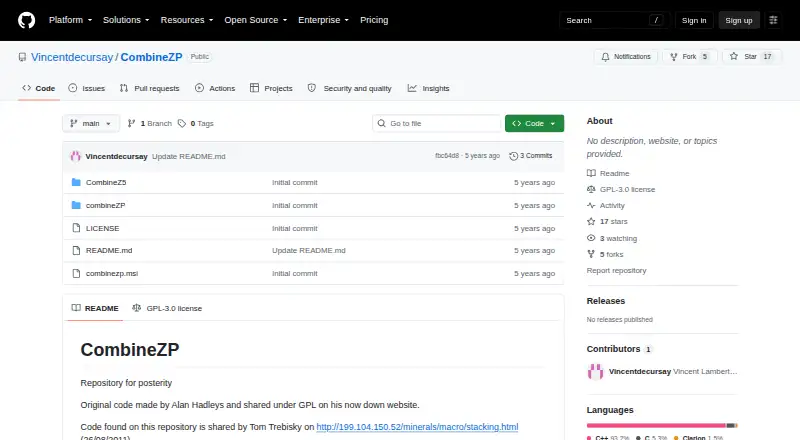
- GitHub identifies the repository license as GPL-3.0.checked 8 Oct 2026
- Maintenance
- A third-party microscopy tools page describes CombineZP as not maintained.checked 8 Oct 2026
- Memory controls
- The product page says users can configure memory usage for image sets that place heavier demands on the computer.checked 8 Oct 2026
- Original author
- The repository says the original code was made by Alan Hadley and shared under GPL on his now-down website.checked 8 Oct 2026
- Output
- The product page documents JPEG as the output format.checked 8 Oct 2026
- Project description
- The repository states that it has no description, website, or topics provided.checked 8 Oct 2026
- Purpose
- The repository preserves CombineZP, whose original code was made by Alan Hadley and shared under the GPL.checked 8 Oct 2026
- Release availability
- The repository lists no published releases.checked 8 Oct 2026
- Releases
- The repository's GitHub Releases page says there are no releases.checked 8 Oct 2026
- Repository contents
- The repository contains CombineZ5 and combineZP directories, a GPL-3.0 license file, a README, and a combinezp.msi installer.checked 8 Oct 2026
- Repository status
- The repository describes itself as a repository for posterity.checked 8 Oct 2026
- Security
- The opened repository and product pages provide no security or compliance claims.checked 8 Oct 2026
- Stacking methods
- The product page names Do Stack and Pyramid Maximum Contrast among its stacking methods.checked 8 Oct 2026
Where it runs
- Macro controls
- The product page says users can edit macro parameters for additional control over close-up stacking.checked 8 Oct 2026
- Platform
- A third-party microscopy tools page describes CombineZP as a stacker for MS Windows that works with Wine on Linux.checked 8 Oct 2026
Alternatives to CombineZP
- 1
Avidemux
Free planOpen sourceWebLinuxmacOSWindows7.3Free plan - 2
HexEd.it
Free planAndroidiOSWebAPI7.3Free plan - 3
Bedrock Viz
Free planWebLinuxmacOSWindows6.8Free plan - 4
010 Editor
LinuxmacOSWindows6.6 - 5
BinEd
Free planAndroidWebLinuxmacOS6.6Free plan - 6
Hecate
Free planLinuxmacOSWindows6.5Free plan