Catalogd
Catalogd turns product spreadsheets, photo folders, or manually entered items into catalogs formatted for commerce-platform import.
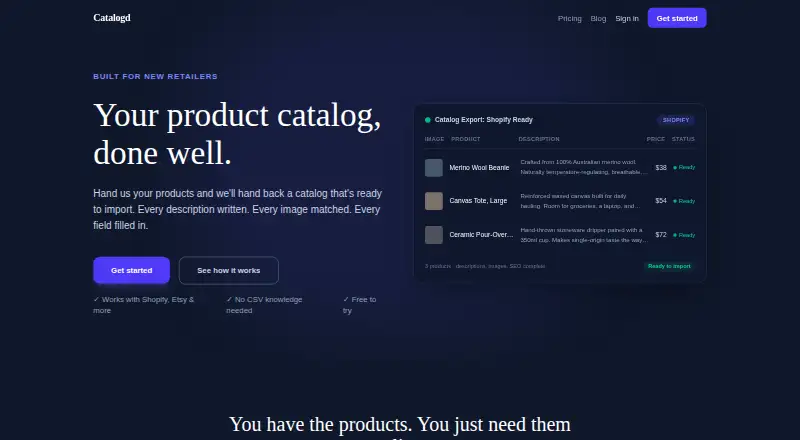
What Catalogd is
Catalogd turns product spreadsheets, photo folders, or manually entered items into catalogs formatted for commerce-platform import. It writes descriptions in a user's brand voice, matches product photos to products with AI, and fills SEO fields such as meta titles, descriptions, alt text, and URL handles. It can generate combinations of variants, including sizes, colors, and materials, with pricing, then export a platform-formatted CSV. Supported platforms listed are Shopify, Etsy, WooCommerce, BigCommerce, Wix, and Squarespace. For Etsy, Catalogd formats files for Vela, a third-party tool, because Etsy has no native CSV import. The product is aimed at boutique retailers moving online and artists and makers with handmade products; freelancers and agencies can also use it for client catalog work. The free plan covers up to five products in one run for one platform and includes AI descriptions, photo matching, and CSV export. Paid plans are one-time purchases: Starter is 49.00 USD, Pro is 149.00 USD, and Studio is 399.00 USD. Studio includes priority support. A one-hour onboarding call can be added to any plan for 199 USD.
Good
- Accepts spreadsheets, photo folders, or manual product entries.
- Generates descriptions in the user's brand voice.
- Matches photos to products with AI.
- Creates variant combinations with pricing.
- Exports CSV files for six listed platforms.
Watch out
- Free plan is limited to five products.
- Starter allows one run and one platform.
- Paid plans are one-time purchases.
- Onboarding call costs 199 USD.
Who it suits
It suits boutique retailers, artists, and makers preparing product catalogs for online selling. Freelancers and agencies can also use it to format catalogs and prepare product descriptions and SEO fields for clients.
Verdict
Catalogd brings product content, image matching, SEO fields, variants, and platform-formatted exports into one catalog workflow. Its free and paid tiers have different product, run, and platform limits, so check the plan details against the size of your catalog.
Plans and prices
From Catalogd's own pricing page, checked 5 Oct 2026.
| Plan | Price | What it gives you |
|---|---|---|
| Free | Free | Up to 5 products · 1 run · 1 platform · AI-written descriptions · AI photo matching · Full CSV export · No credit card required |
| Starter | $49, paid once | Up to 50 products · 1 run · 1 platform · 1 download · $0.98/product · one-time |
| Pro | $149, paid once | Up to 250 products per run · 5 runs · All 6 platforms · Runs never expire · $0.12/product · one-time |
| Studio | $399, paid once | Up to 2,000 products per run · 20 runs · All 6 platforms · Priority support · Runs never expire · $0.01/product · one-time |
The facts
Each one read from Catalogd's own pages, with the date it was checked.
What it does
- AI descriptions
- It writes product descriptions in the user's brand voice.checked 5 Oct 2026
- Etsy workflow
- Catalogd formats Etsy files for Vela, a third-party tool, because Etsy does not have a native CSV import.checked 5 Oct 2026
- Exports
- Catalogd provides a platform-formatted CSV file for import.checked 5 Oct 2026
- Image matching
- It uses AI to match product photos to products.checked 5 Oct 2026
- Onboarding
- A one-hour onboarding call can be added to any plan for $199.checked 5 Oct 2026
- Product catalog builder
- Catalogd turns product spreadsheets, photo folders, or manually entered products into catalogs ready to import.checked 5 Oct 2026
- SEO fields
- It fills in SEO fields including meta titles, meta descriptions, alt text, and URL handles.checked 5 Oct 2026
- Support
- The Studio plan includes priority support.checked 5 Oct 2026
- Variants
- It generates product variant combinations, including sizes, colors, and materials, with pricing.checked 5 Oct 2026
- Who it serves
- The site describes the product as built for boutique retailers going online and artists and makers with handmade products.checked 5 Oct 2026
Money
- Freelancers and agencies
- Catalogd says freelancers and agencies can use it to format catalogs, write descriptions, and fill SEO fields for client projects.checked 5 Oct 2026
Where it runs
- Supported commerce platforms
- The site lists Shopify, Etsy, WooCommerce, BigCommerce, Wix, and Squarespace as supported platforms.checked 5 Oct 2026
The full review of Catalogd
Overview
Catalogd is a web-based tool for turning product data and photos into commerce-ready catalogs. It is best suited to boutique retailers, artists, makers, and client-service teams preparing products for online stores. Its breadth of catalog tools is appealing, though the one-time plans’ run and platform limits matter as much as the headline product caps.
Key features
Catalogd brings catalog building and product content into one workflow: it can work from spreadsheets, photo folders, or manually entered products, then generate brand-voice descriptions, match photos to products, and fill SEO fields such as meta titles, descriptions, alt text, and URL handles. Variant generation covers sizes, colors, and materials with pricing. That combination is useful for sellers who need to prepare a complete product feed rather than just write copy.
Bulk generation and image input suit sellers who already have product information and photos to organize. Brand controls support a consistent voice, while freelancers and agencies can use the same workflow to format client catalogs, write descriptions, and complete SEO fields. The output is a platform-formatted CSV for import.
Catalogd supports Shopify, Etsy, WooCommerce, BigCommerce, Wix, and Squarespace. Etsy is less direct: Catalogd formats files for Vela, a third-party tool, because Etsy has no native CSV import. Sellers who want a direct CSV import should account for that extra step.
Pricing
The free plan costs nothing and covers up to 5 products, 1 run, and 1 platform, with AI-written descriptions, AI photo matching, and full CSV export. No credit card is required. It is a useful way to try the workflow, but the product and run caps make it unsuitable for a substantial catalog.
Starter costs $49, paid once, billed one-time. It covers up to 50 products, 1 run, 1 platform, and 1 download, at $0.98/product. The lack of repeat runs and the single-platform limit make it a narrow fit for a small, one-off catalog.
Pro costs $149, paid once, billed one-time. It allows up to 250 products per run, 5 runs, all 6 platforms, and runs never expire, at $0.12/product. It is the more practical option for sellers with multiple batches or destinations who do not need Studio’s larger per-run capacity.
Studio costs $399, paid once, billed one-time. It raises capacity to 2,000 products per run and 20 runs, covers all 6 platforms, includes priority support, and keeps runs from expiring; the stated rate is $0.01/product. Its scale suits larger catalog projects and agencies handling repeated client work. A one-hour onboarding call can be added to any plan for $199. No seat limits or renewal terms are given.
Platforms
Catalogd is available on the web and exports catalogs for Shopify, Etsy, WooCommerce, BigCommerce, Wix, and Squarespace. The plan choice affects platform access: Free and Starter each cover one platform, while Pro and Studio cover all six.
Who it's for
Catalogd is a strong fit for boutique retailers moving online and artists or makers selling handmade products, especially when they need descriptions, image matching, variants, and SEO fields alongside the export. Freelancers and agencies can also use it to prepare client catalogs. It is less compelling for a seller with only a handful of products who needs ongoing monthly work: the free tier is tightly capped, and the paid options are one-time purchases with finite run counts.
Pros and cons
- Pros: One workflow covers product descriptions, photo matching, SEO fields, variants, and platform-formatted CSV export.
- Pros: Pro and Studio include all six supported platforms, and their runs never expire.
- Pros: Studio’s 2,000-product run limit and priority support suit larger catalog projects.
- Cons: Free is limited to 5 products, 1 run, and 1 platform; Starter allows only 1 download.
- Cons: Etsy requires a handoff to Vela rather than a native CSV import.
- Cons: Starter, Pro, and Studio provide finite run counts, so frequent ongoing catalog work may require careful planning.
Alternatives
For a smaller recurring product-description workflow, Catalog Mind offers 10 products per month on its free plan and a $29 a month Starter plan; Catalogd is stronger when photo matching, SEO fields, variants, and larger one-time batches matter.
EcomIQX is worth considering for a more technical setup: it supports API and self-hosted use as well as web access, and its free plan includes 30 credits per month, one connector, and imports of up to 25,000 products. Catalogd is the more focused fit when the goal is preparing platform-formatted content and exports.
Blurbi is another freemium option for product descriptions, with web and extension access and a free allowance of 5 descriptions per month across seven platforms.
Describely has a free version for 5 products and a pay-as-you-go option priced at $0.75 per product for up to 500 products; it may suit a product-copy task where Catalogd’s broader catalog workflow is unnecessary.
Ecopy offers a free preview of one AI product page and a full page builder with templates, so it is an alternative when the priority is a product page rather than a multi-platform catalog export.
Esergon provides 5 free listings per month with AI titles and descriptions, image or name input, and a Shopify one-click push; choose it when that direct Shopify workflow is the priority.
InkForge is an alternative for product-description generation, with 50 credits per month on its free plan.
Selluminate offers 10 lifetime free generations with photo uploads, generation, and listing previews; it may suit a small initial batch rather than Catalogd’s wider export workflow.
Browse AI Product Description Generators for more options focused on product copy.
Verdict
Catalogd is a good choice for retailers, makers, and agencies that need to turn product data and photos into a polished, exportable catalog with content and SEO fields included. Its broad workflow and non-expiring Pro and Studio runs are the main reasons to choose it. Look elsewhere if you need ongoing monthly catalog work, a direct Etsy import, or a plan without restrictive run or download caps.
Getting started
- Open the Catalogd website
- Choose the Free, Starter, Pro, or Studio plan
- Provide a spreadsheet, photo folder, or manually entered products
- Select a supported commerce platform
- Run catalog generation and download the platform-formatted CSV
- Import the CSV into your platform; for Etsy, use Vela
Limits worth knowing
The Free plan allows up to 5 products, 1 run, and 1 platform. Starter allows up to 50 products, 1 run, 1 platform, and 1 download; Pro allows 250 products per run and 5 runs; Studio allows 2,000 products per run and 20 runs.
Questions
Is there a free plan or trial?
Yes. Catalogd has a Free plan and a free trial. The Free plan requires no credit card.
What are the paid prices?
Starter costs 49.00 USD once, Pro costs 149.00 USD once, and Studio costs 399.00 USD once.
Which commerce platforms are supported?
Catalogd lists Shopify, Etsy, WooCommerce, BigCommerce, Wix, and Squarespace.
How does Etsy export work?
Catalogd formats Etsy files for Vela, a third-party tool, because Etsy has no native CSV import.
What does the free plan include?
It supports up to 5 products, 1 run, and 1 platform, with AI-written descriptions, AI photo matching, and full CSV export.
Is onboarding available?
A one-hour onboarding call can be added to any plan for $199.
Alternatives to Catalogd
- 1

Describely
Free planWebAPI7.5From $28 a month - 2

Apport Enrich
Free planWeb7.3From $9 a month - 3
Blurbi
Free planWebExtension7.3From £79 a year - 4

EcomIQX
Free planWebAPISelf-hosted7.3From $99 a month - 5

Ecopy
Free planWebExtension7.3From $47.90 a year - 6

Hypotenuse AI
WebAPI7.2From $29 a month