Canorus
Canorus is free desktop software for writing and editing musical notation on Linux, macOS, and Windows.
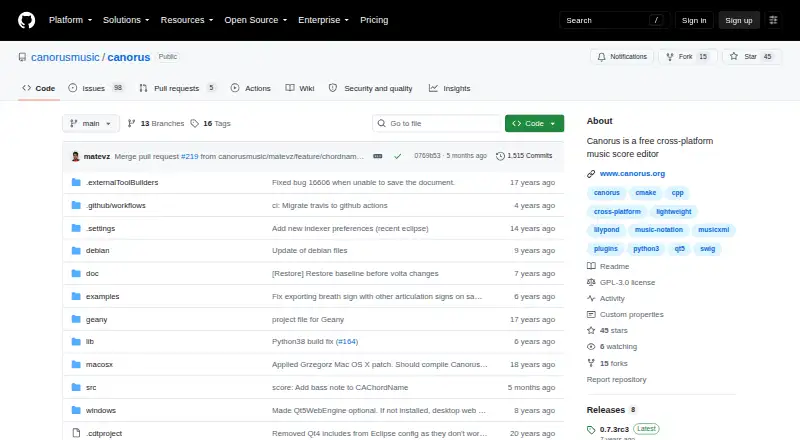
What Canorus is
Canorus is free desktop software for writing and editing musical notation on Linux, macOS, and Windows. It supports notes, rests, clefs, key signatures, time signatures, lyrics, chord markings, and multiple voices, with no stated limit on the number or length of staffs. The project lists MIDI, MusicXML, LilyPond, ABC Music, and MusiXTeX among its import and export formats. MIDI recording and playback are included, with General MIDI instrument configuration. LilyPond provides print preview and printing, while PDF and SVG export are based on LilyPond. Other listed tools include document recovery, undo and redo, copy and paste, scripting, and plugins. Python scripting is working, while Ruby is planned on the SourceForge page. Canorus is licensed under GPLv3 with publicly available source code. The README says development is heavy and that not all features are implemented. The latest listed release is 0.7.3rc3, described as a release candidate.
Good
- Free GPLv3 software with public source code
- Runs on Linux, macOS, and Windows
- Imports and exports MIDI, MusicXML, and LilyPond
- Supports unlimited staff number and length
- Includes MIDI recording and playback
Watch out
- Not all features are implemented
- Latest listed release is a release candidate
- Building requires several development dependencies
- Ruby scripting is planned rather than working
Who it suits
It suits desktop users creating scores who want free, libre software with broad notation and interchange formats. Developers and testers are also listed as intended audiences.
Verdict
Canorus offers a broad free notation toolkit with MIDI, MusicXML, LilyPond, and desktop-platform support. Its active development status and unfinished features mean users should review project requirements before relying on it.
Plans and prices
From Canorus's own pricing page, checked 11 Oct 2026.
| Plan | Price | What it gives you |
|---|---|---|
| Canorus | Free | Free libre software · GNU GPLv3 |
The facts
Each one read from Canorus's own pages, with the date it was checked.
What it does
- Build requirements
- The README lists Qt development tools, SWIG, a C++ compiler, CMake and Python development files among build requirements.checked 11 Oct 2026
- Deployment
- desktopchecked 19 Sep 2026
- Development status
- The project README says Canorus is in heavy development and that not all features are implemented.checked 11 Oct 2026
- File formats
- The project lists import and export support for MIDI, MusicXML and LilyPond, alongside other formats including ABC Music and MusiXTeX.checked 11 Oct 2026
- Intended users
- The release notes describe score-writing capabilities including notes, rests, clefs, key and time signatures, lyrics, and multiple voices, indicating use by music notation authors.checked 11 Oct 2026
- Languages and dependencies
- The README describes Linux, Windows, and Mac OS X support and lists Qt, SWIG, CMake, a C++ compiler, and Python development packages among build dependencies.checked 11 Oct 2026
- License
- The project README says Canorus is licensed under GPLv3 and makes its source code publicly available.checked 11 Oct 2026
- LilyPond
- Release notes describe LilyPond import and export, including using LilyPond for score printing and preview.checked 11 Oct 2026
- Limitations
- The README warns that not all features are implemented and documents runtime dependencies on Qt and Python, with MinGW also required on Windows.checked 11 Oct 2026
- MIDI
- Release notes list MIDI import and export, playback, and an integrated MIDI recorder among the capabilities added to the program.checked 11 Oct 2026
- MIDI support
- Yeschecked 19 Sep 2026
- Music formats
- The project describes import and export for various file formats, including MIDI input and output.checked 11 Oct 2026
- MusicXML
- Release notes list MusicXML import and basic MusicXML export.checked 11 Oct 2026
- MusicXML support
- Yeschecked 19 Sep 2026
- Notation
- Canorus supports standard notation elements including notes, rests, clefs, key signatures and time signatures.checked 11 Oct 2026
- Open source
- Canorus is free libre software licensed under GNU GPL, and its source code is publicly available.checked 11 Oct 2026
- Other features
- The listed features include lyrics, chord markings, document recovery, undo and redo, and copy and paste.checked 11 Oct 2026
- Printing
- Canorus offers print preview and printing through LilyPond, plus PDF and SVG export based on LilyPond.checked 11 Oct 2026
- Purpose
- Canorus is a free music score editor for writing and editing musical notation.checked 11 Oct 2026
- Recent release listed
- The GitHub releases page lists 0.7.3rc3 as the latest release and describes it as a release candidate.checked 11 Oct 2026
- Score capacity
- Canorus supports polyphony and an unlimited number and length of staffs.checked 11 Oct 2026
- Scripting
- The project README lists scripting support, and its build notes describe optional Python and Ruby support.checked 11 Oct 2026
Money
- Free plan
- Yeschecked 19 Sep 2026
Where it runs
- Platforms
- The project README says Canorus runs on Linux, Windows, macOS and other platforms.checked 11 Oct 2026
Alternatives to Canorus
- 1

Flat
Free planAndroidiOSWebmacOS8.7From $49.99 a year - 2
Fender Notion
Free planAndroidiOSWebLinux8.6$14.99 one-time - 3

DomiSol
Free planAndroidiOSWebAPI8.1From $880 a month - 4
Sibelius
iOSWebmacOS7.8 - 5

Noteflight
Free planWeb7.8From $49 a year - 6
ScoreCloud
Free planiOSWebWindowsmacOS7.7From $5.99 a month