
Calico Cloud
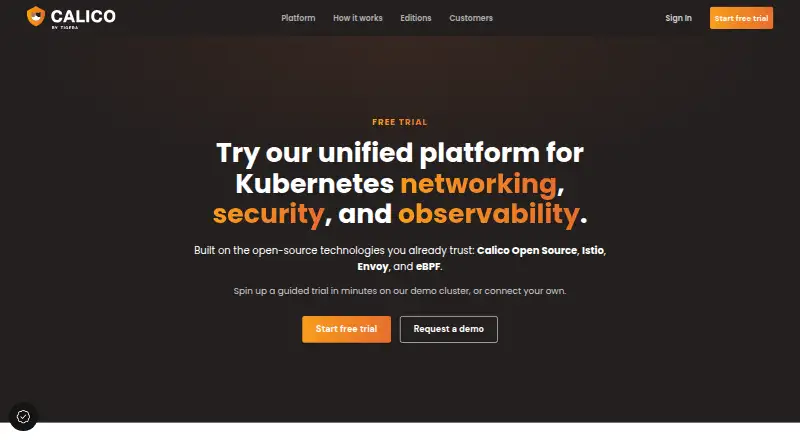
Calico Cloud provides network security, observability, and traffic controls for Kubernetes environments in cloud, on-premises, or edge deployments.
What Calico Cloud is
Calico Cloud provides network security, observability, and traffic controls for Kubernetes environments in cloud, on-premises, or edge deployments. Its observability tools show network topology, workload connections, dependencies, and traffic data to assist troubleshooting. Security capabilities include integrated IDS/IPS, WAF, and DDoS protection, along with forensics and network-policy quarantine for infected workloads. Teams can use policy recommendations, tiered enforcement, and security policy as code in CI/CD pipelines. Networking features listed include eBPF, nftables, iptables, Windows data planes, Envoy Gateway, Egress Gateways, and cluster mesh. Compliance reporting covers PCI, SOC 2, HIPAA, and GDPR, with scheduled or on-demand reports and exportable data. Tigera presents Calico Cloud as a managed SaaS service, with a free trial that does not require a credit card. Supported environments include self-provisioned Kubernetes, EKS, AKS, GKE, and Rancher Kubernetes Engine 2. The Free plan allows one user and one cluster, requires Calico 3.30 or greater, retains logs for 24 hours, and limits Policy Editor to view-only.
Good
- Shows network topology, workload connections, and traffic data.
- Includes IDS/IPS, WAF, and DDoS protection.
- Offers policy recommendations and tiered enforcement.
- Compliance reports cover PCI, SOC 2, HIPAA, and GDPR.
- Free trial requires no credit card.
Watch out
- Free plan is limited to one user and one cluster.
- Free plan requires Calico 3.30 or greater.
- Free logs are retained for 24 hours.
- Policy Editor is view-only on the Free plan.
Who it suits
Calico Cloud suits teams securing and monitoring Kubernetes environments across cloud, on-premises, or edge settings. Its fit depends on having a CNI installed and, when using it for both networking and policy, Calico Open Source.
Verdict
Calico Cloud combines Kubernetes network visibility, policy controls, and security features in a managed service. Check the Free plan limits and cluster prerequisites before connecting an environment.
Plans and prices
From Calico Cloud's own pricing page, checked 14 Oct 2026.
| Plan | Price | What it gives you |
|---|---|---|
| Free | Free | 1 user · 1 cluster · requires Calico Open Source 3.30+ · 24-hour logs · view-only policy editor · no packet capture, egress gateway, threat defense, DNS/L7, alerts or anomaly detection |
| Calico Cloud SaaS Platform | Priced on request | Ingress gateway · observability · policy management · egress gateways · threat detection · enterprise support · 7-day log retention · unlimited users · multi-cluster support · $0.025 / vCPU Hour; usage-based or annual subscription via cloud marketplaces |
| Calico Enterprise | Priced on request | Self-managed platform · ingress gateway · observability · policy management · egress gateways · threat detection · enterprise support · custom log retention · unlimited users · multi-cluster support · Custom Pricing |
| Pay-As-You-Go | Priced on request | Unlimited users · Unlimited clusters · 7-day log retention · Packet capture · Egress Gateway · Threat Defense · DNS and L7 · Alerts · Anomaly Detection |
The facts
Each one read from Calico Cloud's own pages, with the date it was checked.
What it does
- API and extensibility
- The Tigera Operator exposes an operator.tigera.io/v1 Kubernetes API with resources such as Installation, APIServer, EgressGateway, GatewayAPI, IntrusionDetection and PacketCaptureAPI.checked 14 Oct 2026
- Automated installation
- Automated deployment is supported through Helm and kubectl using client credentials, custom values files and a published Calico Cloud Helm repository.checked 14 Oct 2026
- Cluster requirements
- A cluster must have a CNI installed before connecting; Calico Open Source is required when Calico Cloud will provide both networking and network policy.checked 4 Oct 2026
- Compliance
- The site describes compliance reporting for PCI, SOC 2, HIPAA, and GDPR, including scheduled or on-demand reports and exportable compliance data.checked 4 Oct 2026
- CPU architectures
- Supported node architectures are x86-64 and ARM64.checked 14 Oct 2026
- Documentation depth
- The documentation includes installation guides, system requirements, troubleshooting checklists, API schemas, resource definitions, tutorials, operations guidance and release notes.checked 14 Oct 2026
- Egress gateway
- Its egress gateway assigns static source IP addresses to Kubernetes pod traffic for firewall and identification integrations.checked 14 Oct 2026
- Ingress gateway
- The ingress gateway uses Kubernetes Gateway API with an enterprise-hardened Envoy Gateway implementation.checked 14 Oct 2026
- Installation prerequisite
- A cluster must already have a CNI installed before it can be connected to Calico Cloud.checked 14 Oct 2026
- Integrations
- Calico Cloud supports Prometheus and Grafana metrics, either through its Tigera-managed Prometheus operator or a customer-provided Prometheus deployment.checked 14 Oct 2026
- Limit: documentation and setup
- PeerSpot feedback asks for clearer documentation, a more intuitive setup process and better troubleshooting guidance.checked 14 Oct 2026
- Limit: performance and support
- PeerSpot’s product summary reports concerns about performance speed, troubleshooting complexity and customer-support responsiveness.checked 14 Oct 2026
- Managed service
- Calico Cloud is presented as a fully managed SaaS service run by Tigera, with a free trial available without a credit card.checked 4 Oct 2026
- Networking
- The site lists eBPF, nftables, iptables, Windows data planes, Envoy Gateway, Egress Gateways, and cluster mesh capabilities.checked 4 Oct 2026
- Network security
- The platform applies fine-grained network policies, including egress restrictions by IP, domain and CIDR, and can recommend namespace-isolation policies.checked 14 Oct 2026
- Network visibility
- Its observability features show network topology, workload connections, dependencies, and traffic data to support troubleshooting.checked 4 Oct 2026
- Observability dashboards
- Built-in dashboards cover traffic flows, policy decisions and layer-7 requests, with custom dashboards supported.checked 14 Oct 2026
- Open-source relationship
- Project Calico code is released under Apache License 2.0, while Calico Cloud itself is a commercial managed service.checked 14 Oct 2026
Where it runs
- Browser requirements
- The web console supports the latest two versions of Chrome and Safari.checked 14 Oct 2026
- Console browsers
- The web console supports the latest two versions of Chrome and Safari.checked 4 Oct 2026
- Platform architecture
- Calico Cloud supports x86-64 and ARM64 nodes and hybrid Kubernetes clusters with a Linux control plane and Windows nodes on EKS or AKS.checked 4 Oct 2026
The company
- Company legal seller
- AWS Marketplace identifies Tigera Inc. as the seller of Calico Cloud.checked 14 Oct 2026
- Independent company profile
- Gartner describes Tigera as a private company founded in 2016 with a San Jose head office and 51–200 employees.checked 14 Oct 2026
- Maker headquarters and age
- LinkedIn lists Tigera as privately held, founded in 2016, headquartered in San Jose, California, with 51–200 employees.checked 14 Oct 2026
The full review of Calico Cloud
Calico Cloud is a managed Kubernetes networking and security service for teams running clusters across cloud, on-premises, or edge environments. It suits operators who need traffic insight alongside policy controls, rather than broad protection for unrelated devices. Its Free plan is a narrow way to start, while expanded capacity and security features require custom-priced Pay-As-You-Go.
Overview
Calico Cloud brings network visibility, policy management, and threat protection into a service Tigera operates as SaaS. Topology and traffic views can help teams investigate how workloads connect; the product also describes IDS/IPS, WAF, DDoS protection, forensics, and network-policy quarantine. That Kubernetes focus is its strength, but also its boundary: it is not a general-purpose endpoint security suite.
Connecting a cluster requires an installed CNI. If Calico Cloud is expected to provide both networking and network policy, Calico Open Source is also required. This makes it a better fit for teams already equipped to manage Kubernetes networking than for organizations seeking a security tool they can deploy independently of cluster infrastructure.
Key features
Visibility and policy controls
Network topology, workload connections, dependencies, and traffic data provide context for troubleshooting service communication. Policy recommendations, tiered enforcement, and policy as code in CI/CD pipelines give teams ways to move from observation to controlled changes. Those capabilities are particularly relevant to operators who need policy changes to fit established deployment workflows.
Threat protection and networking
The product describes integrated IDS/IPS, WAF, and DDoS protection, plus forensics and quarantine for infected workloads through network policy. Response actions include denying HTTP traffic, blocking traffic to suspicious IPs, and creating a security-event exception. Its networking options include eBPF, nftables, iptables, Windows data planes, Envoy Gateway, Egress Gateways, and cluster mesh; the breadth is useful for varied Kubernetes setups, but does not remove the CNI prerequisites.
Compliance
Compliance reporting covers PCI, SOC 2, HIPAA, and GDPR, with scheduled or on-demand reports and exportable data. That can support teams with recurring reporting needs, though the Free plan's one-cluster scope and 24-hour log retention constrain its usefulness for sustained operations.
Pricing
Free: free. This plan allows one user and one cluster, requires Calico 3.30 or greater, retains logs for 24 hours, and limits the Policy Editor to view-only. It is suited to a small evaluation or tightly bounded deployment, not a team that needs shared access, longer log history, or active policy editing.
Pay-As-You-Go: custom pricing. It provides unlimited users and clusters, seven-day log retention, packet capture, Egress Gateway, Threat Defense, DNS and L7, alerts, and anomaly detection. This is the practical tier for teams needing those operational and security capabilities at scale, but its custom pricing means buyers should establish cost before committing. The free trial does not require a credit card.
Platforms
Calico Cloud is a web-based, agent-based service for Linux and Windows hosts, with Linux, self-hosted, web, and Windows platform support. It supports x86-64 and ARM64 nodes, including hybrid clusters with a Linux control plane and Windows nodes on EKS or AKS. Tested and supported Kubernetes environments include self-provisioned Kubernetes, Amazon EKS, Azure AKS, Google GKE, and Rancher Kubernetes Engine 2. Other distributions may connect with Calico Open Source installed, with Support available for guidance. The console supports the latest two versions of Chrome and Safari.
Who it's for
Calico Cloud is a strong candidate for Kubernetes teams that want traffic troubleshooting, policy controls, and security capabilities in a managed service across cloud, on-premises, or edge environments. It is less suitable for individuals seeking broad device protection, or teams unable to meet the CNI and Calico Open Source prerequisites for their intended setup.
Pros and cons
- Useful traffic context: topology, dependencies, workload connections, and traffic data support investigation of Kubernetes networking issues.
- Policy workflow options: recommendations, tiered enforcement, and policy as code can support controlled policy changes.
- Meaningful Free-plan limits: one user, one cluster, 24-hour logs, and a view-only Policy Editor make Free a limited evaluation tier rather than a shared operational plan.
- Cluster setup has prerequisites: a CNI is required, and Calico Open Source is necessary when the service provides both networking and network policy.
- Expanded capabilities have custom pricing: teams needing unlimited clusters, longer retention, or the Pay-As-You-Go security features must budget without a published fixed price.
Alternatives
For broader cloud-workload protection categories, browse Cloud Workload Protection Platforms.
- Bitdefender Total Security is a better match for readers seeking paid security across Android, iOS, macOS, and Windows devices; its Total Security Individual plan is $59.99 a year, billed at the first-year price, for five devices and one account, plus applicable sales tax.
- Amazon GuardDuty is worth considering for an AWS-focused, pay-as-you-go service; charges depend on analyzed data volume and source and vary by AWS Region.
- Qualys TotalCloud offers a free license with limited API calls for control evaluation, with a paid Cloud Platform subscription at custom pricing.
- Falco is a free, open-source Linux option for teams preferring a self-hosted tool.
- Tracee is a free, open-source Linux option, but requires a compatible kernel and elevated capabilities.
- CrowdStrike Falcon Surface is another paid security option with pricing provided through a demo.
- FortiCNAPP is a paid option with Standard tiers available on one- or three-year terms and entitlement per vCPU.
- Palo Alto Networks Cortex Cloud API Security is another paid option.
Verdict
Choose Calico Cloud if your team operates Kubernetes clusters and wants managed network visibility, policy controls, and security features together. Its strongest case is the combination of traffic context and policy management across supported environments; look elsewhere if you need general device protection, cannot meet the cluster prerequisites, or need predictable published pricing for the broader feature set.
Getting started
- Visit the Calico Cloud website.
- Confirm the cluster has a CNI installed before connecting.
- Use Calico Open Source if Calico Cloud will provide both networking and network policy.
- Start the free trial without a credit card.
- Connect a supported Kubernetes environment, such as EKS, AKS, GKE or Rancher Kubernetes Engine 2.
Limits worth knowing
The Free plan allows one user and one cluster, requires Calico 3.30 or greater, retains logs for 24 hours and limits the Policy Editor to view-only access.
Questions
Does Calico Cloud have a free plan?
Yes. It allows one user and one cluster, requires Calico 3.30 or greater, retains logs for 24 hours and has a view-only Policy Editor.
Is a free trial available?
Yes. Calico Cloud offers a free trial without requiring a credit card.
Which Kubernetes environments are supported?
Listed environments include self-provisioned Kubernetes, Amazon EKS, Azure AKS, Google GKE and Rancher Kubernetes Engine 2.
What does Pay-As-You-Go include?
It lists unlimited users and clusters, seven-day log retention, packet capture, Egress Gateway, Threat Defense, DNS and L7, alerts and anomaly detection.
What must a cluster have before connecting?
A cluster must have a CNI installed. Calico Open Source is required if Calico Cloud will provide both networking and network policy.
Which platforms are supported?
Listed platforms include Linux, self-hosted, web and Windows. The service supports x86-64 and ARM64 nodes and hybrid clusters with Linux control planes and Windows nodes on EKS or AKS.
Alternatives to Calico Cloud
- 1

Amazon GuardDuty
Free planWebAPILinux7.6From $0.03 a month - 2

Sysdig Secure
WebAPILinuxmacOS7.2From $20 a month - 3
Qualys TotalCloud
Free planWebAPI7.0Free plan - 4
SentinelOne Singularity Cloud Security
AndroidiOSWebAPI6.9 - 5
KubeArmor
Free planAPILinuxSelf-hosted6.5Free plan - 6
Tetragon
Free planAPILinuxSelf-hosted6.4Free plan