
Cadence
Cadence is an open-source workflow engine for building fault-tolerant, stateful distributed applications.
What Cadence is
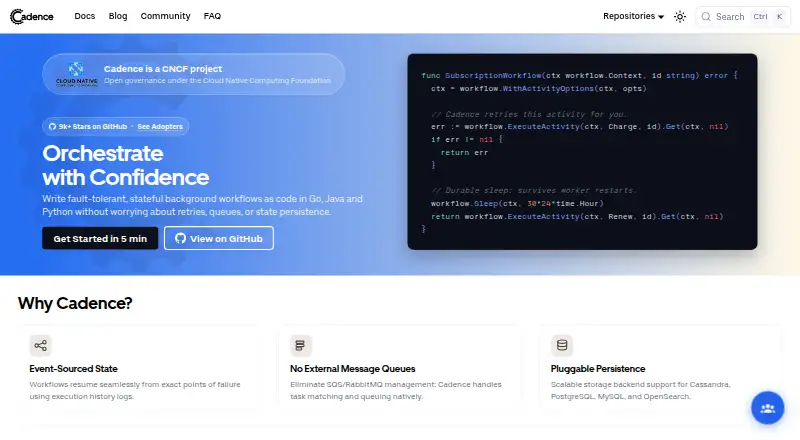
Cadence is an open-source workflow engine for building fault-tolerant, stateful distributed applications. Its durable workflows can continue after process restarts, infrastructure failures or pauses, with workflow state reconstructed through replay. This makes determinism an important requirement: workflow code must behave consistently when replayed. Official SDKs are listed for Go, Java and Python, with a community Ruby client. Schedules support recurring runs, overlap policies, pausing, updates, backfills and execution history. Deployment options include embedded SQLite, Docker Compose and Kubernetes with Helm. For workflow history, production integrations include Cassandra, MySQL or PostgreSQL; visibility options include Elasticsearch, OpenSearch or Apache Pinot. Kafka is listed for search indexing, and Prometheus, StatsD and M3 for metrics. TLS can be configured for backing-service connections, and SDK connections to the frontend support mutual TLS. Cadence targets application developers building workflows and platform engineers operating shared infrastructure. It is self-hosted, open source and listed as free, with no license key, usage limits or per-execution fee.
Good
- Durable workflows resume after failures and pauses
- Official SDKs for Go, Java and Python
- Schedules include backfills and execution history
- No license key, usage limits or per-execution fee
- Supports automatic retries and human approvals
Watch out
- Self-hosted deployment requires operating the infrastructure
- Workflow code must be deterministic
- Ruby support is through a community client
Who it suits
Cadence is intended for application developers building workflows and platform engineers running Cadence as shared infrastructure. It suits teams prepared to deploy and operate the system themselves.
Verdict
Cadence offers durable workflows and multiple deployment and integration options for teams building distributed applications. Its self-hosted model and determinism requirement are important considerations.
Plans and prices
From Cadence's own pricing page, checked 9 Oct 2026.
| Plan | Price | What it gives you |
|---|---|---|
| Open source Cadence | Free | No license key · no usage limits · no per-execution fee |
The facts
Each one read from Cadence's own pages, with the date it was checked.
What it does
- Deployment
- Deployment options include embedded SQLite, Docker Compose, and Kubernetes with Helm; the page also lists a managed Uber cluster for Uber internal teams.checked 9 Oct 2026
- Durable workflows
- Workflows are durable functions that Cadence can resume across process restarts, infrastructure failures, and pauses.checked 9 Oct 2026
- Languages
- The project lists official SDKs for Go, Java, and Python, and a community Ruby client.checked 9 Oct 2026
- Messaging and metrics
- The integrations page lists Kafka for search indexing and Prometheus, StatsD, or M3 for metrics.checked 9 Oct 2026
- Notable constraint
- Workflow code must be deterministic because Cadence may replay it to reconstruct state after a failure.checked 9 Oct 2026
- Payload protection
- A custom data converter can compress or encrypt workflow payloads, or replace large payloads with references to external object storage.checked 9 Oct 2026
- Scheduling
- Schedules support recurring workflow runs, overlap policies, pausing, updates, backfills, and execution history.checked 9 Oct 2026
- Security
- TLS is configurable on backing service connections, and SDK connections to the frontend support mutual TLS.checked 9 Oct 2026
- Storage integrations
- The production integrations page lists Cassandra, MySQL, or PostgreSQL for workflow history, and Elasticsearch, OpenSearch, or Apache Pinot for visibility.checked 9 Oct 2026
- Support
- The project points users to Stack Overflow, CNCF Slack, GitHub Issues, and community contributors for support.checked 9 Oct 2026
- What it does
- Cadence is an open-source workflow engine for building fault-tolerant, stateful distributed applications.checked 9 Oct 2026
- Who it is for
- Cadence targets application developers writing workflows and platform engineers operating Cadence as shared infrastructure.checked 9 Oct 2026
The company
- Founded
- 2017checked 28 Sep 2026
Alternatives to Cadence
- 1
Flowable
Free planOpen sourceAndroidiOSWebAPI8.7From $99 a month - 2

Inngest
Free planOpen sourceWebAPILinuxmacOS8.3From $99 a month - 3

Windmill
Free planOpen sourceWebAPILinuxSelf-hosted8.3From $120 a month - 4

Flyte
Free planOpen sourceWebAPILinuxSelf-hosted8.0Free plan - 5
Kestra
Free planOpen sourceWebAPILinuxmacOS7.9Free plan - 6

ActiveBatch
AndroidiOSWebAPI7.6$10,000 one-time