Byword
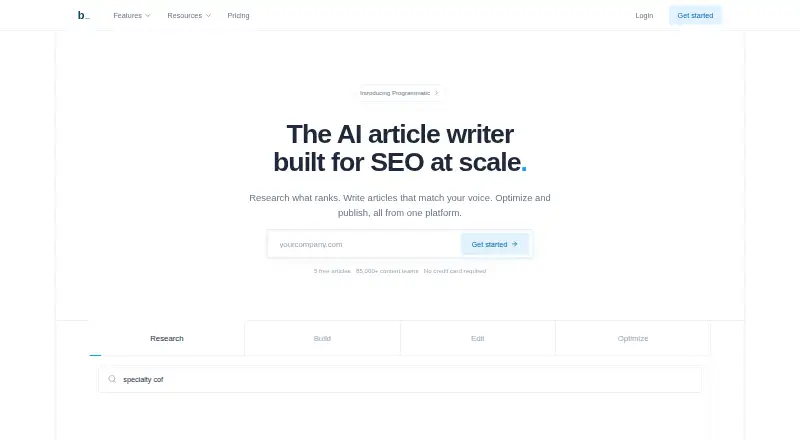
Byword is an AI writing service for creating SEO-focused articles, researching keywords and writing in a user's brand voice.
What Byword is
Byword is an AI writing service for creating SEO-focused articles, researching keywords and writing in a user's brand voice. It supports long-form writing, multilingual content and 50 content templates, with collaboration features. For existing content, it can analyze a URL and create a refreshed, rewritten, outperforming or repurposed version. Its listed AI models are GPT-5.4, Claude Opus 4.6 and Gemini 3.1 Pro. Byword can publish to WordPress, Webflow and four other CMSs. Its integrations list includes Ghost, HubSpot, Medium, Notion, Google Docs, Google Sheets, Airtable, Slack, webhooks and an API; integrations require a paid plan, and multiple platforms can be connected at once. Published URLs can be submitted to Google's Indexing API if the customer connects that API. A REST API reference and MCP server setup are documented. The free plan offers five articles at no cost, with no credit card required. The Unlimited plan costs $1,999 a month plus approximately $0.10 per article and uses the customer's own AI API keys.
Good
- Generates articles in a user's brand voice
- Can refresh or repurpose content from a URL
- Publishes to WordPress, Webflow and other CMSs
- Free plan includes five articles without a card
Watch out
- Integrations require a paid plan
- Starter costs $99 a month for 25 articles
- Unlimited plan uses the customer's own AI API keys
Who it suits
Byword suits content teams producing SEO-focused or long-form articles and people refreshing existing web pages. Its Unlimited plan is described for agencies and enterprises producing 500 or more articles monthly.
Verdict
Byword combines article generation, URL-based content revisions and publishing integrations. The free plan allows a small start, while paid options scale from a monthly article allotment to Unlimited with customer-provided AI keys.
Plans and prices
From Byword's own pricing page, checked 15 Oct 2026.
| Plan | Price | What it gives you |
|---|---|---|
| Starter | $99 a month | 25 articles · monthly |
| Standard | $299 a month | 80 articles · monthly |
| Scale | $999 a month | 300 articles · monthly |
| Free articles | Free | 5 free articles · no credit card required |
| Unlimited | $1,999 a month | unlimited article generation · customer API keys · approximately $0.10 per article · monthly |
The facts
Each one read from Byword's own pages, with the date it was checked.
What it does
- AI models
- The homepage says Byword uses GPT-5.4, Claude Opus 4.6, and Gemini 3.1 Pro.checked 4 Oct 2026
- API
- Byword documentation provides a REST API reference and MCP server setup.checked 4 Oct 2026
- API and MCP
- Public documentation describes an HTTP API with fixed request and response contracts and a Byword MCP option for AI assistants.checked 15 Oct 2026
- Audience
- Byword says it is trusted by more than 85,000 content teams.checked 4 Oct 2026
- Brand voice controls
- Yeschecked 23 Sep 2026
- Bulk campaigns
- Campaigns can generate articles from uploaded lists containing 10, 100 or 1,000 keywords.checked 15 Oct 2026
- Competition insights
- The article workflow shows average competitor word count, common headings and topics, top results and table-of-contents usage.checked 15 Oct 2026
- Content formats
- Byword can analyze a URL and generate a refresh, rewrite, outperform, or repurpose version of existing content.checked 4 Oct 2026
- Content templates
- 50checked 23 Sep 2026
- Developer documentation
- The documentation site includes quick start, article, campaign, programmatic, research, optimization, indexing, integration, API, MCP and settings sections.checked 15 Oct 2026
- Images
- Articles can include AI-generated images with alt text.checked 15 Oct 2026
- Indexing
- Byword can submit published URLs to Google's Indexing API when the customer connects that API.checked 4 Oct 2026
- Integrations
- The integrations directory lists native WordPress, Webflow, Shopify, Google Sheets, Airtable and Notion connections plus Zapier access to more than 5,000 apps.checked 15 Oct 2026
- Internal linking
- Byword can add internal links after a website sitemap is indexed in settings.checked 15 Oct 2026
- Legal name
- Crunchbase lists the legal name as Byword and the operating status as active.checked 15 Oct 2026
- Licence
- The public documentation describes a hosted service and does not publish an open-source licence or self-hosting package.checked 15 Oct 2026
- Limit: Capterra content quality
- The Capterra reviewer says generated text can be repetitive, WordPress headings may format incorrectly and internal links can be irrelevant.checked 15 Oct 2026
The company
- Company history
- Founder Mack Grenfell says the first public version of Byword launched in November 2022.checked 4 Oct 2026
- Company profile
- LinkedIn lists Byword as a privately held technology, information and internet company founded in 2022 with 2–10 employees.checked 15 Oct 2026
- Company reach claim
- LinkedIn says Byword is used by more than 75,000 marketers and has produced millions of articles.checked 15 Oct 2026
- Company size and funding
- Crunchbase shows a 1–10 employee range and does not expose a verified funding total on the public profile.checked 15 Oct 2026
- Headquarters
- Crunchbase places Byword in London, England, United Kingdom.checked 15 Oct 2026
Money
- Free access
- The pricing and programmatic pages advertise five free articles with no credit card required.checked 15 Oct 2026
- Free plan
- Yeschecked 23 Sep 2026
The full review of Byword
Byword is an AI platform for creating and revising search-focused articles, accessible on the web and through an API. It suits teams with a regular publishing schedule and a defined brand voice. Its strongest case is a connected article workflow; the jump from five free articles to 25 for $99 a month is a meaningful cost step.
Overview
Byword combines keyword research, long-form writing, SEO features, brand-voice controls, multilingual support, and 50 content templates. The company says it can generate an article in under two minutes and uses GPT-5.4, Claude Opus 4.6, and Gemini 3.1 Pro. Those capabilities make it a focused tool for article production rather than a general-purpose writing workspace.
It can also work from an existing URL, producing a refresh, rewrite, outperform, or repurpose version. That gives content teams a way to address both new articles and updates to published pages. Byword says more than 85,000 content teams trust it, though the practical fit still depends on whether the monthly article allowance matches a team's output.
Key features
Article creation and revisions
Keyword research, SEO-oriented long-form generation, brand voice, and templates support a repeatable article workflow. URL-based revisions extend that process to existing content, which is useful for teams maintaining a library as well as commissioning new pieces. The emphasis is on articles; readers looking for a broader content operation may prefer a different tool.
Publishing and connections
Byword publishes to WordPress, Webflow, and four other CMSs. Its integrations include WordPress, Webflow, Ghost, HubSpot, Medium, Notion, Google Docs, Google Sheets, Airtable, Slack, webhooks, and API access; paid plans can connect multiple platforms at once. That breadth can reduce handoffs for teams already using those services, but the free plan does not include integrations.
Published URLs can be submitted to Google's Indexing API when the customer connects that API. The REST API reference and MCP server setup also give technical teams ways to build around Byword rather than relying only on its web interface.
Pricing
The free plan costs nothing and includes five articles with no credit card required. It is a useful way to assess the article workflow, but five pieces provide little room for an ongoing publishing schedule.
- Starter: $99 a month for 25 articles. It suits a modest but recurring content pipeline; teams publishing more than that will need to move up.
- Standard: $299 a month for 80 articles. This is a better fit for a busier team that needs substantially more monthly capacity than Starter.
- Scale: $999 a month for 300 articles. It targets high-volume production, but remains capped, making it less suitable for organizations whose demand exceeds that allowance.
- Unlimited: $1,999 a month platform fee plus approximately $0.10 per article. It provides unlimited article generation with customers' own AI API keys and is intended for agencies and enterprises producing 500 or more articles monthly. The API-key requirement and per-article charge matter when comparing its headline platform fee with the other plans.
The paid tiers are billed monthly. The main trade-off is clear: the free allowance is small, while paid plans begin at a sizable monthly commitment and scale by article volume. Unlimited is for very high output, not simply a more generous low-volume plan.
Platforms
Byword is available on web and through an API. Its integrations cover publishing, writing, and team tools, with connections reserved for paid plans. That setup favors teams coordinating content across existing services over individuals who want a standalone mobile app.
Who it's for
Byword is a strong candidate for SEO and content teams that produce articles regularly, need consistent brand voice, and want to revise existing pages as part of the same workflow. Starter and Standard fit smaller recurring pipelines, while Scale and Unlimited address heavier production. Occasional writers may find the free cap too restrictive and the first paid tier more commitment than their needs justify.
Pros and cons
- Pros: URL-based refreshes, rewrites, outperform versions, and repurposing bring existing content into the article workflow.
- Pros: Twelve integrations and API access support publishing and coordination across multiple platforms on paid plans.
- Pros: Brand-voice controls, multilingual support, and 50 templates give teams ways to standardize article production.
- Cons: Five free articles are a limited basis for regular publishing, and paid plans start at $99 a month.
- Cons: Integrations require a paid plan, so free users cannot use the connected publishing workflow.
- Cons: Unlimited requires customer-provided AI API keys and adds an approximately $0.10 per-article charge to its monthly platform fee.
Alternatives
Frase is worth considering for readers who want a lower-priced entry point: its Starter plan is $39 a month billed yearly, or $49 per month month to month, with one site and one person.
Writecream is a better fit for readers who want a free plan with several formats beyond long articles, including icebreakers, podcasts, and voice-overs.
NEURONwriter offers a lower-cost starting point at $23 a month for its Bronze plan, with two projects or folders and 25 content-writer analyses.
seo.ing may suit a lighter publishing need: its free plan allows up to two articles per month and includes multilingual support.
SEORise is an option for readers who want a free tier with one credit or a $9 a month Starter plan with 30 credits.
KeywordBolt is a lower-cost alternative for generation quotas and user seats, with a $19 a month Starter plan for 100 generations and one user.
BrandWell is another option for readers comparing paid software in this category.
ContentRyte may appeal to readers seeking a $29 a month Starter plan that bundles AI words, images, videos, voiceover, and one WordPress site.
Browse SEO Writing Software, AI Blog Writing Tools, and AI Writing Tools for more options.
Verdict
Choose Byword if your team needs a repeatable, SEO-focused article pipeline that covers both new drafts and URL-based updates, with publishing connections and API access as output grows. Its monthly quotas and paid-only integrations make the free plan a limited trial of the workflow, while the $99 a month starting point is hard to justify for occasional writing. Teams producing 500 or more articles monthly may find Unlimited more appropriate, provided they can bring their own AI keys and account for the per-article charge.
Getting started
- Open https://byword.ai/.
- Start with the free plan, which includes five articles and requires no credit card.
- Choose a monthly plan if you need more articles: Starter, Standard, Scale, or Unlimited.
- For publishing connections, use a paid plan and connect the platforms you need.
- Connect Google’s Indexing API if you want Byword to submit published URLs.
Limits worth knowing
The free plan includes five articles. The least expensive paid plan, Starter, costs $99 a month and includes 25 articles; integrations are available on paid plans.
Questions
Is Byword free?
Yes. Its free plan includes five articles, with no credit card required.
What does the Starter plan cost?
Starter costs $99 a month and includes 25 articles.
Which platforms does Byword support?
The listed platforms are web and API. Its publishing and integration options include WordPress, Webflow, Ghost, HubSpot, and other named services.
Are integrations available on the free plan?
The integrations documentation says they are available on paid plans. Multiple platforms can be connected at once.
What does Unlimited cost and require?
Unlimited costs $1,999 a month plus about $0.10 per article. It uses customers’ own AI API keys and is intended for agencies and enterprises producing 500 or more articles monthly.
What models does Byword say it uses?
Its homepage names GPT-5.4, Claude Opus 4.6, and Gemini 3.1 Pro.