
Browsersync
Browsersync is a free, open-source tool for coordinating browser testing across pages, devices, and browsers.
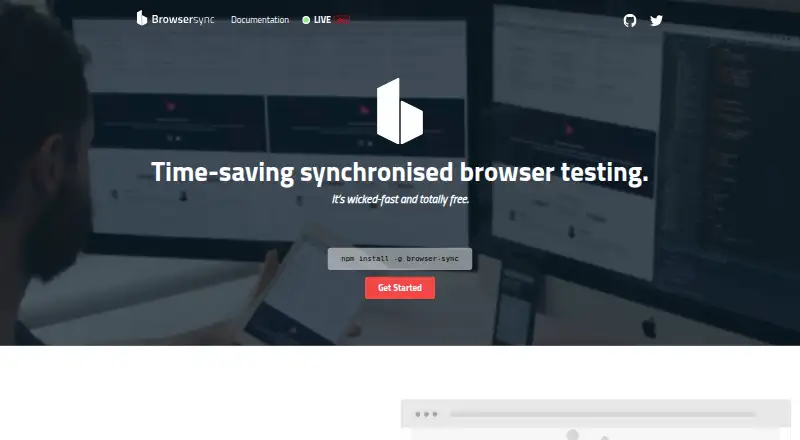
What Browsersync is
Browsersync is a free, open-source tool for coordinating browser testing across pages, devices, and browsers. When project files such as HTML, CSS, or images change, it can update connected browsers. During testing, it can mirror scrolling, clicks, refreshes, and form actions, helping reduce repeated manual steps. Network throttling lets developers check a site over a slower connection, including on devices connected through Wi-Fi. For static sites, Browsersync can start a mini-server; for dynamic sites, it can proxy an existing local server. Developers can control it through a browser-based interface or command line and customize synchronization settings. Its API can be used in Node.js programs or to connect it with other tools. The maker lists Grunt, Gulp, and other Node.js projects as integration options; the Grunt guide provides an official plugin, while Gulp projects can require the module and use its API. Browsersync is a Node.js module installed through npm, available for Linux, macOS, and Windows under the Apache 2.0 License. It is intended to accompany regular watch tasks such as SASS or LESS compilation, not replace them.
Good
- Free and open source under Apache 2.0.
- Mirrors browser interactions during testing.
- Can throttle network connections.
- Supports static servers and dynamic-site proxies.
- Available for Linux, macOS, and Windows.
Watch out
- Requires Node.js and npm.
- Designed to complement, not replace, watch tasks.
Who it suits
Browsersync suits developers who want to synchronize local browser testing across pages, devices, or browsers while working on a site. It fits Node.js workflows and can be used with Grunt, Gulp, or other Node.js projects.
Verdict
Browsersync helps developers coordinate browser checks as project files change, with interaction sync, network throttling, and local server options. It is a companion for existing watch workflows rather than a replacement for them.
Plans and prices
From Browsersync's own pricing page, checked 4 Oct 2026.
| Plan | Price | What it gives you |
|---|---|---|
| Browsersync | Free | Free and open source · Apache 2.0 License |
The facts
Each one read from Browsersync's own pages, with the date it was checked.
What it does
- API
- The API can be used to create a Node.js program for local development or to integrate Browsersync with other tools.checked 4 Oct 2026
- Controls
- Browsersync can be controlled through its browser-based UI or command line, with customizable sync settings.checked 4 Oct 2026
- Grunt integration
- The Grunt guide provides an official plugin for incorporating Browsersync into a development workflow.checked 4 Oct 2026
- Gulp integration
- The Gulp guide says no official Gulp plugin is needed because projects can require the module and use its API.checked 4 Oct 2026
- Integrations
- The maker lists Grunt, Gulp, and other Node.js projects as integration options.checked 4 Oct 2026
- Interaction sync
- Scroll, click, refresh, and form actions can be mirrored between browsers during testing.checked 4 Oct 2026
- License
- The maker describes Browsersync as an open-source project available under the Apache 2.0 License.checked 4 Oct 2026
- Live reload
- It updates connected browsers as project files such as HTML, CSS, and images change.checked 4 Oct 2026
- Network throttling
- It can test a website over a slower connection, including when devices are connected to Wi-Fi.checked 4 Oct 2026
- Purpose
- Browsersync synchronizes browser testing across pages, devices, and browsers to reduce repetitive manual tasks.checked 4 Oct 2026
- Runtime requirement
- Browsersync is a Node.js module installed through npm.checked 4 Oct 2026
- Server modes
- For static sites Browsersync can start a mini-server, and for dynamic sites it can proxy an existing local server.checked 4 Oct 2026
- Usage limit
- The Grunt guide says Browsersync is designed to be used alongside regular watch tasks such as SASS or LESS compilation, not as their replacement.checked 4 Oct 2026
Alternatives to Browsersync
- 1

TestCafe
Free planOpen sourceAndroidiOSWebAPI8.7From $20 a month - 2

TestMu AI
Free planAndroidiOSWebAPI8.3From $17 a month - 3

Testsigma
Open sourceAndroidiOSWebAPI8.3From $14 a month - 4

Browserling
Free planAndroidiOSWebAPI8.1From $9 a month - 5

Happo
Free planAndroidiOSWebAPI8.1From $149 a month - 6
Percy
Free planAndroidiOSWebAPI8.0From $199 a month