Breadbin466
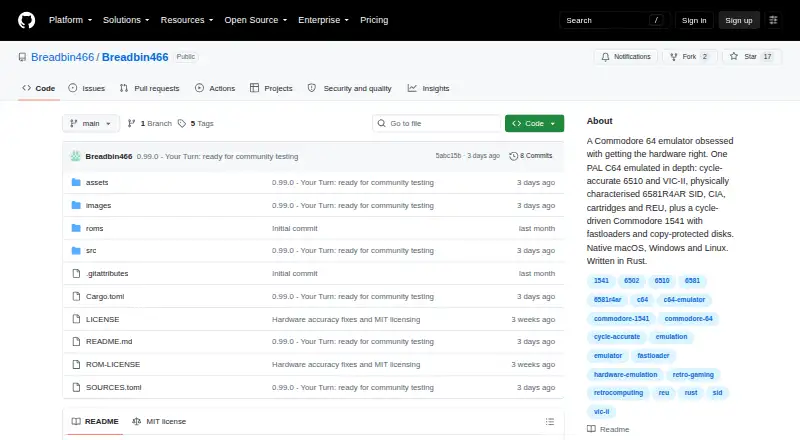
Breadbin466 is a free Commodore 64 emulator written from scratch in Rust, focused on modeling a PAL Assy 250466 machine.
What Breadbin466 is
Breadbin466 is a free Commodore 64 emulator written from scratch in Rust, focused on modeling a PAL Assy 250466 machine. Its cycle-driven hardware emulation covers a MOS 6510 CPU and VIC-II raster timing, video generation, and bus arbitration. Its SID sound model is based on characterization of a physical datecode 2286 chip and covers oscillator, DAC, mixing, and filter behavior. The cycle-driven 1541 drive emulation includes its own CPU, VIAs, mechanics, GCR read channel, IEC communication, fastloaders, and protected-disk behavior.
Other modeled hardware includes CIA timers and interfaces, a 1351 proportional mouse, a 1530 Datassette with TAP playback and recording, cartridges, and a 1764 REU with 512 KB. It supports D64, G64, NIB, NBZ, and D7Z disk images, along with tools for creating and converting images and reclaiming space. The integrated debugger offers breakpoints, disassembly, history, and configurable tracing. Native menus and Inspector windows are available on macOS, Windows, and Linux. Version 0.99.0 is described as feature-complete and ready for community testing, with broader testing still remaining before 1.0.
Good
- Models cycle-driven CPU and video hardware.
- Emulates a cycle-driven 1541 disk drive.
- Supports five listed disk-image formats.
- Includes an integrated debugger and PCM WAV capture.
Watch out
- Emulation focuses on one PAL Assy 250466 machine.
- Linux support is through source builds.
- Version 0.99.0 still has broader testing remaining before 1.0.
- Bundled Commodore ROM images are excluded from the MIT license.
Who it suits
Breadbin466 suits users seeking a detailed emulator for a PAL Assy 250466 Commodore 64, including those who want disk tools, audio capture, or debugging features. It is also relevant to users who need macOS, Windows, or Linux support.
Verdict
Breadbin466 emphasizes detailed modeling of one C64 hardware configuration, with disk, tape, debugger, and audio-capture capabilities. Note that its ROM images are not covered by the emulator's MIT license and the project identifies wider testing as remaining before version 1.0.
Plans and prices
From Breadbin466's own pricing page, checked 29 Sep 2026.
| Plan | Price | What it gives you |
|---|---|---|
| Breadbin466 | Free | MIT-licensed emulator · Commodore ROM images are not covered by the MIT License |
The facts
Each one read from Breadbin466's own pages, with the date it was checked.
What it does
- Audio capture
- The project lists session-long PCM WAV audio capture and command-line automation facilities for testing and characterisation.checked 29 Sep 2026
- Availability
- The repository says macOS and Windows builds are available through release downloads and Linux is supported through source builds.checked 29 Sep 2026
- CPU and video
- It emulates a cycle-driven MOS 6510 CPU and VIC-II raster timing, video generation, and bus arbitration.checked 29 Sep 2026
- Debugging
- The integrated debugger includes breakpoints, disassembly, history, and configurable execution, read, and write tracing.checked 29 Sep 2026
- Desktop features
- Native menus and Inspector windows are provided on macOS, Windows, and Linux, with fixed-refresh display pacing and 44.1 kHz audio preferred.checked 29 Sep 2026
- Disk drive
- The cycle-driven Commodore 1541 emulation includes its own CPU, VIAs, mechanics, GCR read channel, IEC communication, fastloaders, and protected disk behavior.checked 29 Sep 2026
- Disk formats
- It supports D64, G64, NIB, NBZ, and the project's open D7Z disk-image format, plus disk-image creation, conversion, and space-reclamation tools.checked 29 Sep 2026
- License
- The emulator is licensed under MIT, while the Commodore ROM images distributed with it are explicitly excluded from that license.checked 29 Sep 2026
- Other hardware
- Features include CIA timers and interfaces, a 1351 proportional mouse, a 1530 Datassette with TAP playback and recording, cartridges, and a 1764 REU with 512 KB.checked 29 Sep 2026
- Project status
- Version 0.99.0 is described as feature-complete and ready for community testing, with broader testing remaining before 1.0.checked 29 Sep 2026
- Purpose
- Breadbin466 is a from-scratch Commodore 64 emulator written in Rust that focuses on accurately modeling one PAL Assy 250466 machine.checked 29 Sep 2026
- Sound
- Its MOS 6581R4AR SID model is based on characterisation of a physical datecode 2286 chip and models oscillator, DAC, mixing, and filter behavior.checked 29 Sep 2026
- Support
- Users can send feedback to [email protected] or report reproducible problems through GitHub Issues.checked 29 Sep 2026
The full review of Breadbin466
Overview
Breadbin466 is a free Commodore 64 emulator for people who care about the behavior of a particular machine, not broad coverage of C64 variants. Its PAL Assy 250466 focus supports unusually detailed modeling of the computer and its peripherals, though version 0.99.0 is still awaiting wider community testing before 1.0.
That narrow target shapes the experience: the emulator models a cycle-driven MOS 6510 and VIC-II timing, video generation, and bus arbitration. Its MOS 6581R4AR SID model draws on characterization of a physical datecode 2286 chip, covering oscillator, DAC, mixing, and filter behavior. This depth makes Breadbin466 a compelling fit for preservation and hardware-focused use; it is less suitable if you need to switch among several C64 configurations.
Key features
- Cycle-driven disk drive: The emulated Commodore 1541 has its own CPU and VIAs, along with mechanics, a GCR read channel, IEC communication, fastloaders, and protected-disk behavior. That makes the drive a substantial part of the emulation rather than a simple image loader.
- Peripherals: CIA timers and interfaces, a 1351 proportional mouse, cartridges, and a 1764 REU with 512 KB extend the modeled setup. The 1530 Datassette supports TAP playback and recording, useful for working with tape software as well as disks.
- Disk formats and tools: Breadbin466 supports D64, G64, NIB, NBZ, and its open D7Z disk-image format. Creation, conversion, and space-reclamation tools help users manage images without relying only on external utilities.
- Debugger and automation: Breakpoints, disassembly, history, and configurable execution, read, and write tracing serve users investigating program behavior. Command-line automation supports testing and characterisation, while session-long PCM WAV capture gives audio-focused work a direct recording path.
- Desktop presentation: Native menus and Inspector windows are provided on macOS, Windows, and Linux. Fixed-refresh display pacing and a preferred 44.1 kHz audio rate suit a conventional desktop setup, though the project does not claim support for other refresh or audio configurations here.
Pricing
Breadbin466 costs nothing. The single free plan includes the MIT-licensed emulator and its documented capabilities; there are no paid tiers, seat limits, quotas, trial period, or renewal terms to weigh.
The license distinction matters: Commodore ROM images distributed with the emulator are explicitly excluded from the MIT license. Users should not treat the emulator's free software license as covering those images.
Platforms
Breadbin466 supports macOS, Windows, and Linux. macOS and Windows builds are available through release downloads, while Linux users are supported through source builds. That difference makes the first two more direct choices for users seeking a packaged build; Linux users should be comfortable building from source.
Who it's for
Breadbin466 is best for C64 enthusiasts, preservation-minded users, and developers who want to examine one PAL hardware configuration in depth. The built-in debugger, tracing, command-line automation, and audio capture also make it relevant to technical analysis and characterisation work.
It is a less natural choice for users who need several emulated C64 variants or a Linux release download rather than a source build. The project calls version 0.99.0 feature-complete and ready for community testing, but says broader testing remains before version 1.0, so users seeking a project already past that testing milestone may prefer another option.
Pros and cons
- Pro: Cycle-driven CPU, video, and 1541 modeling, plus a characterized SID model, give hardware-focused users meaningful depth across the system.
- Pro: The combination of multiple disk formats, image utilities, a debugger, automation, and WAV capture supports both ordinary software use and technical investigation.
- Pro: The emulator is free and MIT-licensed, with builds for macOS and Windows and source-build support for Linux.
- Con: Its emulated target is one PAL Assy 250466 configuration, limiting its appeal when coverage of multiple C64 variants is important.
- Con: Linux users need to build from source, and wider project testing remains before version 1.0.
- Con: The bundled Commodore ROM images are not covered by the emulator's MIT license, a distinction users must keep in mind.
Alternatives
Compare Commodore 64 emulators if you want to weigh Breadbin466's single-machine focus against other approaches. VICE is a free alternative for users who want Android support in addition to Linux, macOS, and Windows; its software is under GNU GPL v2 or later and carries no warranty.
Buddi is budgeting software rather than a C64 emulator, so it is not a substitute for Breadbin466's emulation. Frodo is another free option for Linux, macOS, and Windows users considering C64 software. VirtualC64 suits macOS or web users who want an open-source option under the GNU General Public License.
C64 Forever is a Windows-only freemium option for users considering an alternative with a free plan. Viciious is a free choice for Linux or web users, while Z64K is a free choice across Linux, macOS, and Windows. CCS64 may suit Linux or Windows users willing to pay $30, paid once for regular use; registered users may receive special features.
Verdict
Choose Breadbin466 if you want a free emulator built around detailed modeling of one PAL C64 configuration, especially for debugging, disk work, or audio characterisation. Its focused hardware coverage is the reason to choose it; look elsewhere if you need multiple emulated variants, a Linux release build, or a project already beyond its remaining pre-1.0 testing.
Getting started
- Download a release build for macOS or Windows.
- For Linux, use the supported source-build route.
- Use D64, G64, NIB, NBZ, or D7Z disk images, or use the included image tools to create or convert images.
Questions
How much does Breadbin466 cost?
The listed plan is free at no cost.
Which systems can run it?
Breadbin466 supports macOS, Windows, and Linux. Release builds are available for macOS and Windows; Linux is supported through source builds.
Which C64 configuration does it emulate?
It focuses on the PAL Assy 250466.
Which disk-image formats does it support?
It supports D64, G64, NIB, NBZ, and D7Z.
Is Breadbin466 open source?
The emulator is licensed under MIT. The Commodore ROM images distributed with it are explicitly excluded from that license.
What is the project's current status?
Version 0.99.0 is described as feature-complete and ready for community testing, with broader testing remaining before 1.0.
Alternatives to Breadbin466
- 1
TRX64
Free planOpen sourceWebAPILinuxmacOS7.5Free plan - 2
Frodo
Free planOpen sourceAndroidLinuxmacOSSelf-hosted7.4Free plan - 3
Avidemux
Free planOpen sourceWebLinuxmacOSWindows7.3Free plan - 4
VICE
Free planAndroidLinuxmacOSWindows7.1Free plan - 5
Power64
macOS6.7$30 one-time - 6
C64 Forever
Free planWindows6.6$19.95 one-time