
BlueVolt
BlueVolt is a learning management system and course-sharing network for training, certifying, and activating external channel partners.
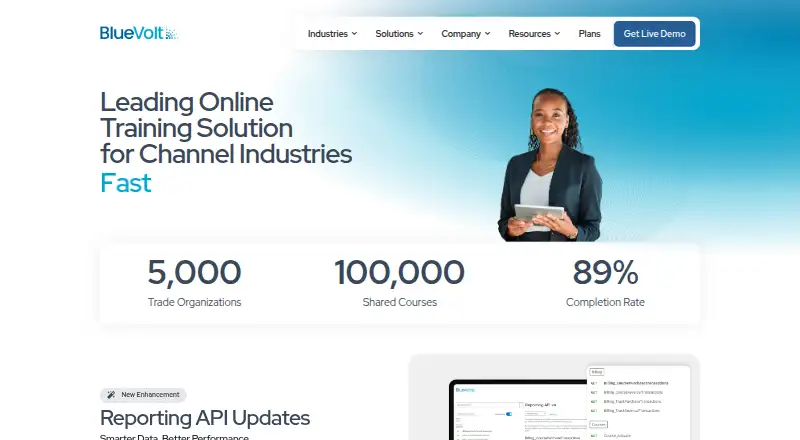
What BlueVolt is
BlueVolt is a learning management system and course-sharing network for training, certifying, and activating external channel partners. It is purpose-built for manufacturers, distributors, buying groups, and trade associations in areas including construction, electrical, HVAC, plumbing, and industrial markets. BlueVolt says its network connects more than 1.2 million learners across trade and industrial channels. Organizations can create branded universities and Training Tracks, use incentives and automation rules, and manage analytics, reporting, certifications, badges, and instructor-led training. Course materials can include SCORM or xAPI content, presentations, PDFs, videos, and external URLs. The platform supports course authoring, assessments, custom branding, custom domains, and API access. Listed integrations include single sign-on, REST APIs for reporting and user management, Salesforce, payment services, content tools, and NATE reporting. The APIs do not create enrollments or modify courses and do not provide certificate records. BlueVolt is accessible on web, Android, and iOS through responsive web access, though course compatibility varies. Pricing is custom or a flat annual fee per course, depending on the program; no price is listed.
Good
- Supports branded universities and Training Tracks.
- Accepts SCORM, xAPI, PDFs, videos, and other formats.
- Includes certification, badging, assessments, and reporting.
- Supports custom branding, domains, and API access.
Watch out
- Pricing is custom or a flat annual fee per course; no price is listed.
- Mobile course compatibility varies.
- APIs cannot create enrollments or modify courses.
- APIs do not provide certificate records.
Who it suits
BlueVolt suits manufacturers, distributors, buying groups, and trade associations that train external channel partners. Its course-sharing and certification tools address organizations in trades and industrial markets.
Verdict
BlueVolt brings partner training, course sharing, and reporting together for trade and industrial organizations. Buyers should consider the limits of its API and the variation in mobile course compatibility.
Plans and prices
From BlueVolt's own pricing page, checked 15 Oct 2026.
| Plan | Price | What it gives you |
|---|---|---|
| Publisher Program | — | Scales with courses · create own content · Flat annual fee per course |
| SaaS University | Priced on request | Scales with users/enrollments · reporting · full branding · platform ownership · learner management · Custom pricing |
| Sharing Portal | Priced on request | Scales with partners · reporting · publish and share widely · Custom platform fee |
The facts
Each one read from BlueVolt's own pages, with the date it was checked.
What it does
- AI course search
- The 2026 product update added multilingual natural-language search across course materials with topic and duration filtering.checked 15 Oct 2026
- API authentication
- API calls require a primary subscription key plus a university-scoped API key obtained through the Developer Portal.checked 15 Oct 2026
- API limitation
- Reporting endpoints are read-only and the User Management API cannot create enrollments or modify course content.checked 15 Oct 2026
- API limits
- The APIs support reporting and user profile management, but do not expose endpoints to create enrollments or modify courses, and do not provide certificate records.checked 5 Oct 2026
- API rate limit
- The documented API limit is 30 requests per minute.checked 15 Oct 2026
- Assessments
- The platform supports assessments, surveys, question banks and essay grading.checked 15 Oct 2026
- Audience
- The platform is purpose-built for manufacturers, distributors, buying groups, and trade associations in trades including construction, electrical, HVAC, plumbing, and industrial markets.checked 5 Oct 2026
- Certificates and badges
- BlueVolt provides course-completion certificates, Training Track certificates and badges.checked 15 Oct 2026
- Channel network
- BlueVolt says its course-sharing network reaches more than 1.2 million learners.checked 15 Oct 2026
- Content integrations
- BlueVolt supports LINK Accounts, OpenSesame marketplace deployment and Easygenerator publishing with automatic update synchronization.checked 15 Oct 2026
- Course content
- BlueVolt supports SCORM, xAPI, presentations, PDFs, videos, and external URLs as course content formats.checked 5 Oct 2026
- Documentation and support
- BlueVolt provides a Zendesk knowledge base covering administration, learner issues, APIs, SSO, reports, payments and release notes, plus ticket submission and email support.checked 15 Oct 2026
- E-commerce integrations
- Course sales can connect to Payflow Pro, Authorize.net and Bank of America Merchant Services accounts.checked 15 Oct 2026
- Independent catalog size
- GetApp describes BlueVolt as offering a catalog of about 20,000 published courses.checked 15 Oct 2026
- Integrations
- Listed integrations include SAML and OAuth single sign-on, REST APIs for user management and reporting, Salesforce, PayFlow Pro, Authorize.net, Bank of America Merchant Services, Open Sesame, Easygenerator, and NATE reporting.checked 5 Oct 2026
- Limit: bugs and workflow issues
- G2 reviewers report recurring bugs, including problems assigning multiple training tracks and occasional course or browser issues.checked 15 Oct 2026
- Limit: changing interface
- A G2 reviewer says frequent updates move menus and make existing how-to videos obsolete.checked 15 Oct 2026
- Limit: reporting usability
- G2 feedback says extracting reports could be more user-friendly, despite broad reporting capability.checked 15 Oct 2026
The company
- Company
- BlueVolt says it was founded in 2002 and is headquartered in Portland, Oregon.checked 5 Oct 2026
- Company founded
- BlueVolt was founded in 2002.checked 15 Oct 2026
- Company headquarters
- BlueVolt lists Portland, Oregon as its headquarters and gives an address at 541 NE 20th Avenue, Suite 115.checked 15 Oct 2026
- Company size
- LinkedIn lists BlueVolt as a privately held company with 11–50 employees.checked 15 Oct 2026
- Founded
- 2002checked 28 Sep 2026
- Headquarters
- Portland, Oregon, United Stateschecked 28 Sep 2026
The full review of BlueVolt
Overview
BlueVolt is a learning platform and course-sharing network for organizations that train external partners. It is best suited to manufacturers, distributors, buying groups, and trade associations in trade and industrial markets. Its partner-focused training tools are compelling, but its API gaps and uneven mobile course compatibility can constrain some programs.
Founded in 2002 and based in Portland, Oregon, BlueVolt says its network connects more than 1.2 million learners across trade and industrial channels. It combines branded learning destinations with course distribution and learner administration, making it a stronger fit for ongoing partner education than for organizations seeking a general-purpose employee LMS.
Key features
Partner learning and course sharing
Branded universities give organizations a dedicated training destination, while Training Tracks support structured learning. Incentives, automation rules, analytics, certification, badging, and instructor-led training support help teams motivate learners and monitor progress. These capabilities suit programs that need to train and certify partners across a channel, rather than simply host a collection of courses.
BlueVolt supports SCORM and xAPI alongside presentations, PDFs, videos, and external URLs. Course authoring, assessments, certificates, custom branding, and custom domains are also supported. Its course-sharing network can extend distribution beyond a single organization, but teams should distinguish that reach from the needs of a tightly automated integration: the APIs support reporting and user profile management, but cannot create enrollments, modify courses, or provide certificate records.
Integrations, security, and support
Listed integrations include SAML and OAuth single sign-on, Salesforce, payment services, Open Sesame, Easygenerator, and NATE reporting. BlueVolt says it is certified under AICPA SOC 2 and compliant with EU GDPR. University customers can receive a dedicated Customer Success Manager; technical support is available during business hours, with a knowledge base accessible anytime. The support agreement sets weekday business-hours coverage from 7:00 am to 3:30 pm PST and phone support outside those hours every day.
Pricing
BlueVolt is paid, with custom pricing for its platform plans. There is no published dollar figure to compare, so buyers should request a quote against their expected course, partner, and learner scale.
- Publisher Program: A flat annual fee per course supports quick sharing, scaling by course count, and creating your own content. It suits publishers focused on distributing courses without buying a full training platform; the per-course structure makes course volume central to the cost.
- Sharing Portal: Custom platform pricing covers partner programs, scaling with partners, reporting, and publishing and sharing widely. It is aimed at organizations distributing training across a partner network.
- SaaS University: Custom pricing covers a full training system that scales with users and enrollments, with full branding and platform ownership and direct learner management. It is the broadest fit for organizations that need to operate their own partner university.
The available plan structure does not state seat caps, quotas, trial terms, or renewal terms, so those should be confirmed during pricing discussions.
Platforms
BlueVolt offers web, Android, and iOS access, plus API access. Its responsive mobile experience does not guarantee that every course works well on a phone or tablet. BlueVolt recommends desktops or laptops for CEU courses because mobile devices may not reliably report seat time; that caveat matters for learners who need continuing-education credit recorded correctly.
Who it's for
BlueVolt is a natural shortlist candidate for manufacturers, distributors, buying groups, and trade associations in construction, electrical, HVAC, plumbing, and industrial markets. It is particularly relevant when partner training, course sharing, certification, and branded delivery belong in one program. Organizations that depend on API-driven enrollment or course changes, certificate-record access, or dependable mobile CEU reporting should assess those limitations before committing.
Pros and cons
- Pro: The network connects more than 1.2 million learners across trade and industrial channels, giving course sharing a partner-focused reach.
- Pro: Training Tracks, incentives, automation, reporting, certification, and instructor-led support cover multiple stages of partner education.
- Pro: Course formats include SCORM, xAPI, documents, video, and external URLs, accommodating varied training materials.
- Con: APIs cannot create enrollments, modify courses, or expose certificate records, limiting administrative automation.
- Con: Mobile course compatibility varies, and CEU seat-time reporting may require desktop or laptop use.
- Con: Platform plans use custom pricing, while the Publisher Program charges a flat annual fee per course, making cost comparison dependent on a buyer's structure and scale.
Alternatives
Customer Education Software is a broader category directory for buyers comparing customer education tools.
Consider Continu if broad platform coverage matters: it supports Android, iOS, web, API, browser extension, Linux, macOS, and Windows, with paid Growth and Professional plans organized by monthly active-user bands.
Gainsight Customer Education may suit teams prioritizing academy sites and seat or course capacity, with an Essentials plan that includes one academy site, unlimited seats, and unlimited courses.
LatitudeLearning is worth comparing when a published per-user price is useful: its 100-user license is $11.25 a year, based on a three-year contract billed annually.
SkyPrep offers a free trial and Lite and Premium plans with 100 active users and unlimited courses, making it a comparison point for teams evaluating a capped-user LMS.
AcademyOcean may be preferable for buyers who want a published entry price and a built-in editor: its Essential plan is $250 a month and includes quizzes, certification, SCORM, reports, and a mobile learner interface.
LearnRight is another paid option with a free trial and a Standard plan priced at €899 a year, including 250 active users and one portal.
Thought Industries is an alternative for buyers seeking an option with omnichannel learning, conversational AI learning, content creation, assessment, and certification pathways.
Peerfold is another paid option with a free trial; its Starter and Professional plans offer an organization-seats add-on at $99 a month.
Verdict
Choose BlueVolt when partner and trade-channel education is the core requirement and you want course sharing, branded training, and certification in one platform. Its channel-specific focus and broad training toolkit are the main reasons to shortlist it. Look elsewhere if your workflows rely on APIs to manage enrollments, courses, or certificate records, or if learners must complete CEU courses reliably on mobile devices.
Getting started
- Visit https://bluevolt.com/.
- Choose among Sharing Portal, Publisher Program, or SaaS University pricing models.
- Contact BlueVolt for pricing; costs are custom or a flat annual fee per course depending on the program.
- Use the web platform or its Android and iOS access options.
- For CEU courses where seat time matters, use a desktop or laptop.
Limits worth knowing
Pricing is custom for Sharing Portal and SaaS University; Publisher Program charges a flat annual fee per course, with no listed amounts. The APIs do not create enrollments or modify courses and do not provide certificate records. Mobile course compatibility varies, and mobile devices may not reliably report CEU seat time.
Questions
How is BlueVolt priced?
Pricing is on request. Sharing Portal and SaaS University use custom pricing, while Publisher Program uses a flat annual fee per course.
Which platforms can I use?
BlueVolt is available on the web, Android, and iOS, and it provides API access.
What course content formats does it support?
Supported formats include SCORM, xAPI, presentations, PDFs, videos, and external URLs.
What integrations are listed?
Integrations include SAML and OAuth single sign-on, REST APIs, Salesforce, PayFlow Pro, Authorize.net, Bank of America Merchant Services, Open Sesame, Easygenerator, and NATE reporting.
What do the APIs allow?
They support reporting and user profile management, but do not create enrollments, modify courses, or provide certificate records.
Can learners use it on mobile devices?
The responsive web experience is accessible on mobile, but compatibility varies by course. BlueVolt recommends desktops or laptops for CEU courses because mobile devices may not reliably report seat time.
Alternatives to BlueVolt
- 1

Academy of Mine
AndroidiOSWebAPI7.7From $999 a month - 2

EraLMS
Free planWebAPI7.3From $100 a month - 3
Gainsight Customer Education
AndroidiOSWebAPI7.3From $25,000 a year - 4
Thinkific
AndroidiOSWebAPI7.3 - 5
LearnRight
AndroidiOSWebAPI6.9From €899 a month - 6
Peerfold
WebAPI6.8From $209 a month