binjgb
binjgb is a free, MIT-licensed emulator for Game Boy and Game Boy Color, with support for Super Game Boy also described by the project.
What binjgb is
binjgb is a free, MIT-licensed emulator for Game Boy and Game Boy Color, with support for Super Game Boy also described by the project. Written in C, it runs on Linux, macOS, Windows, and in a browser through WebAssembly. The browser demo lets users upload a game file, and touch-capable devices display an on-screen gamepad. The emulator is described as cycle accurate and as passing many timing tests. It supports several cartridge controllers, including MBC1, MBC1M, MMM01, MBC2, MBC3, MBC5, and HuC1. Users can save or load battery backup data and emulator states as files. Controls include fast-forward, pause, single-frame stepping, rewind, and seeking to a cycle; audio channels and background, window, and sprite layers can be toggled. The README describes Game Boy Color support as incomplete but passable and Super Game Boy support as mostly there. The debugger is a work in progress. Building requires CMake and SDL2, and the debugger uses Dear ImGui.
Good
- Free and MIT licensed.
- Runs on desktop platforms and in a browser.
- Supports saving and loading emulator states.
- Includes rewind and single-frame stepping.
- Touch-capable browser devices show an on-screen gamepad.
Watch out
- Game Boy Color support is incomplete.
- Super Game Boy support is incomplete.
- Debugger is marked as a work in progress.
Who it suits
binjgb suits people looking for a Game Boy-family emulator on desktop or in a browser, including those who want file-based save states and playback controls. Building from source requires CMake and SDL2.
Verdict
binjgb combines browser and desktop availability with detailed playback controls and file-based saves. Its project notes describe incomplete support for Game Boy Color and Super Game Boy, and a debugger still in progress.
Plans and prices
From binjgb's own pricing page, checked 4 Oct 2026.
| Plan | Price | What it gives you |
|---|---|---|
| Free / MIT-licensed | Free | No pricing or usage limits stated |
The facts
Each one read from binjgb's own pages, with the date it was checked.
Where it runs
- Browser build
- The project runs in a browser using WebAssembly, and its demo lets users upload a game file to play.checked 4 Oct 2026
- Platforms
- The README provides build instructions for Linux, Mac, and Windows, and also documents a WebAssembly build.checked 4 Oct 2026
What it does
- Build requirements
- The README lists CMake and SDL2 as build requirements, and says the debugger uses Dear ImGui.checked 4 Oct 2026
- Cartridge hardware
- Supported cartridge controllers include MBC1, MBC1M, MMM01, MBC2, MBC3, MBC5, and HuC1.checked 4 Oct 2026
- Display and audio
- Users can toggle individual audio channels and the background, window, and sprite layers.checked 4 Oct 2026
- Embedding
- The README explains how to copy the JavaScript, WebAssembly, HTML, and CSS files to a web server to embed the emulator in a page.checked 4 Oct 2026
- Emulation support
- The README describes CGB support as “Hacky-but-passable” and Super Game Boy support as “Mostly-there.”checked 4 Oct 2026
- License
- The repository includes an MIT license that permits use, copying, modification, distribution, sublicensing, and sale, subject to its conditions.checked 4 Oct 2026
- Notable limitations
- The README marks the debugger as work in progress and describes CGB and Super Game Boy support as incomplete.checked 4 Oct 2026
- Playback controls
- The listed controls include fast-forward, pause, single-frame stepping, rewind, and seeking to a specific cycle.checked 4 Oct 2026
- Purpose
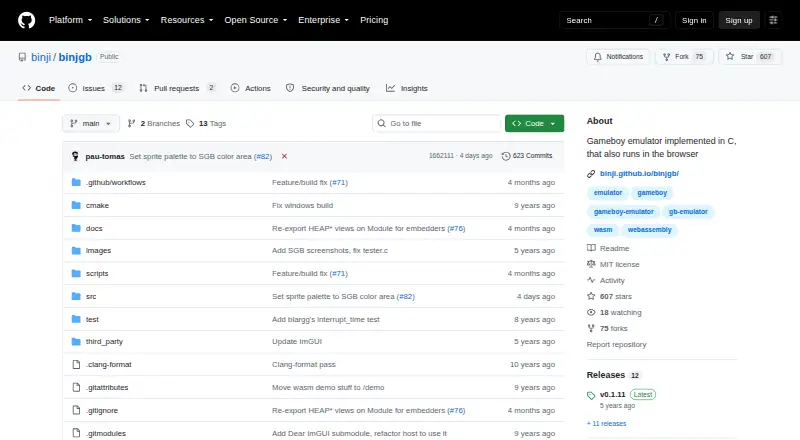
- binjgb is a Game Boy and Game Boy Color emulator implemented in C, with browser support.checked 4 Oct 2026
- Save features
- It supports saving and loading battery backup data and emulator states to files.checked 4 Oct 2026
- Timing
- The emulator is described as cycle accurate and as passing many timing tests.checked 4 Oct 2026
- Touch controls
- The browser emulator displays an on-screen gamepad on devices that support touch events.checked 4 Oct 2026