
BinderHub
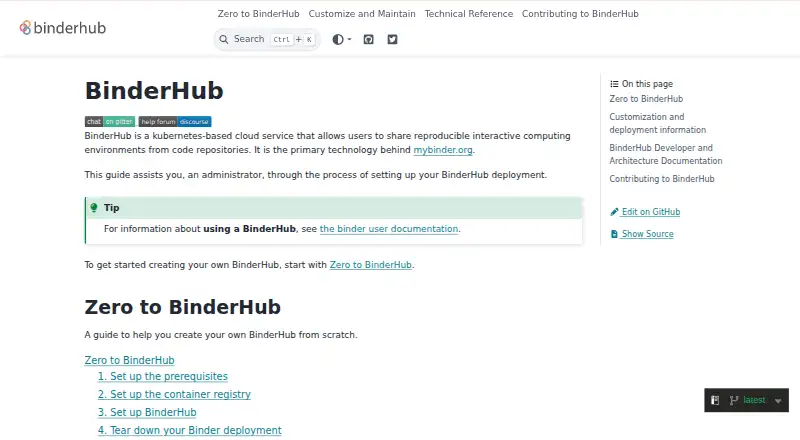
BinderHub is open-source software for creating shareable, interactive computing environments from code repositories.
What BinderHub is
BinderHub is open-source software for creating shareable, interactive computing environments from code repositories. It links repo2docker, which builds Docker images from repositories, with JupyterHub, which launches user sessions. If a requested image is missing, BinderHub builds it, pushes it to a Docker registry, and asks JupyterHub to start the session. Built-in repository sources include GitHub, GitLab, Gist, Zenodo, Figshare, HydroShare, Dataverse, CKAN, and generic Git URLs. Deployers can add providers through custom implementations. A deployment needs Kubernetes, Helm, Docker, a container registry, repo2docker, JupyterHub, and cloud or other infrastructure. The project describes BinderHub as cloud- and hardware-agnostic, leaving hardware choices to deployers. It runs without authentication by default; authentication can be enabled through JupyterHub, and TLS can be configured with supplied certificates or Let’s Encrypt. Its API includes build-and-launch, health, version, Prometheus metrics, and enabled-provider endpoints. JupyterHub monitors user pods and removes them after a short period of inactivity. The software is free; operators supply the infrastructure.
Good
- Builds and launches environments from repositories.
- Supports many built-in repository providers.
- Operators can choose their instance hardware.
- Authentication and TLS can be configured.
- Free open-source deployment software.
Watch out
- Operators must supply cloud or other infrastructure.
- Deployment requires Kubernetes, Helm, Docker, and JupyterHub.
- Setup assumes experience with JupyterHub on Kubernetes.
- Authentication is off by default.
Who it suits
BinderHub suits authors who want to share interactive environments from repositories, users who need those sessions, and operators able to run the deployment infrastructure. Its setup guide assumes experience with JupyterHub on Kubernetes.
Verdict
BinderHub connects repository-based builds with interactive JupyterHub sessions and supports multiple repository providers. It is free software, but running it requires operators to provide and manage substantial infrastructure.
Plans and prices
From BinderHub's own pricing page, checked 4 Oct 2026.
| Plan | Price | What it gives you |
|---|---|---|
| BinderHub (open-source software) | Free | Open-source deployment software · operator supplies cloud or hardware and infrastructure |
The facts
Each one read from BinderHub's own pages, with the date it was checked.
What it does
- API
- The API provides a build-and-launch endpoint, health and version endpoints, Prometheus metrics, and a list of enabled repository providers.checked 4 Oct 2026
- Authentication
- BinderHub runs without authentication by default, and its documentation describes enabling authentication through JupyterHub as an OAuth provider.checked 4 Oct 2026
- Build flow
- When a requested image is missing, BinderHub builds it, pushes it to a Docker registry, then asks JupyterHub to launch it.checked 4 Oct 2026
- Cloud flexibility
- The Binder Project describes BinderHub as cloud- and hardware-agnostic and says deployers can choose the hardware for their own instance.checked 4 Oct 2026
- Custom providers
- Deployers can add repository providers by implementing a RepoProvider subclass and, often, a repo2docker content provider.checked 4 Oct 2026
- How it works
- It connects repo2docker, which builds Docker images from repositories, with JupyterHub, which starts interactive user sessions.checked 4 Oct 2026
- HTTPS
- Deployers can configure TLS for BinderHub and JupyterHub using manually provided certificates or Let’s Encrypt.checked 4 Oct 2026
- Infrastructure
- A deployment uses Kubernetes, Helm, Docker, a container registry, repo2docker, and JupyterHub, plus a cloud provider or other infrastructure.checked 4 Oct 2026
- Installation
- BinderHub is based on Python 3 and can be installed from its GitHub repository with pip; its setup guide assumes experience with JupyterHub on Kubernetes.checked 4 Oct 2026
- Intended users
- The project identifies users, authors sharing interactive environments, and deployers running their own BinderHub as intended audiences.checked 4 Oct 2026
- Operations
- JupyterHub monitors user pods for activity and destroys them after a short period of inactivity.checked 4 Oct 2026
- Purpose
- BinderHub lets users create shareable, interactive, reproducible computing environments from code repositories.checked 4 Oct 2026
- Repository support
- Built-in providers include GitHub, GitLab, Gist, Zenodo, Figshare, HydroShare, Dataverse, CKAN, and generic Git URLs.checked 4 Oct 2026
- Support and community
- The Binder Project points users to its community forum and Zulip channel and invites contributions to the open-source project.checked 4 Oct 2026
Alternatives to BinderHub
- 1

Paperspace Notebooks
Free planWebAPILinuxmacOS7.7From $8 a month - 2

Pluto.jl
Free planOpen sourceAndroidWebAPILinux7.7Free plan - 3

Datalore
Free planWebAPILinuxSelf-hosted7.6From $29.17 a month - 4

Google Colab
Free planWebAPIExtensionSelf-hosted7.6Free plan - 5

JupyterLab
Free planOpen sourceWebAPILinuxmacOS7.6Free plan - 6
Deepnote
Free planWebAPIExtensionLinux7.2From $3,920 a month