
Binder
Binder provides shareable, interactive computing environments that can be launched from publicly available code repositories.
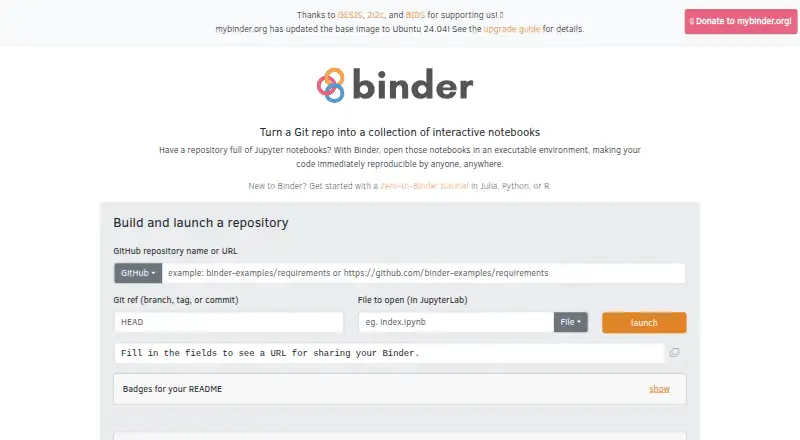
What Binder is
Binder provides shareable, interactive computing environments that can be launched from publicly available code repositories. BinderHub builds an environment image and starts a Binder service; documented repository sources include GitHub, GitLab, and GitHub Gist. JupyterLab is the default interface, with the classic notebook also available. Examples cover Python, R, Julia, and Octave, as well as browser sessions for RStudio, Shiny apps, Voilà dashboards, and Bokeh apps. The free public mybinder.org service requires no login and is intended for interactive, temporary coding, not as the backend for for-profit products. Sessions aim to last up to six hours or one CPU-hour for intensive work, but ongoing availability is not guaranteed. Users are guaranteed at least 1 GB of RAM and may receive up to 2 GB; sessions shut down after more than 10 minutes of inactivity. There is no persistent storage, and session contents are destroyed after logout or inactivity. The stated maximum is 100 simultaneous sessions per repository. Binder can also be self-hosted.
Good
- Free public service with no login required
- Launches repositories from GitHub, GitLab, and GitHub Gist
- JupyterLab and classic notebook interfaces are available
- Examples include Python, R, Julia, and Octave
Watch out
- No persistent storage; session contents are destroyed
- Sessions shut down after more than 10 minutes inactive
- Session duration is not guaranteed
- Maximum 100 simultaneous sessions per repository
Who it suits
Binder suits people who want to share or explore temporary, interactive coding environments from public repositories. It is also an option for users who want to self-host the service.
Verdict
Binder is designed for temporary browser-based coding, with support for several repository sources and notebook interfaces. Its lack of persistent storage and session limits make it unsuitable when work must remain available after a session ends.
Plans and prices
From Binder's own pricing page, checked 8 Oct 2026.
| Plan | Price | What it gives you |
|---|---|---|
| mybinder.org public service | Free | 1–2 GB RAM · sessions aim for up to 6 hours or 1 CPU-hour · 100 concurrent users per repository · no persistent storage |
The facts
Each one read from Binder's own pages, with the date it was checked.
Money
- Free plan
- Yeschecked 22 Sep 2026
What it does
- How it works
- BinderHub dynamically builds user environment images and runs a Binder service.checked 8 Oct 2026
- Intended users
- The project describes mybinder.org as a free public service for interactive and ephemeral coding and asks that it not be used as the backend for for-profit products.checked 8 Oct 2026
- Notebook interface
- JupyterLab is the default Binder interface, and the classic notebook interface is also available.checked 8 Oct 2026
- Other interfaces
- Binder examples show running RStudio, Shiny apps, Voilà dashboards, and Bokeh apps in browser sessions.checked 8 Oct 2026
- Persistence
- Binder does not offer persistent storage, and session contents are destroyed when a user logs off or becomes inactive.checked 8 Oct 2026
- Privacy
- The project says it requires no login, retains IP address logs for 30 days for abuse detection, and publishes an archive of launches without user IP addresses.checked 8 Oct 2026
- Purpose
- The Binder Project provides sharable, interactive, reproducible computing environments.checked 8 Oct 2026
- Repository concurrency
- The stated maximum is 100 simultaneous sessions for a given repository, with quota increases considered for qualifying events but not guaranteed.checked 8 Oct 2026
- Repository sources
- Binder documentation describes launching publicly available repositories from GitHub, GitLab, or a GitHub Gist.checked 8 Oct 2026
- Resource limits
- Users are guaranteed at least 1 GB RAM, may receive up to 2 GB, and sessions are shut down after more than 10 minutes of inactivity.checked 8 Oct 2026
- Security safeguards
- The service limits outgoing bandwidth per session to approximately 1 Mbit, applies anti-cryptomining safeguards, and uses resource limits to reduce abuse.checked 8 Oct 2026
- Session limits
- The project aims for up to six hours per session or one CPU-hour for computationally intensive sessions, without guaranteeing sessions remain running beyond that.checked 8 Oct 2026
- Supported environments
- Examples and documentation cover Python, R, Julia, and Octave environments.checked 8 Oct 2026
- Support model
- The public service is supported by donations, cloud credits, volunteers, and in-kind contributions.checked 8 Oct 2026
Alternatives to Binder
- 1

Replit
Free planAndroidiOSWebLinux9.2From $18 a month - 2

StackBlitz
Free planAndroidiOSWebAPI8.9Free plan - 3

Playcode
Free planAndroidiOSWebAPI8.9From $25 a month - 4
Paperspace Gradient
Free planOpen sourceWebAPIExtensionLinux8.7From $8 a month - 5
GitHub Codespaces
Free planAndroidiOSWebAPI8.6Free plan - 6

JDoodle
Free planAndroidiOSWebAPI8.6From $4 a month