
Auto
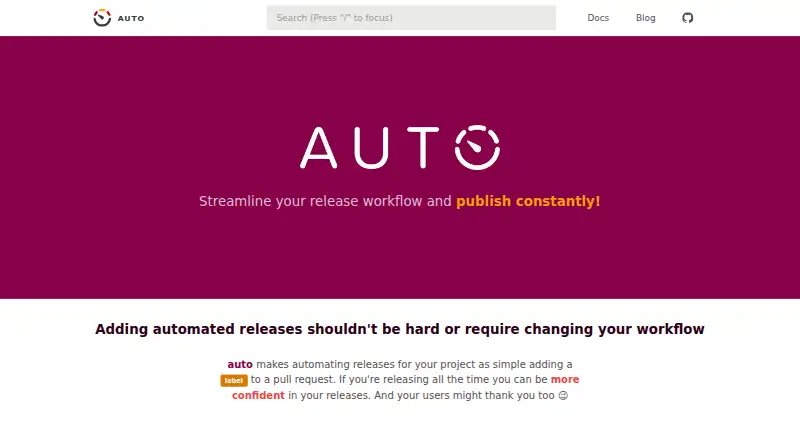
The facts below are what the maker publishes about Auto, checked and dated. Our editors have not written about it yet.
The facts
Each one read from Auto's own pages, with the date it was checked.
What it does
- Additional integrations
- Functionality plugins include Jira, Slack, Microsoft Teams, Amazon S3, GitHub Pages, and Conventional Commits.checked 4 Oct 2026
- Changelogs
- It generates changelogs with pull request links, authors, Jira stories, monorepo awareness, customizable sections, and additional release notes.checked 10 Oct 2026
- CI support
- The documentation includes setup guidance for GitHub Actions, CircleCI, Travis CI, and Jenkins 2.checked 4 Oct 2026
- Credentials
- Publishing and releasing require environment variables including `GH_TOKEN` with repository permission, and publishing plugins may require their own secrets such as `NPM_TOKEN`.checked 4 Oct 2026
- Customization
- Auto exposes a plugin system, and users can configure plugins through command-line arguments or `.autorc`.checked 4 Oct 2026
- Installation
- Auto can be installed as an npm development dependency or downloaded as an executable for major operating systems with Node bundled.checked 10 Oct 2026
- Install requirements
- The getting-started guide says to install Auto as a development dependency; for non-JavaScript projects it offers a bundled build with Node included.checked 4 Oct 2026
- Integrations
- The documented plugins include Jira, Slack, Microsoft Teams, Amazon S3, GitHub Pages, npm, Homebrew, Docker, and VS Code.checked 10 Oct 2026
- Intended users
- Auto is designed for project teams that want to automate releases in continuous integration, while its commands can also be run locally.checked 10 Oct 2026
- License
- The Auto repository is distributed under the MIT License.checked 4 Oct 2026
- Plugin limits
- When plugins are explicitly configured, that configuration overrides the defaults; the docs advise using only one package manager plugin at a time.checked 10 Oct 2026
- Pull request tools
- Its pull request commands can retrieve labels, set status, add Markdown comments, and update the pull request body with build metadata.checked 10 Oct 2026
- Purpose
- Auto automates project releases and pull request interactions, using pull request labels to calculate releases.checked 10 Oct 2026
- Release types
- It supports canary builds, next prereleases, and latest full releases.checked 10 Oct 2026
- Security configuration
- Publishing requires a GH_TOKEN with repo permission, and the documentation recommends keeping local environment files containing tokens out of version control.checked 10 Oct 2026
- Security information
- The official product pages and repository information reviewed do not state security certifications or compliance attestations.checked 4 Oct 2026
- Support
- The repository invites users to file an issue or open a pull request for help and contributions.checked 4 Oct 2026
- Versioning
- Auto calculates semantic version bumps from pull requests.checked 10 Oct 2026
Where it runs
- CI platforms
- The documentation includes setup guides for GitHub Actions, CircleCI, Travis CI, and Jenkins 2.checked 10 Oct 2026
- Platform builds
- The getting-started guide says bundled releases are available for all major operating systems.checked 4 Oct 2026
Alternatives to Auto
- 1

Relic
Free planOpen sourceAndroidiOSWebAPI8.6From $5 a month - 2

Octopus Deploy
Free planWebAPILinuxSelf-hosted7.3From $4,330 a year - 3
Lerna
Free planWebSelf-hostedWindows6.8From $29 a month - 4
nFPM
Free planWebLinuxmacOSWindows6.5Free plan - 5
FerrFlow
Free planWebLinuxmacOSSelf-hosted6.4Free plan - 6
Beachball
Free plan6.3Free plan