AudioGen
AudioGen is a text-to-sound model provided through AudioCraft.
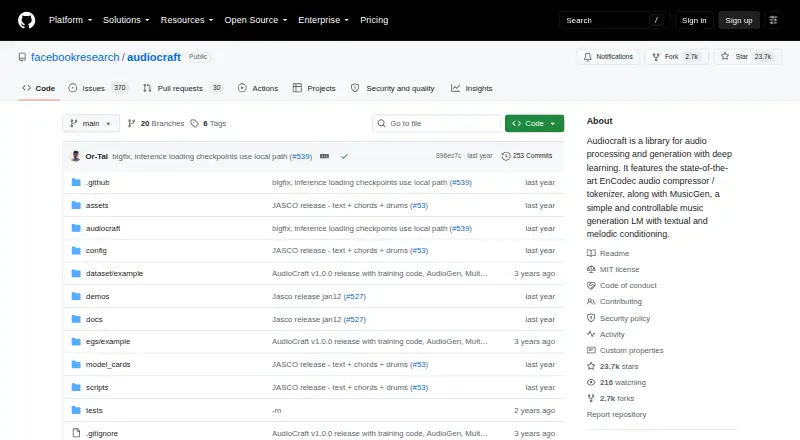
What AudioGen is
AudioGen is a text-to-sound model provided through AudioCraft. It generates audio from text descriptions and supports conditional or unconditional generation, continuation from an audio prompt, and greedy, temperature, top-K and top-P sampling. The listed pretrained model is facebook/audiogen-medium, with 1.5 billion parameters. Its implementation uses an autoregressive Transformer and a 16 kHz EnCodec tokenizer; the example API generates sound and saves it as WAV. The repository provides API access, a local Jupyter notebook demo, and instructions for local use. Running the medium model locally requires a GPU with at least 16 GB of memory. Installation requires Python 3.9 and PyTorch 2.1.0, with ffmpeg recommended. AudioGen was trained on English descriptions and performs less well in other languages. It cannot generate realistic vocals, and prompt engineering may be needed for satisfying results. The code is MIT-licensed, while the model weights use CC-BY-NC 4.0. Training datasets are not provided, and the model card advises further risk evaluation and mitigation before downstream use.
Good
- Generates sound from text descriptions.
- Supports audio continuation from a prompt.
- Offers several sampling controls.
- Provides an API and local notebook demo.
- Code is MIT-licensed.
Watch out
- Local medium-model inference needs a GPU with 16 GB memory.
- English-trained prompts perform less well in other languages.
- It cannot generate realistic vocals.
- Training datasets are not provided.
Who it suits
AudioGen is aimed at audio, machine-learning and AI researchers, as well as amateurs learning about generative models. It suits users comfortable with API or local model workflows.
Verdict
AudioGen offers text-guided sound generation with API and local-use options. Its hardware needs, English-language limitation and noncommercial model-weight license are important considerations.
Plans and prices
From AudioGen's own pricing page, checked 3 Oct 2026.
| Plan | Price | What it gives you |
|---|---|---|
| AudioGen (self-hosted) | Free | Pretrained medium model · local inference requires a GPU with at least 16 GB memory · No price stated by maker |
The facts
Each one read from AudioGen's own pages, with the date it was checked.
What it does
- Audio continuation
- The generation stage supports conditional or unconditional sample generation and audio continuation from a prompt.checked 3 Oct 2026
- Available model
- The page lists one pretrained AudioGen model, facebook/audiogen-medium, with 1.5 billion parameters.checked 3 Oct 2026
- Generation
- The example API generates sound from text descriptions and shows saving output as WAV audio.checked 3 Oct 2026
- Generation modes
- The training documentation describes conditional and unconditional generation, audio continuation from a prompt, and greedy, temperature, top-K, and top-P sampling.checked 3 Oct 2026
- Hardware requirement
- The instructions say inference with the medium-sized models requires a GPU with at least 16 GB of memory.checked 3 Oct 2026
- Installation
- AudioCraft installation requires Python 3.9 and PyTorch 2.1.0; ffmpeg is also recommended by the repository instructions.checked 3 Oct 2026
- Intended users
- The model card names audio, machine learning, and AI researchers, as well as amateurs learning about generative models, as primary users.checked 3 Oct 2026
- Language limit
- The model card says AudioGen was trained on English descriptions and performs less well in other languages.checked 3 Oct 2026
- License
- The repository says its code is MIT-licensed and its model weights use CC-BY-NC 4.0.checked 3 Oct 2026
- Local demo
- The maker provides a Jupyter notebook demo that can be run locally with a GPU.checked 3 Oct 2026
- Model architecture
- The released model combines EnCodec audio tokenization with an autoregressive Transformer language model and has 1.5 billion parameters.checked 3 Oct 2026
- Model availability
- The AudioGen instructions list one pretrained model, facebook/audiogen-medium, and a local Jupyter notebook demo.checked 3 Oct 2026
- Model design
- The provided reimplementation is a single-stage autoregressive Transformer trained over a 16 kHz EnCodec tokenizer with four codebooks sampled at 50 Hz.checked 3 Oct 2026
- Model distinction
- The provided models are not the original models used to report results in the AudioGen publication.checked 3 Oct 2026
- Output limit
- The model card says AudioGen cannot generate realistic vocals and may require prompt engineering for satisfying results.checked 3 Oct 2026
- Prompt generation
- The documented API generates audio samples from text descriptions, with an example configured to generate five-second samples.checked 3 Oct 2026
- Purpose
- AudioGen is a text-to-sound generation model provided through AudioCraft.checked 3 Oct 2026
- Responsible use
- The model card advises against downstream use without further risk evaluation and mitigation.checked 3 Oct 2026
- Sampling controls
- Generation supports greedy sampling, temperature sampling, top-K sampling, and top-P nucleus sampling.checked 3 Oct 2026
- Support
- The model card directs questions and comments to the project’s GitHub repository or its issue tracker.checked 3 Oct 2026
- Training
- AudioGenSolver implements the training pipeline, but the maker says it may not fully reproduce the paper results and does not provide the AudioGen training datasets.checked 3 Oct 2026
- Training data
- The instructions say the datasets used to train AudioGen are not provided.checked 3 Oct 2026
- What it does
- AudioGen is a text-guided audio generation model that generates sounds from text.checked 3 Oct 2026
Money
- Free plan
- Yeschecked 20 Sep 2026
Alternatives to AudioGen
- 1

Resemble AI
Free planAndroidiOSWebAPI8.3From $280 a month - 2

ElevenLabs
Free planWebAPI7.6From $6 a month - 3
Morphic
Free planWeb7.4From $4 a month - 4

Sonilo
Free planAndroidiOSWebAPI7.4From $11.99 a month - 5

Creen
Free planAndroidiOSWeb7.3From $6 a month - 6

Mirelo
Free planWebAPImacOSWindows7.1From €20 a month