
Astro Starlight
Astro Starlight is a free theme for creating documentation websites with the Astro framework.
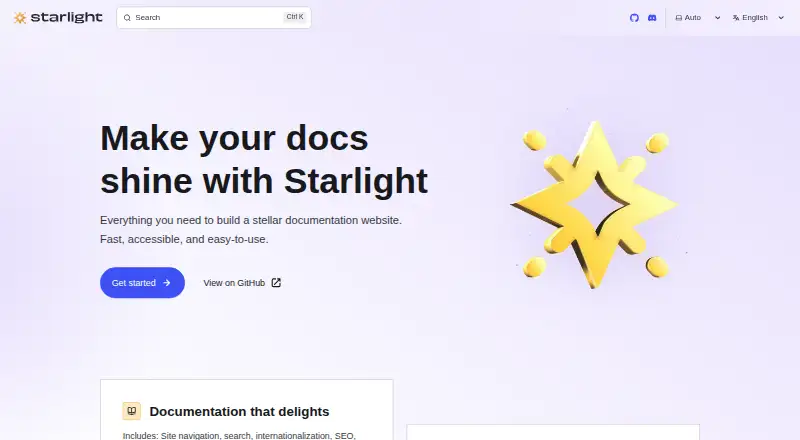
What Astro Starlight is
Astro Starlight is a free theme for creating documentation websites with the Astro framework. It includes navigation, full-text search, internationalization, SEO, code highlighting, and dark mode. Authors can write in Markdown, with support extendable to MDX and Markdoc. Starlight can also use UI components from React, Vue, Svelte, Solid, and other frameworks.
The theme works with Astro integrations and plugins, including community additions and an official Algolia DocSearch plugin that can replace the default Pagefind search provider. Documentation versioning is supported. To begin a new site, users can create an Astro project with a Starlight template, or add Starlight as an integration to an existing Astro project. Projects can be created with npm, pnpm, or Yarn and previewed with Astro’s development server. The project is MIT licensed. Its Getting Started guide describes Starlight as beta software and recommends regular updates; for help, the documentation points users to the Astro Discord support forum and Starlight channel.
Good
- Includes full-text search and documentation versioning.
- Supports Markdown and can be extended to MDX and Markdoc.
- Can use UI components from several frameworks.
- Available under the MIT license.
Watch out
- The Getting Started guide describes it as beta software.
- Regular updates are recommended.
Who it suits
Starlight suits people building documentation websites with Astro, including teams that want search, versioning, or components from other UI frameworks. It may also suit users who are comfortable with software described as beta.
Verdict
Starlight provides documentation-focused features within the Astro framework and supports a range of content and UI extensions. Its beta status and update recommendation are worth considering before choosing it.
The facts
Each one read from Astro Starlight's own pages, with the date it was checked.
What it does
- Built-in features
- It includes site navigation, search, internationalization, SEO, code highlighting, and dark mode.checked 7 Oct 2026
- Community integrations
- The maker’s catalog lists community plugins and tools for uses including OpenAPI documentation, blogs, comments, and broken-link checking.checked 7 Oct 2026
- Content formats
- It supports Markdown, Markdoc, and MDX, with built-in frontmatter validation and TypeScript type safety.checked 7 Oct 2026
- Customization
- Users can bring UI components from React, Vue, Svelte, Solid, and other frameworks.checked 7 Oct 2026
- Deployment
- The getting-started guide directs users to Astro’s documentation for publishing a Starlight site.checked 7 Oct 2026
- Existing projects
- Starlight can be added to an existing Astro project as an integration.checked 7 Oct 2026
- Extensions
- Starlight supports Astro integrations and plugins, including community plugins and an official Algolia DocSearch plugin.checked 7 Oct 2026
- Getting started
- A new project can be created with the Astro project command and a Starlight template.checked 7 Oct 2026
- Intended users
- Starlight is for building documentation websites, and the homepage lists teams including OpenAI, GitHub, Netlify, and Microsoft as users.checked 7 Oct 2026
- License
- The Starlight GitHub repository identifies the project as MIT licensed.checked 7 Oct 2026
- Local development
- Starlight projects can be created with npm, pnpm, or Yarn and previewed with Astro’s development server.checked 7 Oct 2026
- Maturity
- The Getting Started guide describes Starlight as beta software and advises regular updates.checked 7 Oct 2026
- Project status
- The getting-started page describes Starlight as beta software and recommends updating it regularly.checked 7 Oct 2026
- Purpose
- Starlight is a full-featured documentation theme built on the Astro framework.checked 7 Oct 2026
- Search integration
- The official Algolia DocSearch plugin can replace Pagefind, the default search provider.checked 7 Oct 2026
- Support
- The documentation directs users to the Astro Discord, including its support forum and Starlight channel, for help.checked 7 Oct 2026
- UI framework support
- Starlight can be extended with UI components from React, Vue, Svelte, Solid, and other frameworks.checked 7 Oct 2026
Money
- Free plan
- Yeschecked 20 Sep 2026
The full review of Astro Starlight
Astro Starlight is a free, documentation-first theme for the Astro framework. It suits developers and teams building searchable, multilingual technical sites who want framework-level flexibility. The trade-off is beta maturity: teams that require a settled release cycle should weigh that risk carefully.
Overview
Starlight packages the core structure of a documentation website into an Astro project rather than asking teams to assemble a theme and separate utilities. Navigation, full-text search, internationalization, SEO support, code highlighting, dark mode, and documentation versioning address the everyday needs of product and developer docs. The result is a sensible foundation for teams publishing structured documentation, especially when the site itself must remain customizable.
It is not a hosted documentation service. Projects are self-hosted and web-based, and publishing follows Astro’s deployment guidance. That model gives engineering teams control over their build and hosting workflow, but leaves deployment operations to them.
Key features
Markdown is supported out of the box, while MDX and Markdoc can be added through extensions. Markdown is enough for conventional reference and guide content; teams depending on richer component-driven authoring should budget for the additional setup rather than treating those formats as native defaults.
Starlight’s UI is unusually open to existing frontend skills. Components from React, Vue, Svelte, Solid, and other frameworks can be brought into a project. Astro integrations and plugins extend the theme further. The official Algolia DocSearch plugin can replace Pagefind, the default search provider, and community tools cover OpenAPI documentation, blogs, comments, and broken-link checking. This breadth helps specialized documentation projects, although every added integration creates another dependency to select and maintain.
A new site starts with the Astro project command and a Starlight template. Existing Astro projects can add Starlight as an integration, so adoption does not require rebuilding an Astro codebase. npm, pnpm, and Yarn are supported for local setup, with Astro’s development server for previewing changes. Help is directed through the Astro Discord’s support forum and Starlight channel.
Pricing
Starlight is free, with no paid tiers, seat charges, quotas, trial period, or renewal terms. That makes it suitable for individual developers, open-source maintainers, and teams that can host their own documentation. The MIT license identified by the project repository also permits use in projects that need a permissive open-source license. The cost advantage does not remove hosting, deployment, or integration-maintenance work.
Platforms
Starlight runs as a self-hosted web project within Astro. Development can use npm, pnpm, or Yarn and Astro’s development server; publication is handled through the deployment approach documented by Astro.
Who it's for
Choose Starlight for developer portals, API references, and product documentation where search, versioning, localization, and code presentation matter. Its framework support is particularly valuable to teams already comfortable with Astro or one of the supported component ecosystems. The homepage cites users including OpenAI, GitHub, Netlify, and Microsoft, indicating that the format is aimed at serious team documentation as well as personal projects.
Look elsewhere if you want a managed editor, hosting, or a fully stable release channel. Starlight’s beta designation and recommendation to update regularly make ongoing dependency maintenance part of the ownership cost.
Pros and cons
Pros
- Strong documentation baseline: navigation, search, internationalization, SEO, highlighting, dark mode, and versioning arrive in one theme.
- Broad extension surface: React, Vue, Svelte, Solid, MDX, Markdoc, Astro plugins, and integrations support highly tailored sites.
- No software charge: the free plan and MIT licensing remove seat and subscription barriers.
- Flexible adoption: teams can scaffold a new site or integrate Starlight into an existing Astro project.
Cons
- Beta status: teams must keep up with updates, which is a poor fit for organizations demanding mature release guarantees.
- Self-hosting responsibility: deployment and hosting are not provided as a managed service.
- Extension overhead: richer formats and specialized functions rely on integrations that add maintenance choices.
Alternatives
Laravel Vapor is the better choice when a freemium deployment service with a paid unlimited plan fits your Laravel workflow; its Sandbox includes one project and 10 deployments, while Unlimited Monthly costs $39 a month plus AWS cloud costs.
NestJS CLI suits developers seeking a free, MIT-licensed npm CLI for NestJS rather than a documentation theme.
Svelte REPL is a free, MIT-licensed web playground for experimenting with Svelte, not publishing a full documentation site.
Symfony MakerBundle is a free, MIT-style open-source Symfony development dependency installed with Composer on Linux.
Buffalo, Express, and Play Framework are free frameworks for building applications across their listed desktop and web platforms, rather than ready-made documentation themes.
SmartClient is worth considering when commercial enterprise UI capabilities are the priority; its LGPL Edition is open source, while Pro and higher editions use custom pricing.
Verdict
Astro Starlight is a strong recommendation for developers and teams that want a free, extensible documentation site inside the Astro ecosystem. Its built-in publishing essentials, versioning, search, and multi-framework components minimize initial assembly work. Choose another option when managed hosting, a non-Astro stack, or a mature non-beta release process matters more than customization.
Alternatives to Astro Starlight
- 1
Play Framework
Free planOpen sourceWebAPILinuxmacOS7.5Free plan - 2
Symfony MakerBundle
Free planOpen sourceAPILinuxmacOSSelf-hosted7.4Free plan - 3

Laravel Vapor
Free planWebAPI6.6From $399 a year - 4
NestJS CLI
Free plan6.4Free plan - 5
Svelte REPL
Free planWeb6.1Free plan - 6
Buffalo
WebLinuxmacOSWindows5.0