
Asseta
Asseta is a financial platform built for family offices, with a multi-entity general ledger integrating banking, investments, and accounting in a GAAP-aligne…
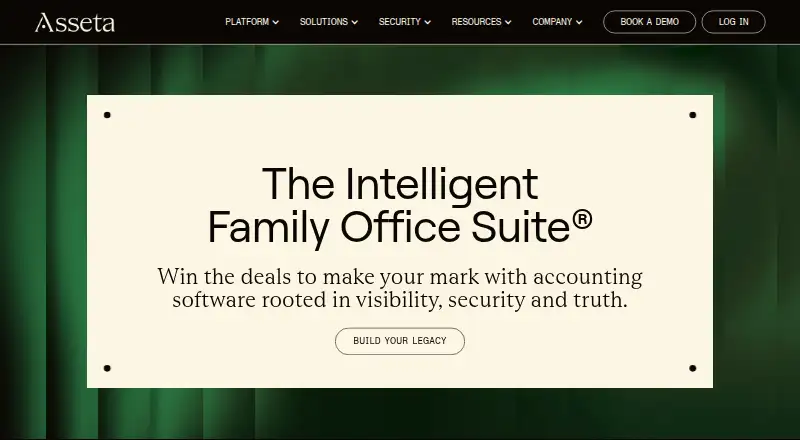
What Asseta is
Asseta is a financial platform built for family offices, with a multi-entity general ledger integrating banking, investments, and accounting in a GAAP-aligned system. It supports multiple dimensions, currencies, and asset types, including cash, public markets, private equity, homes, and art. Its products include banking and cash management, bill pay, reporting, dashboard analytics, forecasting, partnership accounting, collectibles tracking, and document management. The Document Vault reads statements and invoices to create draft entries, links documents to ledger records, and keeps version history. Asseta connects to more than 15,000 financial institutions and applications, and supports QuickBooks and bidirectional Addepar integration. Its mobile app provides dashboards, bill approvals, and AI-powered answers. The company states that SOC 2 Type II, GDPR, ISO 27001, and ISO 42001 compliance are built in, and that AI is opt-in with human oversight and continuous bias monitoring. Pricing is available on request. Asseta notes that full partnership waterfall modeling is not automated for every structure and direct custodian connectivity is still being built out.
Good
- Multi-entity ledger covers several asset types and currencies.
- Connects with more than 15,000 financial institutions and applications.
- Document Vault links source files to ledger records.
- Mobile app includes dashboards and bill approvals.
Watch out
- Pricing is available on request.
- Waterfall modeling is not fully automated for every structure.
- Direct custodian connectivity is still being built out.
- Not yet a full portfolio accounting engine for some transaction-stream cases.
Who it suits
Asseta is aimed at single-family and multi-family offices, RIAs, and accounting firms managing complex financial operations. It may suit teams seeking consolidated accounting, reporting, and document workflows.
Verdict
Asseta brings accounting, reporting, integrations, and document management together for family-office operations. Its stated limits around waterfall modeling and custodian connectivity matter for teams with those requirements.
The facts
Each one read from Asseta's own pages, with the date it was checked.
What it does
- Accounting scope
- The platform supports multi-entity, multi-dimensional, and multi-asset accounting, including cash, public markets, private equity, homes, and art.checked 1 Oct 2026
- Addepar
- Asseta supports bidirectional Addepar integration for positions, transactions, valuations, reference data, reports, documents, and summarized outputs.checked 1 Oct 2026
- AI controls
- Asseta's AI is opt-in only and includes human oversight and continuous bias monitoring.checked 1 Oct 2026
- Core products
- Asseta offers general ledger, banking and cash management, bill pay, financial reporting, dashboard analytics, forecasting, partnership accounting, collectibles tracking, and document management.checked 1 Oct 2026
- Data privacy
- Asseta says customers retain ownership of their information and that it never sells or monetizes customer data.checked 1 Oct 2026
- Document processing
- Its Document Vault reads statements and invoices, creates draft entries, links documents to ledger transactions and provides search, permissions and version history.checked 1 Oct 2026
- Documents
- Asseta's document product stores financial documents, uses AI to turn statements and invoices into draft entries, links documents to ledger records, and maintains version history.checked 1 Oct 2026
- General ledger
- Asseta provides a multi-entity general ledger integrating banking, investments, and accounting in a GAAP-aligned system.checked 1 Oct 2026
- Implementation
- Asseta describes a migration process targeting 100% of reporting moved to the platform within 90 days.checked 1 Oct 2026
- Integration limits
- Direct custodian connectivity is still being built out, with deeper tax-lot feeds described as having a 1–1.5 year horizon.checked 1 Oct 2026
- Integrations
- Asseta connects to more than 15,000 financial institutions and applications through integrations and API connectivity.checked 1 Oct 2026
- Investment limits
- Asseta can compute gains and losses from transaction streams but is not yet a full portfolio accounting engine in those cases.checked 1 Oct 2026
- Multi-entity accounting
- Asseta supports complex multi-entity and multi-currency family-office operations in a shared general ledger.checked 1 Oct 2026
- Partnership limits
- Basic GP/LP ownership and allocations work today, while full waterfall modeling is on the roadmap and is not fully automated for every structure.checked 1 Oct 2026
- Privacy
- Asseta states that it never sells or monetizes customer data.checked 1 Oct 2026
- Purpose
- Asseta is an intelligent financial ecosystem built for modern family offices.checked 1 Oct 2026
- QuickBooks
- Asseta integrates with QuickBooks and supports migration from QuickBooks Desktop and Online data.checked 1 Oct 2026
- Reliability
- Asseta reports 99.9% uptime and redundant infrastructure across zones.checked 1 Oct 2026
- Responsible AI
- Asseta's AI is opt-in, includes human oversight and continuous bias monitoring, and aligns with ISO 42001 standards.checked 1 Oct 2026
- Security
- Asseta states that it has SOC 2 Type II, GDPR, ISO 27001, and ISO 42001 compliance built in.checked 1 Oct 2026
- Security compliance
- Asseta states that SOC 2 Type II, GDPR and ISO 27001/42001 compliance are built in.checked 1 Oct 2026
The company
- Founded
- 2023checked 28 Sep 2026
- Headquarters
- United Stateschecked 28 Sep 2026
Where it runs
- Mobile app
- Asseta's mobile app provides real-time dashboards, bill approvals, and AI-powered answers.checked 1 Oct 2026
The full review of Asseta
Asseta is a family-office finance platform for teams that need to manage accounting, cash, investments, and records across multiple entities. It is strongest as a shared operational hub; offices that rely on sophisticated partnership waterfalls or deep custodian feeds should weigh its current gaps carefully.
Overview
Asseta combines a GAAP-aligned general ledger with banking and cash management, bill pay, reporting, dashboard analytics, forecasting, partnership accounting, collectibles tracking, and document management. Its multi-entity, multi-dimensional, multi-currency ledger can encompass cash, public markets, private equity, homes, and art. That breadth can bring varied holdings and entity records into a common accounting view, rather than splitting those tasks across separate systems.
It connects to more than 15,000 financial institutions and applications through integrations and APIs. QuickBooks integration and migration from Desktop and Online data can ease a move from an established accounting workflow. Bidirectional Addepar integration spans positions, transactions, valuations, reference data, reports, documents, and summarized outputs, making Asseta a more practical fit for offices already using Addepar. These connections are broad, but do not amount to mature direct custodian connectivity.
Key features
Accounting and investment workflows
Consolidated reporting, investment accounting, entity management, and workflow automation sit alongside core ledger functions. Asseta can calculate gains and losses from transaction streams, but it is not yet a full portfolio accounting engine in those cases. Teams whose investment accounting depends on that level of portfolio accounting should not treat the general ledger as a complete substitute.
Partnership accounting supports basic GP/LP ownership and allocations. Full waterfall modeling remains on the roadmap, and some structures are not fully automated. That may be workable for simpler allocation needs, but offices with complex distribution waterfalls will need another way to handle those calculations.
Document management and AI
The Document Vault reads statements and invoices to create draft entries, links files to ledger transactions, and adds search, permissions, and version history. Turning source documents into reviewable drafts can reduce rekeying while preserving a link back to the supporting record; the entries are drafts, not a reason to dispense with review.
AI use is opt-in, with human oversight and continuous bias monitoring. Asseta says it does not sell or monetize customer data and that customers retain ownership. It also states that SOC 2 Type II, GDPR, ISO 27001, and ISO 42001 compliance are built in. These are meaningful safeguards for sensitive financial records, though they do not remove the need for an office to assess its own security requirements.
Mobile, rollout, and support
The mobile app provides real-time dashboards, bill approvals, and AI-powered answers, extending visibility and approval workflows beyond the desktop. Asseta says the average customer goes live within 8–12 weeks and receives dedicated support over Slack, email, and scheduled calls, with response times under one hour. Its stated 99.9% uptime and redundant infrastructure across zones are relevant to teams using it for ongoing operations; the implementation window still calls for a planned migration rather than an instant switch.
Pricing
Asseta is paid software with custom pricing. A quote-based model means buyers should evaluate cost against their entity count, accounting needs, and implementation scope before comparing it with alternatives that publish annual or monthly rates. No free plan or trial terms are established.
Platforms
Asseta is available on Android, iOS, and the web. The mobile apps cover dashboards, bill approvals, and AI-powered answers, while the web platform supports its broader financial operations workflow.
Who it's for
Asseta is purpose-built for single-family offices, multi-family offices, RIAs, and accounting firms. It makes the most sense for teams consolidating multi-entity accounting, documents, cash management, and reporting, particularly when QuickBooks or Addepar integration matters. It is a weaker fit for organizations that require fully automated complex waterfalls or comprehensive direct custodian and tax-lot feeds; deeper tax-lot connectivity is described as a 1–1.5 year horizon.
Pros and cons
- Pros: One multi-entity, multi-currency ledger spans varied asset types, which suits family-office books that do not stop at public investments.
- Pros: QuickBooks migration and broad, bidirectional Addepar connectivity can support consolidation without abandoning those workflows.
- Pros: Document-to-draft-entry processing, ledger links, permissions, and version history keep source records close to accounting activity.
- Cons: Full waterfall modeling is not yet available for every structure, limiting suitability for offices with complex partnership allocations.
- Cons: Direct custodian connectivity and deeper tax-lot feeds are still being built out, a drawback for teams requiring those feeds now.
- Cons: Transaction-stream gains and losses do not make Asseta a full portfolio accounting engine.
- Cons: Custom pricing makes direct budget comparison harder than with products that publish rates.
Alternatives
Compare family office software if you want to survey the category before settling on a platform.
- QPLIX is another paid option, with apps, web, API, desktop, and self-hosted platform availability.
- Elysys is another paid option, available across mobile, desktop, web, and self-hosted platforms.
- Choose Ginkgo if a deployment-period free option is useful: its deployment period is free for 4–8 weeks, followed by a $1,000 a month trial rate, with the contract rate thereafter.
- FundCount is an alternative for buyers who want a published starting price: its Single Family Office / Asset Owner plan starts at $35,899 a year.
- Addepar is worth considering for teams comparing another investment-management platform or already building around its integration ecosystem; pricing is custom.
- Canopy publishes a Single Family Office annual fee starting at $15,000.00 USD per Subscription Unit, with a one-year commitment and additional units at $5,000 per annum.
- WealthSpectrum is another paid alternative, with web, mobile, API, and self-hosted platform availability.
- Asora may suit buyers comparing a published entry tier: $900 a month billed annually, with unlimited users, unlimited bank account connections, and 20 custodian accounts.
Verdict
Choose Asseta if your family office, RIA, or accounting firm wants one multi-entity system for accounting, documents, cash workflows, and reporting, and its QuickBooks or Addepar connections fit your setup. Its document-linked ledger, broad operational scope, and stated security controls make a coherent case for consolidation. Look elsewhere if advanced waterfall automation, full portfolio accounting, or deep direct custodian and tax-lot connectivity is central to the job.
Getting started
- Open the Asseta website
- Contact sales to request pricing
- Discuss implementation for your organization
- Connect financial institutions and applications through integrations or APIs
- Migrate QuickBooks data if needed
- Use the web, Android, or iOS app
Limits worth knowing
Full partnership waterfall modeling is not fully automated for every structure. Asseta says some transaction-stream gains and losses are not handled by a full portfolio accounting engine, and deeper custodian connectivity remains in development.
Questions
Who is Asseta built for?
Asseta is purpose-built for single-family offices, multi-family offices, registered investment advisors, and accounting firms.
How much does Asseta cost?
Asseta is paid software with pricing available on request.
What integrations does Asseta provide?
It connects with more than 15,000 financial institutions and applications, integrates with QuickBooks, and supports bidirectional Addepar integration.
What does the mobile app do?
The mobile app provides real-time dashboards, bill approvals, and AI-powered answers on Android and iOS.
What security and privacy controls are stated?
Asseta states that SOC 2 Type II, GDPR, ISO 27001, and ISO 42001 compliance are built in. It also says customer data is never sold or monetized.
How long does implementation take?
Asseta says its average customer goes live within 8–12 weeks and receives dedicated support through Slack, email, and scheduled calls.
Alternatives to Asseta
- 1

FundCount
AndroidiOSWebAPI7.6From $4,000 a year - 2
Ginkgo
Free planWebAPI7.2From $1,000 a month - 3
Sharpfin Family Office Suite
AndroidiOSWebAPI7.2 - 4

Asora
AndroidiOSWeb6.9 - 5

QPLIX
AndroidiOSWebAPI6.6 - 6

Asset Vantage
AndroidiOSWeb6.5